Soupe Opéra
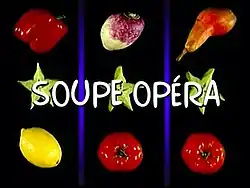
Soupe Opéra (often referred to in English as Soup Opera) is a French children's television programme. Animated using stop motion by a French studio called Marlou Films,[1] the show features fruits and vegetables turning themselves into different creatures and objects.[2] A total of 26 two-minute episodes were made. In France, the series aired on the France 3 channel.
| Soupe Opéra | |
|---|---|
 | |
| Created by | Christophe Barrier Frédéric Clémençon |
| Music by | Garlo |
| Country of origin | France |
| No. of seasons | 2 |
| No. of episodes | 26 |
| Production | |
| Running time | 2 mins |
| Production company | Marlou Films |
| Release | |
| Original network | France 3 |
| Original release | 1991 – 2000 |
| External links | |
| Website | |
Internationally, Soupe Opéra aired in Australia on ABC1 and its sister channel, ABC2, during the ABC 4 Kids line-up.[3] In the UK, it aired on ITV during its CITV children's block and later on the CITV channel. In the USA, Latin America, Brazil and the Asia-Pacific region, the series was aired on Cartoon Network as part of its Small World anthology series, which featured foreign-made shorts.
Visuals
In each episode, various food objects (typically fruit and vegetables) spontaneously exit a basket, moving by themselves, and cut themselves up to form animals and objects. The animals formed then perform actions, such as eating the leftover food. In some episodes, the food that comes out is not fruit or vegetables, such as an egg that is hard boiled, a packet of chips or a bag of baking soda. Non-food items can also come outof the basket too, such as a pot and portable gas stove.
The show is also very similar in style to Poubelles, another Marlou Films production. Instead of fruit and vegetables coming out of a basket, the show features rubbish coming out of a bin to create an animal.
Episodes
Soundtrack
Soupe Opera features a distinctive soundtrack by French artists C.I.P/Garlo. The score consists of two pieces of music, re-used every episode in the same order. The first track is played during the stop motion scenes, and features four voices singing in an a cappella fashion. The voices are a mixture of live performed singing, beatboxing, and sampled vocal sounds played back on a synthesiser. The second track is an electronic funk arrangement of the same tune played over the credits.[4]
Following
The show developed somewhat of a cult following, particularly in France and Australia, where it was regularly played on ABC in the mid-1990s and 2000s.[5] The whole series of 26 episodes have been posted on YouTube.
References
- "Marlou Films- Soupe Opéra". Systonic. 2008-05-28. Retrieved 2012-03-08.
- https://www.repubblica.it/2006/08/gallerie/spettacoliecultura/cartoon-verdura/1.html
- "Soupe Opera - ABC for Kids". Abc.net.au. Retrieved 2012-03-08.
- https://www.cipaudio.com/eng_free.htm
- https://junkee.com/soupe-opera/251842