Southcott family
Southcott is a surname of a prominent family from Devon and Cornwall.
| Southcott Southcote | |
|---|---|
| Landed Gentry family | |
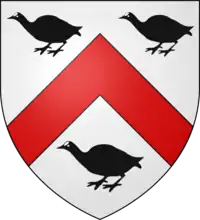
.png.webp) Argent, a chrevron engrailed gules between three coots sables | |
| Country | |
| Current region | |
| Earlier spellings | Sothdyji (Cornish 7th c.), Sudth (Saxon 10th c.), Sudcote (West Saxon 1086), Southcot (Old English 12th c.) |
| Etymology | Southcott (Cornish, West Saxon, Old English): "Sheep house of the South" |
| Place of origin | Dumnonia modern day  Cornwall Cornwall |
| Founded | Ancient |
| Titles | List
|
| Style(s) | |
| Traditions | Anglicanism, Southcottians Movement |
| Motto | Nerth Dre Lelder (Strength Through Loyalty) |
| Estate(s) |
|
.svg.png.webp)
.svg.png.webp)

History
The family originates in Dumnonia the celtic kingdom of Cornwall as a tribe of great sheep farmers, derviving their Cornish surname Sothdyji, translating roughly to "Sheep house of the South". The following centuries lead to a vast amount of political turbulence within Cornwall, following the family's defeat and the Saxon victory in 838 at the Battle of Hingston Down the family became more anglified changing its name and owning large amounts of property in Wessex modern day Devon. The family then became an Anglo-Saxon tribe.[1] It is dated in the Domesday Book of 1086 that the family lived as Lord of Manor of Sudcote in Winkleigh, Devon. [2]
After much anglicisation the modern day surname, Southcott, is first recorded by Michael de Southcott, Lord of Southcott (b.1202) in the 13th Century, and later recorded by Sir Nicholas Southcott Jr of Southcott and Chudleigh (1450-1512) in the 15th century.[3] According to the Survey of Devon, by Tristram Risdon (b.1580), "Michael de Southcott Lord of Southcott was from whom issued divers families. For he was the original of a great kindred in this country". [4]
Sir Nicholas's son, John Southcott Esq of Bovey Tracey (1481-1556), in 1544, following the Dissolution of the Monasteries was granted Indio. At the time he was steward to Thomas Cromwell and held relationship which also leas to him obtaining several monastic holdings in Devonshire on favourable terms.[5] An ancient document exists, in connection with the Dissolution accounts, which refers to "Rent of a messuage in Yondyeo leased on 15 July 1531 to John Southcote, his wife Joan and Johns’s heirs for ever, 26s 8d". He was also made Clerk of the Peace for Devon.[6][7][3]
Sir Nicholas's other second son William Southcott Esq of Chudleigh (b.1485) had a son also called John Southcote Esq of Witham (1510–1585). During his lifetime he became a senior English judge and politician, becoming later Lord of the Manor of Witham, in Essex. [8]
Another desendant of Sir Nicholas Southcott was Capt. Philip Southcote (1698–1758) who married the widowed dowager 1st Duchess of Southampton Anne Fitzroy.
Lords of the Manor of Southcott (c1086-1645)
- Michael Southcot Esq of Southcot (b.c1202)
- William Southcott Esq of Southcot (b.c1233)
- Michael Southcott Esq of Winkleigh (b.c1258)
- William Southcott Esq of Southcott
- Michael Southcotte Esq of Southcotte (b.c1325)
- William Southcote Esq of Southcote (b.c1360)
- William Southcote Esq of Southcote (b.c1390)
- Nicholas Southcote Esq of Southcote and Chudleigh (b.c1419)
- Sir Nicholas Southcott of Southcott and Chudleigh (1450-1512)
- Thomas Southcot Esq of Southcot (b.c1483)
- John Southcott Esq of Southcot
- John Southcot Esq of Southcot
- Phillip Southcott Esq of Southcott (1527-1587)
- Stephen Southcott Esq of Southcott (1562-1619)
- Neil Southcott Esq of Southcott (b.c1566)
Lords of the Manor of Bovey Tracey (1544–1670)
- John Southcote MP of Bovey Tracey, (1481-1556)
- Thomas Southcote MP of Bovey Tracey and of Mohuns Ottery, (1528-1600) [9]
- George Southcot of Bovey Tracey and of Mohuns Ottery, (born 1560)
- Thomas Southcote of Bovey Tracey and of Mohuns Ottery[10]
- Sir Popham Southcote Kt of Bovey Tracey and of Mohuns Ottery, (1603–1643) [10]
Lord of the Manor of Mohuns Ottery (1580–1670)
- Thomas Southcote MP of Bovey Tracey and of Mohuns Ottery, (1528-1600)
- George Southcot of Bovey Tracey and of Mohuns Ottery, (born 1560)
- Thomas Southcote of Bovey Tracey and of Mohuns Ottery
- Sir Popham Southcote Kt of Bovey Tracey and of Mohuns Ottery, (1603–1643)
Southcote Baronets, of Blyborough (1662–1680)
- Sir George Southcote, 1st Baronet of Blyborough (1629-1663)
- Sir George Southcote, 2nd Baronet and Governor of Dartmouth Castle (1664–1680)
Southcote Baronets Family Chart
| Sir George Southcott MP of Shillingford (1572-1638) | |||||||||||||||||||||||||||||||||||||||||||||||||||||||
| Robert Southcote | George Southcote | Thomas Southcott (d.1657) | Judith | Mary | Rebecca | ||||||||||||||||||||||||||||||||||||||||||||||||||
| Richard Southcote (b.1665) | Thomas Southcote MP of Blyborough and Buckland (c1622-1664) | Sir George Southcote Bt 1st Baronet of Bliborough Created 1662 (1629-1663) | |||||||||||||||||||||||||||||||||||||||||||||||||||||
| Thomas Southcott (b.1689) | Elizabeth Portman | Sir George Southcote Bt 2nd Baronet of Bliborough (1664-1680) | George Southcote s.p. | Elizabeth (b.1620) | Anne | Katherine Palmer | |||||||||||||||||||||||||||||||||||||||||||||||||
| Katherine Smith | Constantine Fitzherbert | ||||||||||||||||||||||||||||||||||||||||||||||||||||||
Notable people
Joanna Southcott
Joanna Southcott (1750–1814) was a religious prophetess.[11] She was born in the hamlet of Taleford, baptised at Ottery St Mary, and raised in the village of Gittisham, all in Devon, England.
At the age of 64 Southcott affirmed that she was pregnant and would be delivered of the new Messiah, the Shiloh of Genesis (49:10). The date of 19 October 1814 was that fixed for the birth, but Shiloh failed to appear, and it was given out that she was in a trance. She died not long after.
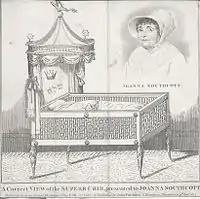
The "Southcottian" movement did not end with her death in 1814. Her followers are said to have numbered over 100,000, but had declined greatly by the end of the 19th century. In 1844 a lady named Ann Essam left large sums of money for "printing, publishing and propagation of the sacred writings of Joanna Southcott".[12][13]
Southcott left a sealed wooden box of prophecies, usually known as Joanna Southcott's Box, with the instruction that it be opened only at a time of national crisis, and then only in the presence of all 24 bishops of the Church of England (there were only 24 at the time), who were to spend a fixed period of time beforehand studying Southcott's prophecies. Attempts were made to persuade the episcopate to open it during the Crimean War and again during the First World War. The box was supposedly opened in 1927, however Southcottians claimed that the box opened in 1927 was not the authentic one and continued to press for the true box to be opened.[14] An advertising campaign on billboards and in British national newspapers such as the Sunday Express was run in the 1960s and 1970s by one prominent group of Southcottians, the Panacea Society in Bedford (formed 1920), to try to persuade the twenty-four bishops to have the box opened. The current state of the box is unknown.
Southcott prophesied that the Day of Judgement would come in the year 2004, and her followers stated that if the contents of the box had not been studied beforehand, the world would have had to meet it unprepared.
Mary Southcott
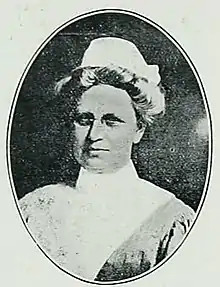
Mary Meager Southcott (1862–1943) was a Newfoundland-born nurse, hospital administrator and campaigner. In 1903 she founded the St. John's General Hospital School of Nursing.[15] In order to raise educational standards for nurses and, more generally, in the professionalisation of nursing.
She was also involved in various campaigns and organisations: in particular as president of the Child Welfare Association, and as an advocate of women's suffrage.[16] She has been named a "person of national historic significance" by the Canadian government.[17]
Ernest Southcott
The Very Rev Ernest William Southcott (1915–1976) was an eminent Anglican priest and author[18] in the 20th century.
He was Vicar of St Wilfrid's, Halton, Leeds, where he pioneered the House Church movement, and then Rural Dean of Whitkirk until 1961 when he was appointed Provost of Southwark Cathedral.[19] He resigned Southwark in 1970 and became Vicar of Rishton in Lancashire. He died on 17 January 1976.[20]
Southcott was notable for his height- six feet six inches- and his conducting of services in parishioners' houses, celebrating communion at family dinner tables. On this subject, Southcott pronounced: 'We don't go to church; we are the Church.' Nevertheless, his own services were so popular that the church was full half an hour before proceedings began.[21]
Members of Parliament
- John Southcote of Bovey Tracey and Shillingford (c1481-1556) was MP for Lostwithiel
- Sir John Southcote QC SL of London and Witham (1510-1585) was MP for Lewes and later Steyning.
- Thomas Southcote of Bovey Tracey, Mohuns Ottery, Stoke Fleming and Shillingford (1528-1600) was MP for Tavistock, then Plympton Erle and later Dartmouth. He was also appointed High Sheriff of Devon.
- George Southcote of London and Calverleigh (1533-1589) was MP for Lostwithiel and later Tavistock.[22]
- Richard Southcote of the Inner Temple, London and Shillingford (1570-1594) was MP for Plympton Erle.
- George Southcote of Blyborough, Shillingford, Stoke Fleming and Withycombe (1572-1638) was MP for Plympton Erle.
- Thomas Southcote DL JP of Stoke Fleming and Blyborough (1622-1664) was MP for Dartmouth. He was also appointed Deputy lieutenant of Devon.
Members of the Australian Parliament
- Heather Southcott AM (1928–2014) was Member of the Australian parliament for City of Mitcham, South Australia. Later she was made a Member of the Order of Australia.
- Andrew Southcott (born 1967) was Member of the Australian parliament for Boothby, South Australia.
Family Prayer
Cornish
|
English
|
Coat of arms
|
|
Notes
References
Citations
- D. Simon Evans, The Story of Cornish (1969), p.294
- Winkleigh Town History
- boveytraceyhistory.org.uk, quoting Youings, Joyce (Joyce Youings, Devon Monastic Lands: Calendar of Particulars for Grants 1536–1558 (Exeter: DCRS New Series, 1955))
- Magna Britannia: Volume 6, Devonshire, Parishes: Winkleigh - Zeal Monachorum (1822)
- boveytraceyhistory.org.uk
- Pole, p.432
- boveytraceyhistory.org.uk, quoting Youings, Joyce
- Lee, Sidney, ed. (1898). . Dictionary of National Biography. 53. London: Smith, Elder & Co.
- Vivian, p.698; Pevsner, p. 193; Risdon, p. 134
- Pole, p. 131
- Denham, G (1815). "Remarks on the Writings and Prophecies of Joanna Southcott: being an attempt to prove her assertions inconsistent with the will of God as revealed in the scriptures of eternal truth". Dean&Munday. p. 23. Retrieved 16 December 2015.
- Austin Wakeman Scott (1966). Select cases and other authorities on the law of trusts. Law school casebook series (5th ed.). Little, Brown. p. 682.
- Frank Swancara (1971). Obstruction of justice by religion: a treatise on religious barbarities of the common law, and a review of judicial oppressions of the non-religious in the United States. Civil liberties in American history. Da Capo Press. p. 171.
- "Religion: Servant Woman's Box". Time. 8 May 1939. Archived from the original on December 14, 2008.
- "Mary Meager Southcott (1862-1943)". Parks Canada. Parks Canada. Retrieved 9 July 2016.
- "Southcott, Mary :: Finding Aids of the Archives and Special Collections". collections.mun.ca. Retrieved 2020-06-15.
- "THE GOVERNMENT OF CANADA COMMEMORATES MARY MEAGER SOUTHCOTT (1862-1943) AS A PERSON OF NATIONAL HISTORIC SIGNIFICANCE". Parks Canada. Parks Canada. Retrieved 9 July 2016.
- Amongst others, he wrote: "Unto a Full Grown Man", 1942; "Receive This Child", 1951; "The Parish Comes Alive", 1956; and "Meditations for Lent", 1957. British Library web site, accessed 27 November 2010
- New Provost Of Southwark The Times Friday, 7 July 1961; pg. 14; Issue 55127; col E
- "Deaths". The Times, 20 January 1976; Issue 59606; p. 24, col A.
- "Private lives made public".
- "SOUTHCOTE, George representing Tavistock - History of Parliament Online". www.historyofparliamentonline.org.
- Calstock Parish Church History, Rev Gordon Ruming
- "Cornish Dictionary |".
External links
 |
Wikimedia Commons has media related to Southcott (surname). |
- Dedicated to the life and writings of Joanna Southcott at the Wayback Machine (archived 18 November 2006)
- The Panacea Society
- Joanna Southcott's memorial stone