Southern Kurdish
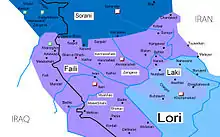
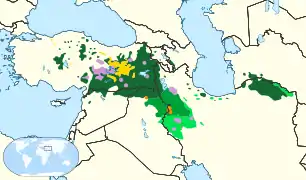
Southern Kurdish (Kurdish: زۆڤان کوردیی باشووری ,کوردی خوارگ, romanized: Zûwane Kurdîy başûrî, Kurdiy xwarig),[2] also known as Kurdiy xwarîn is one of the Kurdish languages, spoken predominantly in eastern Iraq and western Iran.[3] The Southern Kurdish-speaking region spans from Khanaqin in Iraq to Dehloran southward and Asadabad eastward in Iran.[4]
| Southern Kurdish | |
|---|---|
| Kurdish: کوردیی باشووری ,کوردی خوارگ | |
| Native to | Eastern Iraq, Western Iran |
| Region | Kurdistan |
Native speakers | 3 million in Iran, 350,000 in Iraq[1] |
Indo-European
| |
| Perso-Arabic (Sorani alphabet) | |
| Language codes | |
| ISO 639-3 | sdh |
| Glottolog | sout2640 |
| Linguasphere | 58-AAA-c |
 | |
 | |
Variants
Southern Kurdish has many variants, linguist Fattah divides them into 35 varieties. These inculde:
- Bijarî
- The most septentrional variety of Southern Kurdish spoken in and around Bijar in Iran. Bijarî is the only Southern Kurdish variety detached from the greater Southern Kurdish-speaking region.[5]
- Qorwa (Chahar Dawli xarbi)
- The Qorwa variety is spoken around Ghorveh in Iran and is related to the variety spoken in Asadabad and other Kurdish-speaking areas in Hamadan Province.[6]
- Kolyayî
- The Kolyayî variety is spoken northeast of Kermanshah, principally in Sonqor County and surrounding counties. The variety also spans into the Kolyai Rural District in Hamadan Province.[7]
- Bilawar
- The principal Southern Kurdish variety in Poshtdarband Rural District in Kermanshah.[8]
- Dinawar
- About 83 villages in Dinavar District speak the Dinawar variety. The differences between the Dinawar and the Kolyayî varieties are anodine.[9]
- Sahana / lakî-kirmashanî
- The Sahana variety, or lakî-kirmashanî has many similar characteristics with Laki and is spoken in Harsin County and in Sahneh. What distinguishes it most from Laki is the lack of the ergative case.[9]
Alphabet
The Southern Kurdish alphabet is very similar to the Central Kurdish (Sorani) alphabet, which is a derivation of the Arabic alphabet. Southern Kurdish has one additional letter "ۊ"; the Arabic letter waw with two dots above.
| ع | ش | س | ژ | ز | ڕ | ر | د | خ | ح | چ | ج | ت | پ | ب | ا | ئـ |
| 17 | 16 | 15 | 14 | 13 | 12 | 11 | 10 | 9 | 8 | 7 | 6 | 5 | 4 | 3 | 2 | 1 |
| ێ | ی | ۊ | ۆ | و | ە | ھ | ن | م | ڵ | ل | گ | ک | ق | ڤ | ف | غ |
| 34 | 33 | 32 | 31 | 30 | 29 | 28 | 27 | 26 | 25 | 24 | 23 | 22 | 21 | 20 | 19 | 18 |
See also
Notes
- Southern Kurdish at Ethnologue (18th ed., 2015)
- "Kurdish, Southern". Ethnologue. Retrieved 21 August 2020.
- "Kurdish language i. History of the Kurdish language". Iranica Online. Retrieved 25 June 2019.
- Fattah (2000), pp. VII.
- Fattah (2000), pp. 16–17.
- Fattah (2000), pp. 18–19.
- Fattah (2000), p. 19.
- Fattah (2000), p. 20.
- Fattah (2000), p. 21.
- Erik Anonby, Mortaza Taheri-Ardali & Amos Hayes (2019) The Atlas of the Languages of Iran (ALI). Iranian Studies 52. A Working Classification
Biography
- Fattah, Ismaïl Kamandâr (2000), Les dialectes Kurdes méridionaux, Acta Iranica, ISBN 9042909188
External links
 |
Southern Kurdish test of Wikipedia at Wikimedia Incubator |
- Information regarding Southern Kurdish
- Kurdish Academy of Language describing Southern Kurdish
- Audio recordings of wordlists and narratives in Southern Kurdish, archived with Kaipuleohone
- southern Kurdish Wikipedia
Authority control  |
|---|
This article is issued from Wikipedia. The text is licensed under Creative Commons - Attribution - Sharealike. Additional terms may apply for the media files.