Space travel in science fiction
Space travel,[1]: 69 [2]: 209–210 [3]: 511–512 or space flight[2]: 200–201 [4] (less often, starfaring or star voyaging[2]: 217, 220 ) is a classic science-fiction theme that has captivated the public and is almost archetypal for science fiction.[4] Space travel, interplanetary or interstellar, is usually performed in space ships, and spacecraft propulsion in various works ranges from the scientifically plausible to the totally fictitious.[1]: 8, 69–77
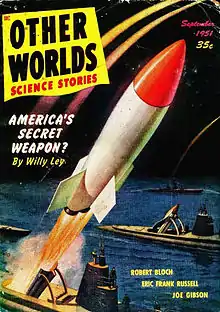
While some writers focus on realistic, scientific, and educational aspects of space travel, for others the concept may be seen as a metaphor for "free[ing] mankind from the prison of the solar system".[4] Though the science-fiction rocket has been described as a 20th-century icon,[5]: 744 according to The Encyclopedia of Science Fiction "The means by which space flight has been achieved in sf – its many and various spaceships – have always been of secondary importance to the mythical impact of the theme".[4] Works related to space travel have popularized such concepts as time dilation, space stations, and space colonization.[1]: 69–80 [5]: 743
While generally associated with science fiction, space travel – involving magic or supernatural entities such as angels – has also occasionally featured in fantasy.[lower-alpha 1][5]: 742–743
History
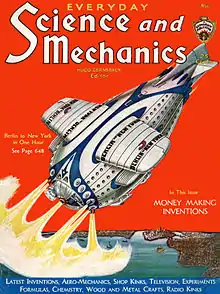
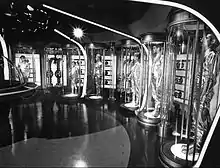
A classic, defining trope of the science-fiction genre is that the action takes place in space, either aboard a spaceship or on another planet.[3]: 511–512 [4] Early works of science fiction, called "proto SF" – such as novels by 17th-century writers Francis Godwin and Cyrano de Bergerac, and astronomer Johannes Kepler – include "lunar romances", much of whose action takes place on the Moon.[lower-alpha 2][4] Science-fiction critic George Slusser also pointed to Christopher Marlowe's Doctor Faustus (1604), in which the main character is able to see the entire earth from high above, and noted the connections of space travel to earlier dreams of flying and air travel, seen as far back as the writings of Plato and Socrates.[5]: 742 In such a grand view, space travel and inventions such as various forms of "star drive" can be seen as metaphors for freedom, one of whose aspects is to "free mankind from the prison of the solar system".[4]
In the ensuing centuries, while science fiction addressed many aspects of futuristic science in addition to space travel, the latter proved the most influential with the general public and the genre's writers and readers, evoking their sense of wonder.[1]: 69 [4] Most works were mainly intended to amuse readers, but a small number, often by authors with a scholarly background, strove to educate readers about various aspects of space-related science, including concepts from astronomy; the latter aspiration was shown by, among others, the influential American editor Hugo Gernsback, who dubbed this approach "sugar-coated science" and "scientification".[1]: 70 Science-fiction magazines, including Gernsback's Science Wonder Stories, alongside works of pure fiction, popularized early studies and discussed the feasibility of space travel; many science-fiction writers published nonfiction on space travel, such as Willy Ley's articles and David Lasser's book, The Conquest of Space (1931).[1]: 71 [5]: 743
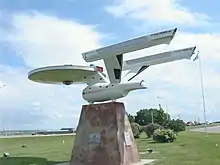
From the late 19th and early 20th centuries onward there was a visible distinction between more "realistic" and scientific fiction (which later would evolve into hard sf[8]), whose writers, often scientists like Konstantin Tsiolkovsky and Max Valier, focused on the more plausible concept of interplanetary travel (to the Moon or Mars), whereas the more grandiose but less grounded in realism were the stories of "escape from Earth into a Universe filled with worlds", which gave rise the genre of space opera, pioneered by E. E. Smith,[lower-alpha 3] popularized by the televisions series Star Trek that debuted in 1966.[4][5]: 743 [9] This trend continues to the present day, with some works focusing on "the myth of space flight",[lower-alpha 4] others are centered on "realistic examination of space flight";[lower-alpha 5] the difference can be also described as that between the writers' concern on the "imaginative horizons rather than hardware".[4] The success of the 20th century space program, such as the Apollo 11 Moon landing, was often described as "science fiction come true", and it has also served to further "demystify" the concept of space travel within the solar system, as from that point onward, the writers who wanted to focus on the "myth of space travel" were increasingly likely to do so through the concept of interstellar travel.[4] While the theme of space travel is seen as one of the very optimistic in general,[3]: 511–512 some revaluatory stories, often more pessimistic and disillusioned, juxtapose both of those trends, contrasting the romantic myth of space travel with a more down-to-earth reality.[lower-alpha 6][4] George Slusser suggested that "science fiction travel since World War II has mirrored the United States space program: anticipation in the 1950s and early 1960s, euphoria into the 1970s, modulating into skepticism and gradual withdrawal since the 1980s."[5]: 743
On the screen the French movie 1902 A Trip to the Moon, by Georges Méliès, also described as the first science fiction film, linked special effects to the depictions of spaceflight.[5]: 744 [10] Together with other early movies such as Woman in the Moon (1929), Thing to Come (1936) they contributed to the early recognition of the concept of the rocket as the iconic and primary means of space travel, decades before the space program begun in earnest.[5]: 744 Later milestones in film and television include the Star Trek series and movies, and the 2001: A Space Odyssey film by Stanley Kubrick (1968), which visually advanced the concept of space travel, allowing it to evolve away from the simplistic rocket towards that of a more complex space ship.[5]: 744
Methods of travel
Generic terms for engines enabling spacecraft propulsion in science fiction include those of a space drive and star drive.[lower-alpha 7][2]: 198, 216 In 1977 The Visual Encyclopedia of Science Fiction listed the following methods of space travel: anti-gravity,[lower-alpha 8] atomic (nuclear), bloater,[lower-alpha 9] cannon one-shot,[lower-alpha 10] Dean,[lower-alpha 11] faster-than-light (FTL), hyperspace,[lower-alpha 12] inertialess,[lower-alpha 13][1]: 75 ion,[lower-alpha 14] photon, plasma, ram-jet,[lower-alpha 15] R. force,[lower-alpha 16] solar sail,[lower-alpha 17] spindizzy[lower-alpha 18] and torchship.[lower-alpha 19][1]: 8, 69–77 The 2007 Brave New Words: The Oxford Dictionary of Science Fiction listed the following vocabulary related to the concept of a space drive: gravity drive,[lower-alpha 20] hyperdrive,[lower-alpha 21] ion drive, jump drive,[lower-alpha 22] overdrive, ramscoop (a synonym of a ram-jet), reaction drive,[lower-alpha 23] stargate,[lower-alpha 24] ultradrive, warp drive[lower-alpha 25] and the torchdrive.[2]: 94, 141, 142, 253 Several of those terms are entirely fictitious or based on rubber science, while others are based on real scientific theories.[1]: 8, 69–77 [2]: 142 Many fictitious ways of travelling through space, in particular, faster than light travel, tend to go against our current understanding of physics, in particular, the theory of relativity.[14]: 68–69 Some works can sport numerous alternative star drives; for example the Star Trek universe, in addition to its iconic warp drive, has introduced concepts such as transwarp, slipstream and the spore drive, among others.[15]
Many writers, particularly of early science fiction, did not address the method of travel in much detail, and many works of the "proto SF" era had to contend with their authors living in the time where knowledge about the "space" was very limited — in fact, many early works did not even consider the concept of vacuum and instead assumed that atmosphere of sorts, composed of air or aether, continues indefinitely.[lower-alpha 26][4] Highly influential in popularizing the "science" part of the science fiction was the 19th-century French writer Jules Verne, whose method of space travel in his 1865 novel, From the Earth to the Moon (and its sequel, Around the Moon), was explained mathematically, and whose vehicle — the gun-launched space capsule — was described as the first such vehicle to be "scientifically conceived" in fiction.[lower-alpha 27][4][1]: 69 [5]: 743 Percy Greg's Across the Zodiac (1880) featured a space ship with a small garden, an early prediction of hydroponics.[1]: 69 Another writer who attempted to merge concrete scientific ideas with science fiction prose was the turn of the century Russian writer and scientist, Konstantin Tsiolkovsky, known for popularizing the concept of rocketry.[4][16][lower-alpha 28] George Mann pointed to works such as Robert A. Heinlein's Rocket Ship Galileo (1947) and Arthur C. Clarke's Prelude to Space (1951) as some of the early, influential modern works that focused on the scientific and engineering aspects of space travel.[3]: 511–512 From the 1960s onward, the growing popularity of modern technology with the public also led to increasing depictions of interplanetary spaceships as based on the advanced but plausible extension of real, modern technology.[lower-alpha 29][3]: 511–512
Slower than light
With regard to interstellar travel, in which faster-than-light speeds are mostly considered unrealistic, more realistic depictions of the theme have often focused on the idea of "generation ships" that travel at sub-light speed for many generations before arriving at their destination.[lower-alpha 30] Other scientifically plausible concepts of interstellar travel include suspended animation[lower-alpha 31] and, less often, ion drive, solar sail, Bussard ramjet, and time dilation.[lower-alpha 32][1]: 74
Faster than light
Some works involve discussion of Einstein's general theory of relativity and challenges it faces from the quantum mechanics, and include concepts of space travel through wormholes or black holes.[lower-alpha 33][3]: 511–512 Many writers, however, gloss over such problems, introducing entirely fictional concepts such as hyperspace (also, subspace, nulspace, overspace, jumpspace or slipstream) travel using inventions such as hyperdrive, jump drive, the warp drive or space folding.[lower-alpha 34][1]: 75 [3]: 511–512 [13][18][12][17]: 214 Invention of completely made up devices enabling space travel has a long tradition — already in the early 20th century, Verne criticized H. G. Wells' The First Men in the Moon (1901) for abandoning realistic science (his spaceship relied on anti-gravitic material called "cavorite").[1]: 69 [5]: 743 Out of the fictitious drives, by mid-70s the concept of travelling through hyperspace has been described as having achieved the most popularity, and would subsequently be further popularized — as hyperdrive — through its use in the Star Wars franchise.[1]: 75 [18] While the fictitious drives "solve" many problems related to physics as understood today (namely, the difficulty of faster-than-light travel), some writers introduce new wrinkles — for example, a common trope involves the difficulty of using such drives in close proximity to other objects, in some cases allowing their use only from the outskirts of solar systems.[lower-alpha 35][1]: 75–76
While usually the method of traveling through space is just a means to an end, for some works, particularly short stories, it is a central plot device. Such works focus on themes such as the mysteries of hyperspace, or the consequences of getting lost after an error or malfunction.[1]: 74–75 [lower-alpha 36]
See also
Notes
- For example, C.S. Lewis' Perelandra (1942); Antoine de Saint-Exupéry's The Little Prince (1943); the 1988 film The Adventures of Baron Munchausen; and Diana Wynne Jones' 2000 novel Year of the Griffin.[5]: 742
- Somnium (1634), The Man in the Moone (1638), Comical History of the States and Empires of the Moon (1657).[6][7][1]: 69 See also A True Story (c. 2nd century).
- Through his Skylark series which debuted in 1928.[4]
- In addition to works of space opera, this genre includes works such as Robert A. Heinlein's The Man Who Sold the Moon (1950) or James Blish's Surface Tension (1952).[4]
- Examples of such realistic science fiction include Stephen Baxter's Voyage (1996), and Andy Weir's The Martian (2011).[4]
- Examples here include Nigel Balchin's Kings of Infinite Space (1967), Barry N. Malzberg's The Falling Astronauts (1971) and Dan Simmons's Phases of Gravity (1989)
- The term space drive was used as early as 1932 (John W. Campbell, Invaders from Infinite); and star drive, 1948 (Paul Anderson, Genius). Space drive is more generic, whereas star drive implies the capability of interstellar travel.[2]: 198, 216
- An early concept, introduced by Daniel Defoe in The Consolidator (1705) and also used in H. G. Wells' The First Men in the Moon (1901). Some writers and inventors gave unique name to their anti-gravity drives — for example, the Dean drive or the James Blish's spindizzy.[1]: 69, 76
- A term invented by Harry Harrison in his Bill, the Galactic Hero (1965)[1]: 108
- A classic idea popularized in the 19th century by Jules Verne's From the Earth to the Moon (1865).[1]: 69
- Dean drive is a real-world, patented invention that promised to generate an anti-gravity force. Before slipping back into obscurity, it was briefly promoted by American sci-fi magazine editor John W. Campbell in one of his editorials.[1]: 76 [11]: 181–182
- A popular concept in science fiction, first used in John W. Campbell's Islands of Space (1957), a work which also introduced the term "space warp".[1]: 77 [12][13]
- Inertialess drive is one of the early terms for fictitious space drives, introduced in 1934, in the Tri-planetary Lensman series of E.E. Smith.[1]: 75
- Devces that provide steady thrust through a stream of accelerated ions, successfully tested by NASA in the 1990s.[2]: 142
- A scientifically plausible concept of giant scoops that collect interstellar hydrogen to generate fuel during the travel. A concept adopted, among others, by Larry Niven in his Known Space series, ex. World of Ptavvs (1965).[1]: 76
- A term invented by George Griffith in his A Honeymoon in Space (1901)[1]: 69, 108
- An early treatment of this idea is Cordwainer Smith's The Lady Who Sailed the Soul (1960).[1]: 74 This concept was revisited by a number of other writers, such as Arthur C. Clarke's The Wind from the Sun (1972) and Robert L. Forward's Future Magic (1988).[5]: 743
- An anti-gravity engine used in James Blish's Cities in Flight series that begun in 1950.[1]: 76–77
- A torchship is a ship powered by a torchdrive, a type of a nuclear or fusion drive. Brave New Words cites the first use of the word torchship as Robert Heinlein's Sky Lift (1953), and that of a torch drive to Larry Niven's 1976 essay Words in SF.[2]: 142, 246
- A drive that uses some form of gravity control — which generally implies anti-gravity as well — to propel the ship. Term used by Poul Anderson in his Star Ship (1950).[2]: 81–82, 142
- With regard to hyperdrive, overdrive and ultradrive, all are defined in Brave New Words as space drives that propel spaceships faster than the speed of light; while overdrive and ultradrive do not have any additional characteristic, hyperdrive does so by having spaceships "enter hyperspace". With regards to hyperdrive, Brave New Words cited an unspecified story in the January 1949 issue of Startling Stories as the first occurrence of the term. Overdrive is attributed to First Contact (1945) by Murray Leinster, and ultradrive, to Poul Anderson's Tiger by Tail (1958).[2]: 94, 141, 142, 253
- Drives that teleport ships instatenously from one point to another.[2]: 142 The concept of "jumps" between star has been popularized by Isaac Asimov's Foundation series that debuted in 1942.[1]: 75 [2]: 142 The term "jump drive" was used by Harry Harrison's Ethical Engineer (1963).[2]: 104
- The classic and proven slower-than-drive drive that generates thrust by ejecting matter in the direction opposite of the travel — in other words, rockets. The term has been used as early as 1949 by Theodore Sturgeon in his Minority Report.[2]: 142, 162
- A fixed teleporter for spaceships. Also known as jump gate. The term "star gate" was used by Arthur C. Clarke in his 2001: A Space Odyssey (1968); "stargate", by Robert Holdstock and Malcolm Edwards in Tour of the Universe (1980), and "jump gate", in Babylon 5 TV series that debuted in 1993.[2]: 105–106, 142, 217
- A device that distorts the shape of the space-time continuum.[2]: 142 A concept popularized by the Star Trek TV series, but that has precedents in older works, which often use the term "space warp"; such as the John W. Campbell's Islands of Space (1957).[1]: 77 [12] Robert A. Heinlein's Starman Jones already considered the concepts of "folds" in space in 1953.[5]: 743 Brave New Words gave the earliest example of the term "space-warp drive" as Fredric Brown's Gateway to Darkness (1949), and also cited an unnamed story from Cosmic Stories (May 1941) as using the word "warp" in the context of space travel, although the usage of this term as a "bend or curvature" in space which facilitates travel can be traced to several works at as far back as the mid-1930s, ex. Jack Williamson's The Cometeers (1936).[2]: 212, 268
- That theme has been occasionally revisited by modern works, such as Bob Shaw's Land and Overland trilogy that begun with The Ragged Astronauts (1986), set among a pair of planets, Land and Overland, which orbit about a common center of gravity, close enough to each other that they share a common atmosphere.[4]
- Although Verne's idea of using a cannon shot as means of propulsion did not stand the test of time, and the proposed hydraulic shock absorbers and padded walls would not save the capsule's crew from death during take-off.[1]: 69
- For example, Tsiolkovsky's Beyond the Planet Earth (1920, but begun in 1896) is a story of the travel to Moon and the asteroid belt in a rocket spacehip.[1]: 69
- As seen Stanley Kubrick's 2001: A Space Odyssey (1968).[3]: 511–512
- The concept was explored as early as 1934 in Laurence Manning's The Living Galaxy, and shortly after, in 1940, in Don Wilcox's The Voyage That Lasted 600 Years (1940). The concept was popularized in Robert A. Heinlein's Universe, later expanded into the novel Orphans of the Sky (1964). Other classics featuring this concept include Brian Aldiss' Non-Stop (1958) and Gene Wolfe's Book of the Long Sun series that began in 1993.[1]: 73 [3]: 485–486, 511–512 [5]: 743
- This concept featured, for example, in A. E. van Vogt's Far Centaurus (1944).[1]: 74
- Bussard ramjets and time dilation feature prominently in Poul Anderson's Tau Zero (1970).[3]: 511–512 [1]: 76 [5]: 743 Time dilation has also been a major plot device in a number of works, for example in L. Ron Hubbard's To the Stars (1950), where the returning astronauts face a society in which centuries have passed.
- Wormhole travel is depicted, for example, in Joe Haldeman's Forever War series that started in 1972.[1]: 77
- Space folding is a term used in, among others, Dune (1965) of Frank Herbert.[17]: 214
- Such an idea appeared in Thomas N. Scortia's Sea Change (1956).[1]: 76
- For example, this is the main theme of Frederick Pohl's The Mapmakers (1955).[1]: 75 Consider also the aptly named Lost in Space.[19]
References
- Ash, Brian (1977). The Visual Encyclopedia of Science Fiction. Harmony Books. ISBN 978-0-517-53174-7.
- Prucher, Jeff (2007-05-07). Brave New Words: The Oxford Dictionary of Science Fiction. Oxford University Press. ISBN 978-0-19-988552-7.
- Mann, George (2012-03-01). The Mammoth Encyclopedia of Science Fiction. Little, Brown Book Group. ISBN 978-1-78033-704-3.
- "Themes : Space Flight : SFE : Science Fiction Encyclopedia". www.sf-encyclopedia.com. Retrieved 2021-09-01.
- Slusser, George (2005). "Space Travel". In Westfahl, Gary (ed.). The Greenwood Encyclopedia of Science Fiction and Fantasy: Themes, Works, and Wonders. Greenwood Publishing Group. ISBN 978-0-313-32952-4.
- "Authors : Godwin, Francis : SFE : Science Fiction Encyclopedia". www.sf-encyclopedia.com. Retrieved 2021-09-03.
- "Authors : Cyrano de Bergerac : SFE : Science Fiction Encyclopedia". www.sf-encyclopedia.com. Retrieved 2021-09-03.
- "Themes : Hard SF : SFE : Science Fiction Encyclopedia". www.sf-encyclopedia.com. Retrieved 2021-09-03.
- "Media : Star Trek : SFE : Science Fiction Encyclopedia". www.sf-encyclopedia.com. Retrieved 2021-09-03.
- Creed, Barbara (2009), Darwin's Screens: Evolutionary Aesthetics, Time and Sexual Display in the Cinema, Academic Monographs, p. 58, ISBN 978-0-522-85258-5
- George Arfken (1 January 1984). University Physics. Academic Press. ISBN 978-0-323-14202-1. Retrieved 28 May 2013.
- "Themes : Space Warp : SFE : Science Fiction Encyclopedia". www.sf-encyclopedia.com. Retrieved 2021-09-04.
- "Themes : Hyperspace : SFE : Science Fiction Encyclopedia". www.sf-encyclopedia.com. Retrieved 2021-09-03.
- Nicholls, Peter; Langford, David; Stableford, Brian M., eds. (1983). "Faster than light and relativity". The Science in Science Fiction. Knopf. ISBN 978-0-394-53010-9.
- Dwilson, Stephanie Dube (2017-10-09). "'Star Trek: Discovery' New Spore Drive vs. Other Faster-Than-Warp Tech". Heavy.com. Retrieved 2021-09-09.
- "Authors : Tsiolkovsky, Konstantin : SFE : Science Fiction Encyclopedia". www.sf-encyclopedia.com. Retrieved 2021-09-03.
- Grazier, Kevin R. (2007-12-11). The Science of Dune: An Unauthorized Exploration into the Real Science Behind Frank Herbert's Fictional Universe. BenBella Books, Inc. ISBN 978-1-935251-40-8.
- "5 Faster-Than-Light Travel Methods and Their Plausibility". The Escapist. 2014-06-18. Retrieved 2021-09-03.
- "Media : Lost in Space : SFE : Science Fiction Encyclopedia". www.sf-encyclopedia.com. Retrieved 2021-09-08.
| Outline | |||||||||||
|---|---|---|---|---|---|---|---|---|---|---|---|
| Subgenres |
| ||||||||||
| Culture |
| ||||||||||
| Media |
| ||||||||||
| Themes |
| ||||||||||
| Related | |||||||||||
| |||||||||||

