Sphecodes albilabris
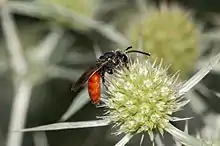
Sphecodes albilabris is a solitary parasitic bee that is endemic to Central and Western Europe. It also occurs in North Africa and is thought to have been introduced to the United States and Australia by accident. The larvae of this species are parasites of Colletes cunicularius.[1]
| Sphecodes albilabris | |
|---|---|
 | |
Scientific classification  | |
| Kingdom: | Animalia |
| Phylum: | Arthropoda |
| Class: | Insecta |
| Order: | Hymenoptera |
| Family: | Halictidae |
| Genus: | Sphecodes |
| Species: | S. albilabris |
| Binomial name | |
| Sphecodes albilabris Fabricius, 1793 | |
The length of the bee is 11–14 mm. It flies from March to September.
References
- Özbek, Hikmet; Bogusch, Petr; Straka, Jakub (2015). "A contribution to the kleptoparasitic bees of Turkey: Part I.,the genus Sphecodes Latreille (Hymenoptera: Halictidae)". Turkish Journal of Zoology. 39: 1095–1109. doi:10.3906/zoo-1501-43.
This article is issued from Wikipedia. The text is licensed under Creative Commons - Attribution - Sharealike. Additional terms may apply for the media files.