Pomacea bridgesii
Pomacea bridgesii, common names the spike-topped apple snail or mystery snail, is a South American species of freshwater snail with gills and an operculum, an aquatic gastropod mollusk in the family Ampullariidae. These snails are mainly introduced through aquarium trades, which impacted in aid from fertilizations and food production and accessibility[2].
| Pomacea bridgesii | |
|---|---|
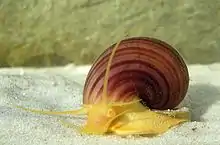 | |
| Pomacea bridgesii in aquarium | |
| Scientific classification | |
| Kingdom: | |
| Phylum: | |
| Class: | |
| (unranked): | |
| Superfamily: | |
| Family: | |
| Genus: | |
| Subgenus: | Pomacea |
| Species: | P. bridgesii |
| Binomial name | |
| Pomacea bridgesii (Reeve, 1856) | |

Subspecies
- Pomacea bridgesii bridgesii (Reeve, 1856)
- Pomacea bridgesii diffusa (Blume, 1957)
Anatomy
Mystery snails possess structurally complex eyes at the tip of a cephalic eyestalk. They are able to regenerate the eye completely after amputation through the mid-eyestalk. They are born with both gills and lungs. Mystery snails also possess a siphon which is a small tube used to breathe air. They frequently surface to breathe.[3]
Mystery snail's posses a very distinct physical feature, which allows for its identity determined based on the exterior observation of its shell. Characteristics of the shell allows for the Mystery Snail to comfortably move and protect itself from the dangers of its environment. With 5-6 whorls allocated on its shell, wide shoulder ranges, and deep shell structure in the interior; these characteristics help keep the Mystery Snail safe due to its vibrant shell colors and being easily visible to predators.[4]
Distribution
The native distribution of this snail is Bolivia, Brazil, Paraguay and Peru.
Non-indigenous distribution
This species is non-indigenous in Hawaii since 1960 (Pomacea bridgesii diffusa), southeast Asia since the 1980s, and Florida since the early 1980s (Pomacea bridgesii diffusa).[5]
Offspring
Most mystery snails lay their eggs above the water line. They are gonochoristic which means a male and female must be present for reproduction. The eggs take 2–4 weeks to hatch. The snails can produce as many as two hundred offspring from one egg-laying event. Sometimes not all the eggs are fertilized so they do not all hatch. When they do hatch, the hatchlings run the risk of being eaten if they share an aquarium with fish.[6] Hatchling mystery snails will grow quickly if given an appropriate amount of food and calcium. A hatchling mystery snail will start as a speck and can grow to the size of a pea in just over a week. A mystery snail is considered to be breeding size once it is almost the size of a golf ball, which can take as little as two months with the proper diet.
Human relevance
This species is often kept as an aquarium pet, because of its wide range of shell colors, lack of appetite for live plants, and ease of care. Although they seem like simple creatures, mystery snails do require proper maintenance. Many domestic mystery snails or those in pet stores suffer health issues related to shell, nutrient, and water quality. Regular calcium intake is required for their shells. Many mystery snail owners make food called snail jello for their pets to eat. Nutritious vegetables and as well calcium supplements can be added to this.
Environment
Mystery Snails are often found in lakes or rivers, where the oxygen levels is low, allowing them to easily breath and take in the proper oxygen needed for survival. Pomace bridgesii are mainly found in tropical environments and unable to sustain conditions under 50 degrees.[7]
References
- Pastorino, G.; Darrigan, G. (2011). "Pomacea bridgesii". IUCN Red List of Threatened Species. 2011: e.T189088A8678453. doi:10.2305/IUCN.UK.2011-2.RLTS.T189088A8678453.en. Retrieved 19 November 2021.
- "spiketop applesnail (Pomacea bridgesii) - Species Profile". nas.er.usgs.gov. Retrieved 7 November 2021.
- Bover, M. M. (1988). "Eye regeneration in the mystery snail". J. Exp. Zool. 245 (1): 33–42. doi:10.1002/jez.1402450106. PMID 3351443.
- "Pomacea bridgesii (Ampullariidae) - HEAR species info". www.hear.org. Retrieved 7 November 2021.
- Pomacea bridgesi at applesnail.net
- "Mystery Snail Complete Care Guide (Blue, Black, Gold and More) | Fishkeeping World". Retrieved 10 October 2019.
- Hayes, K (12 September 2018). "Spiketop Applesnail (Pomacea Bridgesi) ERSS-FWS". U.S Fish and Wildlife Service. Retrieved 19 October 2021.
