Square du Vert-Galant
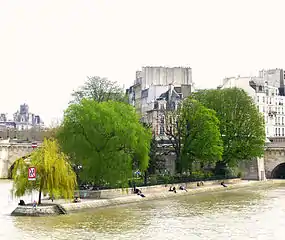
The Square du Vert-Galant is a small, triangular park pointing downstream located at the western tip of the Ile de la Cité, next to the Pont Neuf, in the First Arrondissement of Paris. It was created in 1884 by joining two small islands to the larger island.[1]
History
The Pont Neuf, completed in 1606, was the first bridge in Paris to cross the entire length of the Seine, and was the first that was not lined with houses.[2] It was the project of Henry IV. After his assassination, his statue was placed on the bridge. It was first equestrian statue in Paris, overlooking the future park.
When the Pont Neuf, was completed the bridge was at the west end of the Ile de la Cité, overlooking the river. Two small islands originally lay just west of the bridge; the Île à la Gourdaine or Island of the Patriarch, and the Ile aux Juifs, which had been the site of the persecution and execution of Jews, and which in 1314 had been the execution site of Jacques de Molay, the head of the Knights Templar.[2]
In 1884, under the Third Republic, a new project was begun to link the small islands to the main island. Embankments were constructed and the land between the islands was filled in, and the park was formed.
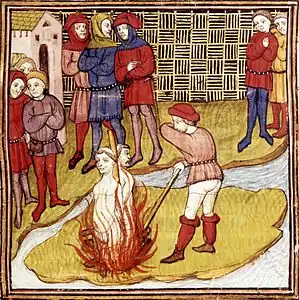 Execution of Jacques de Molay on the ile aux Juifs, March 18, 1314 (miniature du Maître de Virgile. Grandes Chroniques de France, vers 1380, BL, Royal MS 20 C vii, f.48r.
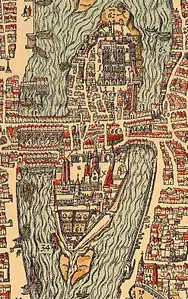 The two small islands in 1575, before they were joined together to form the square
Description
The square has an area of 1,642 square meters, or just four-tenths of an acre. It is planted with chestnut trees, taxus or yew trees, prunus pissardii or plum trees; black walnut trees, érables negundo, flowering apple trees, Salix babylonica or weeping willows, Olive trees from Bohemia, Sophora trees, catalpa, robiniers, and Ginkgo biloba. When the Seine rises to an unusual height, as in January 2018, the park is submerged.
Gallery
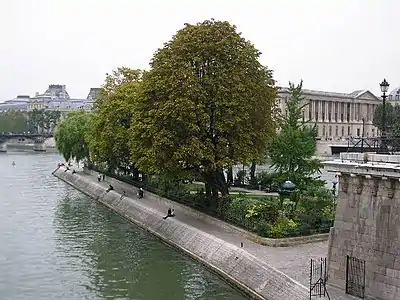 Square du Vert-Galant
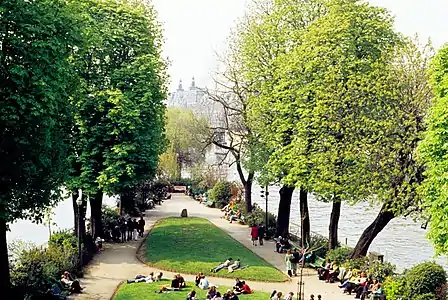 Park viewed from the Pont Neuf
 Park flooded in January 2018
Bibliography (in French)
Notes and Citations
- Sarmant, Thierry, "Histoire de Paris - Politique, Urbanisme, Civilisation", (2012), p. 90
- Lecompte 2013, p. 118.
External links
- Square du Vert-Galant on the site of the Mairie de Paris (in French)