Saint Guinefort
Saint Guinefort (French pronunciation: [ɡin.fɔʁ]) was a 13th-century French dog that received local veneration as a folk saint after miracles were reported at his grave.[1][2][3]
Saint Guinefort | |
|---|---|
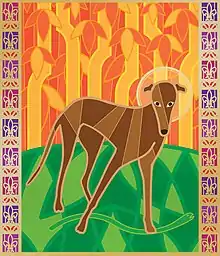 Modern illustration of St. Guinefort | |
| Dog Saint | |
| Died | 13th-century near Lyon, France |
| Venerated in | Folk Catholicism |
| Feast | Venerated locally on August 22 |
| Patronage | Infants |
Catholic cult suppressed | Never recognized officially in the Catholic Church; Cult persisted until the 1930s by the Catholic Church |
Legend
His story is a variation on the well-travelled "faithful hound" motif, similar to the Welsh story of the dog Gelert. Guinefort the greyhound belonged to a knight who lived in a castle near Lyon. One day, the knight went hunting, leaving his infant son in the care of Guinefort. When he returned, he found the nursery in chaos – the cot overturned, the child nowhere to be seen and Guinefort greeted his master with bloody jaws. Believing Guinefort to have devoured his son, the knight slew the dog. He then heard a child crying; he turned over the cot and found his son lying there, safe and sound, along with the body of a viper. Guinefort had killed the snake and saved the child. On realizing the mistake the family dropped the dog down a well, covered it with stones and planted trees around it, setting up a shrine for Guinefort. Guinefort became recognised by locals as a saint for the protection of infants. It was alleged by contemporary commentators that locals left their babies at the site to be healed by the dog:
- The local peasants hearing of the dog's noble deed and innocent death, began to visit the place and honor the dog as a martyr in quest of help for their sicknesses and other needs.
- Stephen of Bourbon (d. 1262): De Supersticione: On St. Guinefort.[2][3]
In part because of the rigorous persecution and demonization of the belief, it persisted and was given wider circulation and support — an unintended consequence and a precursor manifestation of the Streisand effect.[2][3] As Protestant churches emerged in the Sixteenth century, they "criticized the cult of Guinefort seeing in it an example of the abuses and errors of the Catholic Church." Catholic hierarchy adopted the critique, and sought to euthanize Guinefort belief and practices, and ostracize practitioners.[4] A fine for the practice was implemented.[5] "Despite this early attempt to ridicule and dismiss the cult of Saint Guinefort, the local tradition continued."[upper-alpha 1] The cult of this dog saint persisted for several centuries, until the 1930s, despite the repeated prohibitions of the Catholic Church.[3] And community memory of the practices was evidence in the 1970s.[6]
In popular culture
The 1987 French film Le Moine et la sorcière (in the US known as The Sorceress) depicts the controversy over St. Guinefort as seen through the eyes of Fr. Etienne de Bourbon, a Dominican inquisitor and the author of the above passage.[1]
Thomas of Hookton, the main character in Bernard Cornwell's The Grail Quest trilogy (2000–2003), was a mock believer in Saint Guinefort, praying to the saint and wearing a paw on a piece of leather around his neck.
In Adam Gidwitz's 2017 young adult novel The Inquisitor's Tale, the main characters' pet greyhound Gwenforte bears a strong resemblance to Saint Guinefort, especially in the manner of his death and resurrection early in the novel.
The questions of "why did the French peasants include a dog among the Christians saints, and what does today's anthropozoology have to say about animals' healing powers?" remains a matter for research.[7]
See also
- Cynocephaly
- Saint Christopher - a saint often portrayed with the head of a dog
- Saint Gelert
- The Brahmin and the Mongoose
References
Notes
- "In 1879 a folklorist named Vayssière passed through “Saint Guinefort’s wood” and found it still intact. Similarly, the modern historian Jean-Claude Schmitt found evidence of the cult still in practice after World War I."[4]
Citations
- Rist, R. (2019). "The papacy, inquisition and Saint Guinefort the Holy Greyhound" (PDF). Reinardus: The Yearbook of the International Reynard Society. University of Reading. 30 (1): 190–211. doi:10.1075/rein.00020. ISSN 0925-4757.
- Halsall, Paul (September 8, 2000). "Stephen de Bourbon (d. 1262): De Supersticione: On St. Guinefort Etienne de Bourbon". Medieval Sourcebook. Fordham University. Retrieved October 5, 2013.
- Dickey, Colin (June 18, 2013). "A Faithful Hound". Lapham's Quarterly. Retrieved September 4, 2016.
In the late 1960s, when the Vatican revolutionized itself to stay current and relevant, Jean-Claude Schmitt was still making inquiries about Guinefort in the regions around Lyon—asking around about a supposed healer in the nearby forest, one of the locals answered Schmitt, “My grandmother told me: it seems he was a dog!”
- Lynn, Michael. "The Cult of Guinefiord: An Unusual Saint". The Ultimate History Project. Retrieved November 18, 2021.
- Su, Minjie. "Oh My Dog! St Guinefort and St Christopher". Medievalists.net. Retrieved November 18, 2021.
- "The legend of Saint Guignefort" (in French). Association Saint Guignefort. Retrieved November 18, 2021.
Some old people of Châtillon still remembered in the years 1970 that formerly (before the second world war), one went in this wood to invoke there certain Saint Guignefort and to obtain the cure of the sick or weak children.
- Van Ruymbeke Stey, Marie-Madeleine (June 2007). "Saint Guinefort Addressing Thomas Aquinas's Shadow". Journal of Jungian Scholarly Studies. 3. doi:10.29173/jjs77s. Retrieved November 19, 2021.
Further reading
- Saint Guignefort Légende, Archéologie, Histoire in French.
- Schmidtt, Jean-Claude (June 29, 2009) [1983]. The Holy Greyhound: Guinefort, Healer of Children since the Thirteenth Century (Paperback ) (Reissue ed.). Cambridge, New York, Melbourne: Cambridge University Press, Cambridge Studies in Oral and Literate Culture. ISBN 0521108802. ISBN 978-0521108805.
External links
- Halsall, Paul (September 8, 2000). "Stephen de Bourbon (d. 1262): De Supersticione: On St. GuinefortEtienne de Bourbon". Medieval Sourcebook. Fordham University. Retrieved October 5, 2013. (the source text for the story)
- Holy Dogs and Dog-Headed Saints
Authority control: National libraries  |
|---|