Narrow-nosed rhinoceros
The narrow-nosed rhinoceros (Stephanorhinus hemitoechus) is an extinct species of rhinoceros that lived in western Eurasia and North Africa[1] during the Pleistocene. It first appeared in Europe some 600,000 years ago, and survived there until as recently as 40,000 years Before Present
| Narrow-nosed rhinoceros Temporal range: | |
|---|---|
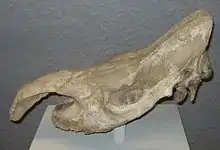 | |
| Skull of Stephanorhinus hemitoechus | |
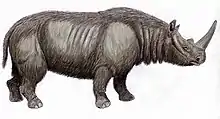 | |
| Stephanorhinus hemitoechus life restoration | |
Scientific classification  | |
| Kingdom: | Animalia |
| Phylum: | Chordata |
| Class: | Mammalia |
| Order: | Perissodactyla |
| Family: | Rhinocerotidae |
| Genus: | †Stephanorhinus |
| Species: | †S. hemitoechus |
| Binomial name | |
| †Stephanorhinus hemitoechus Falconer, 1859 | |
| Synonyms | |
| |
Description
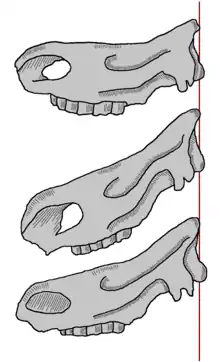
The narrow-nosed rhinoceros was a large animal, reaching a shoulder height of as much as 2 m (6.6 ft).[2] It can be distinguished from other species of Stephanorhinus by its very long and low skull. Its nasals are relatively low, and its horn base poorly developed. Teeth are forward shifting.[3]
The narrow-nosed rhinoceros probably favored temperate open areas rich in low-growing vegetation. It displayed many similarities to its better known extinct relative, the woolly rhinoceros. However, it was probably not a true grazer, but a mixed feeder, eating low-growing vegetation in open habitats.[3][4]
In Apulia in southern Italy, remains of narrow-nosed rhinoceros from the middle Late Pleistocene were found to be smaller than those of other areas, indicating they may have been an insular form.[5]
Age and distribution
From the late Middle Pleistocene onwards, the narrow-nosed rhinoceros and its relative, the Merck's rhinoceros were the only surviving species of Stephanorhinus. In comparison to the widespread Merck's rhinoceros, the narrow-nosed rhinoceros was generally confined to the western Palearctic.[6]
In North Africa, the youngest remains of the narrow-nosed rhinoceros date to between 109 and 53 kya.[1]
The narrow-nosed rhinoceros survived until around 40 kya in southern Europe. The last records in Italy date to around 41,000 years ago.[7], while remains dating to 40,000 years ago are knowns from Bacho Kiro cave in Bulgaria.[8]
References
- Faith, J. Tyler (2014). "Late Pleistocene and Holocene mammal extinctions on continental Africa". Earth-Science Reviews. 128: 105–121. doi:10.1016/j.earscirev.2013.10.009.
- "Narrow-nosed Rhinoceros(Stephanorhinus hemitoechus)". Gibraltar Nanational Museum.
- Fortelius, M.; Mazza, P.; Sala, B. (1993). "Stephanorhinus (Mammalia: Rhinocerotidae) of the Western European Pleistocene, with a revision of S. etruscus (Falconer, 1868)". Palaeontographia Italica, Pisa. 80: 63–155.
- Salari, L. (2019). "The Late Pleistocene faunal assemblage from Cava Muracci (Latium, Italy): Palaeoenvironmental implications for coastal central Italy during MIS 3". Comptes Rendus Palevol. 18: 51–71.
- Pandolfi, Luca; Petronio, Carmelo (2011). "The small-sized rhinoceroses from the Late Pleistocene of Apulia (southern Italy)". Rivista Italiana di Paleontologia e Stratigrafia. 117 (3): 509–520. doi:10.13130/2039-4942/5989.
- Diana Pushkina: The Pleistocene easternmost distribution in Eurasia of the species associated with the Eemian Palaeoloxodon antiquus assemblage. Mammal Review, 2007. Volume 37 Issue 3, Pages 224 - 245
- PANDOLFI, LUCA; BOSCATO, PAOLO; CREZZINI, JACOPO; GATTA, MAURIZIO; MORONI, ADRIANA; ROLFO, MARIO; TAGLIACOZZO, ANTONIO (2017-04-13). "LATE PLEISTOCENE LAST OCCURRENCES OF THE NARROW-NOSED RHINOCEROS STEPHANORHINUS HEMITOECHUS (MAMMALIA, PERISSODACTYLA) IN ITALY". Rivista Italiana di Paleontologia e Stratigrafia (Research In Paleontology and Stratigraphy). V. 123: N. 2 (2017). doi:10.13130/2039-4942/8300.
- Stuart, A.J., Lister, A.M., 2007. Patterns of Late Quaternary megafaunal extinctions in Europe and northern Asia. In: Kahlke, R.-D., Maul, L.C., Mazza, P. (Eds.), Late Neogene and Quaternary Biodiversity and Evolution: Regional Developments and Interregional Correlations Vol. II, Proceedings of the 18th International Senckenberg Conference (VI International Palaeontological Colloquium in Weimar). Courier Forschungsinstitut Senckenberg 259, pp. 287-297.