Stinking Bishop (cheese)
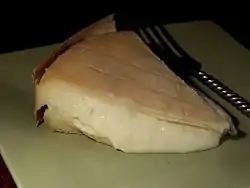
Stinking Bishop is a washed-rind cheese produced since 1972 by Charles Martell and Son at Hunts Court Farm, Dymock, Gloucestershire, in the west of England. It is made from the milk of Gloucester cattle.
| Stinking Bishop | |
|---|---|
 | |
| Country of origin | United Kingdom |
| Region | Gloucestershire |
| Town | Dymock |
| Source of milk | Cow |
| Pasteurised | Yes |
| Texture | Smooth, creamy, semi-soft |
| Fat content | 48% |
| Aging time | 6-8 weeks |
| Certification | None |
 Related media on Wikimedia Commons Related media on Wikimedia Commons | |
History
By 1972 there were just 68 Gloucester breed heifers left in the world. Charles Martell bought up many of the surviving cows, and began to produce cheese from their milk, not initially for its own sake, but to promote interest in the breed. Since then his own herd has expanded to 25 cows, and there has been a revival of interest by other farmers, which has increased the total number of cows to around 450. The relatively small size of Martell's herd means that the Gloucester milk is combined and pasteurised with the milk of Friesian cattle from another farm nearby.[1] The fat content is 48%.
The colour of Stinking Bishop ranges from white/yellow to beige, with an orange to grey rind. It is moulded into wheels 2 kilograms (4.4 lb) in weight, 20 centimetres (7.9 in) in diameter, and 4 centimetres (1.6 in) deep. Only about 20 tonnes are produced each year.[2]
The distinctive odour comes from the process with which the cheese is washed during its ripening; it is immersed in perry made from the local Stinking Bishop pear (from which the cheese gets its name) every four weeks while it matures. To increase the moisture content and to encourage bacterial activity, salt is not added until the cheese is removed from its mould.[1]
This cheese was brought to international attention in the 2005 film Wallace & Gromit: The Curse of the Were-Rabbit, in which Gromit uses it to revive Wallace. Demand for the cheese subsequently rose by 500%,[3] forcing the cheesemaker to hire more staff and increase production.[4]
Availability
Stinking Bishop is an artisanal, handmade cheese and is therefore not produced for supermarkets. It currently has over 130 stockists[5] across the UK, and can be found in artisan food stores and delicatessens, as well as in Harrods and Selfridges.
Awards
- 2010, Gold Medal Winner at the British Cheese Awards[6]
See also
References
- "Stinking Bishop". Teddington Cheese. Retrieved 25 December 2016.
- Kirby, Terry (14 September 2005). "A history of the Stinking Bishop". The Independent. London. Archived from the original on 6 November 2005. Retrieved 24 May 2010.
- "Farmer's vow as film boosts demand". The Scotsman. Edinburgh. 30 December 2005. Archived from the original on 24 June 2006.
- Morris, Steven (13 September 2005). "Stinking Bishop lives in fear of the Wallace & Gromit effect". The Guardian. London.
- "Invite the Bishop!". Charles Martell & Son - Cheesemakers and Distillers. 15 March 2017. Retrieved 22 March 2017.
- "Stinking Bishop". britishfinefoods.com. Retrieved 21 May 2018.
External links
- "Stinking Bishop". Charles Martell & Son - Cheesemakers and Distillers.
- "Stinky Cheese Maker Shuns 'Wallace & Gromit' Spotlight". All Things Considered. NPR. 7 October 2005.