9K34 Strela-3
The 9K34 Strela-3 (Russian: 9К34 «Стрела-3», 'arrow', NATO reporting name: SA-14 Gremlin) is a man-portable air defense missile system (MANPADS) developed in the Soviet Union as a response to the poor performance of the earlier 9K32 Strela 2 (SA-7 Grail) system. The missile was largely based on the earlier Strela 2, and thus development proceeded rapidly. The new weapon was accepted into service in the Soviet Army in January 1974.
| 9K34 Strela-3 | |
|---|---|
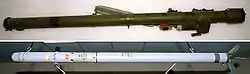 A 9K34 Strela-3 (SA-14) missile and launch tube. | |
| Type | Man-portable air-defense systems (MANPADS) |
| Place of origin | Soviet Union |
| Service history | |
| In service | 1974–present |
| Used by | See Operators |
| Wars | Iran–Iraq War Salvadoran Civil War War in Abkhazia (1992–1993) Yugoslav Wars Second Congo War Afghan Civil War Iraq War |
| Production history | |
| Manufacturer | KBM, Kolomna |
| Specifications | |
| Mass | Missile weight: 10.3 kilograms (23 lb), Full system: 16.0 kg (35.3 lb) |
| Length | 1.47 metres (4.8 ft) |
Operational range | 4,500 metres (14,800 ft) |
| Flight altitude | 1,800 metres (5,900 ft) vs jets 3,000 metres (9,800 ft) vs slow moving targets |
| Maximum speed | 470 metres per second (1,700 km/h; 1,100 mph) |
Description
The most significant change over the Strela 2 was the introduction of an all-new infra-red homing seeker head. The new seeker worked on FM modulation (con-scan) principle, which is less vulnerable to jamming and decoy flares than the earlier AM (spin-scan) seekers, which were easily fooled by flares and even the most primitive infrared jammers. The new seeker also introduced detector element cooling in the form of a pressurized nitrogen bottle attached to the launcher.
The effect of cooling was to expand the seeker's lead sulphide detector element's sensitivity range to longer wavelengths (slightly over 4 µm as opposed to 2.8 µm of uncooled PbS elements). In practice this made possible the tracking of cooler targets over longer ranges, and enabled forward-hemisphere engagement of jets under favourable circumstances. The seeker also had better tracking rate, enabling the missile to track maneuvering of fast and approaching targets.
A negative side effect from the aforementioned improvements was increased missile weight, which caused a slight decrease in the kinematic performance of the original Strela-2 (SA-7). Against relatively slow, low-altitude battlefield air threats the overall effectiveness was much improved.
Strela-3 missiles have been exported to over 30 countries.
The original Strela-3 missile was the 9M36. The follow-on to the Strela-3 was Igla.
The naval version of this missile has the NATO reporting name of SA-N-8.
Operational history
Iraq
On 22 November 2003 an Airbus A300 cargo plane was hit by a Strela-3 missile after takeoff from Baghdad International Airport, but managed to land safely despite losing hydraulic power.
On 6 May 2006, a British Westland Lynx AH.7 of the Royal Navy from 847 Squadron was shot down with a Strela-3 over Basra, killing five crewmen and crashing into a house.[1]
Georgia
During the War in Abkhazia (1992–1993), a Russian Mi-8 helicopter was shot down by a Georgian Army SA-14 on December 14, 1992, resulting in the death of 3 crew and 58 passengers, most of them Russian refugees. A Georgian Air Force Su-25 was shot down over Nizhnaya Eshera on 4 July 1993 by SA-14,[2] and several other aircraft on both sides may have been shot down by SA-14s.[3]
Former Yugoslavia
A British Sea Harrier FRS1 of 801 Naval Air Squadron, operating from aircraft carrier HMS Ark Royal on 16 April 1994, was shot down during its attack on two Serbian T-55 tanks in Bosnia. The pilot, Lieutenant Nick Richardson, ejected and landed in territory controlled by friendly Bosnian Muslims.
DRC Congo
A Zimbabwe Air Force Il-76 was shot down by Congolese rebels using an SA-14 on 11 October 1998 during the Second Congo War, resulting in the death of 40 troops and crew.[4]
Afghanistan
SA-14s used by the Northern Alliance are credited with having shot down 8 Taliban MiG-21 and Su-22 fighters during the Taliban's 2000 offensive against Taloqan.[5]
Turkey
SA-14 (9K34 Strela-3) MANPADS was found during Operation Claw (2019-2020) in June 2019 in the Hakurk region of northern Iraq belonging to the PKK.[6]
Operators
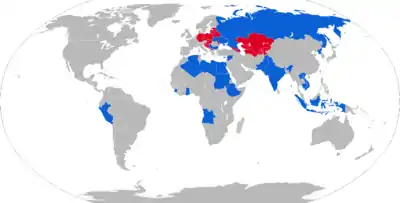
Current operators
 Afghanistan
 Algeria
 Angola[8]
 Armenia
 Azerbaijan[8]
 Bosnia and Herzegovina[8]
 Bulgaria
 Cambodia
 Croatia[8]
 Cuba[8]
 Cyprus
 Egypt
Egypt Ethiopia
 Ghana
Ghana Georgia – used during Georgian civil war.[9]
 Hezbollah[7]
 Indonesia
 Iran[8]
 Jordan[8]
 Kazakhstan[10]
 Kurdistan Workers' Party[11]
 Laos
Laos Lebanon
 Libya
Libya Morocco
 Myanmar- fitted on the Kilo class submarine, INS Sindhuvir (S58) which was transferred from India navy.
 Nicaragua[8]
 North Korea[8]
 Pakistan
 Peru[8]
 Russia[8]
 Sierra Leone
 Serbia - 600
 Sudan
Sudan Syria[8]
 Turkmenistan[8]
 Ukraine
 Vietnam


Former operators
 Czechoslovakia – never inducted in military service[12]
 East Germany – never acquired to military service[12]
 Hungary – never acquired to military service[12]
.svg.png.webp) Iraq – some of them were looted after the Iraq War in 2003, being used in the post war insurgency and subsequent regional wars and finding their way in the black market.
Iraq – some of them were looted after the Iraq War in 2003, being used in the post war insurgency and subsequent regional wars and finding their way in the black market.- Liberation Tigers of Tamil Eelam[7]
 Poland – 100 bought in the 1980s, but never acquired to military service.[12]
 Soviet Union
.svg.png.webp) Yugoslavia
Yugoslavia
Comparison chart
| System | 9K32M Strela-2M (missile: 9M32M) | 9K34 Strela-3 (missile: 9M36)[13] | FIM-43C Redeye[14] |
|---|---|---|---|
| Service entry | 1968 | 1974 | 1968 |
| Mass, full system, ready to shoot | 15 kg | 16 kg | 13.3 kg |
| Weight, missile | 9.8 kg | 10.3 kg | 8.3 kg |
| Length | 1.44 m | 1.47 m | 1.40 m |
| Warhead | 1.15 kg (0.37 kg HMX) directed-energy blast fragmentation | 1.17 kg (0.39 kg HMX) directed-energy blast fragmentation, including a 20g secondary charge to set off remaining rocket propellant | 1.06 kg M222 (0.36 kg HTA-3) blast fragmentation |
| Seeker type | AM-modulated (spin scan), uncooled PbS detector element (1–2.8 µm sensitivity range). Tail-chase only. | FM-modulated (con scan), nitrogen-cooled PbS detector element (2–4.3 µm sensitivity range). Limited forward hemisphere (all-aspect) capability | AM-modulated, uncooled PbS detector element. Tail-chase only. |
| Maximum range | 4,200 m | 4,500 m | 4,500 m |
| Speed | 430 m/s | 470 m/s | 580 m/s |
| Target's maximum speed, approaching/receding | 150/260 m/s | 310/260 m/s | –/225 m/s |
| Engagement altitude | 0.05–2.3 km | 0.03–3.0 km | 0.05–2.7 km |
See also
References
- "RAF Pursues Common DAS Demonstrator".
- "Archived copy". Archived from the original on 2015-09-23. Retrieved 2013-04-20.CS1 maint: archived copy as title (link)
- Cooper, Tom. "Georgia and Abkhazia, 1992-1993: the War of Datchas". ACIG.org. Archived from the original on 3 March 2008. Retrieved 18 February 2013.
- Cooper, Tom. "Zaire/DR Congo, 1980-2001". ACIG.org. Retrieved 18 February 2013.
- Cooper, Tom. "Afghanistan, 1979-2001; Part 2". ACIG.org. Retrieved 18 February 2013.
- COIN_TR (2019-06-19). "SA-14 (9K34 Strela-3) MANPADS was found today in Hakurk belonging to the PKK. Additionally, multiple caves, shelters, ammunition and IED's have been found and destroyed in the last couple of days. #OperationClaw #PençeHarekatıpic.twitter.com/zcaG89889K". @ddsgf9876. Retrieved 2020-02-08.
- "Guided light weapons reportedly held by non-state armed groups 1998-2013" (PDF). Small Arms Survey. March 2013. Archived from the original (PDF) on August 18, 2014.
- International Institute for Strategic Studies (IISS) (14 February 2018). "The Military Balance 2018". The Military Balance. 118.
- Cooper, Tom. "Georgia and Abkhazia, 1992-1993: the War of Datchas". ACIG.org. Archived from the original on 3 March 2008. Retrieved 18 February 2013.
- Small Arms Survey (2012). "Blue Skies and Dark Clouds: Kazakhstan and Small Arms". Small Arms Survey 2012: Moving Targets. Cambridge University Press. p. 131. ISBN 978-0-521-19714-4. Archived from the original (PDF) on 2018-08-31. Retrieved 2018-08-30.
- "SA-14 (9K34 Strela-3) MANPADS was found today in Hakurk belonging to the PKK. Additionally, multiple caves, shelters, ammunition and IED's have been found and destroyed in the last couple of days". twitter.com. Retrieved 8 October 2019.
- "Samolotypolskie.pl - 9K34 (9M36) "Strzała-3"".
- Istorija sozdanija i razvitija vooruzhenija i vojennoi theniki PVO suhoputnyh voisk Rossii
- General Dynamics FIM-43 Redeye
Bibliography
- Petukhov, Sergei I.; Shestov I.V. (1998). History of design and development of missile systems and military systems of AAW of Russian Land Forces / Istorija sozdanija i razvitija vooruzhenija i vojennoi tehniki PVO suhoputnyh voisk Rossii, 1.-2. VPK Publishing.
- "Directory of U.S. Military Rockets and Missiles, FIM-43". Archived from the original on 17 April 2008. Retrieved 2008-04-23.
External links
 |
Wikimedia Commons has media related to Strela-3. |