Macedonian phonology
This article discusses the phonological system of Standard Macedonian (unless otherwise noted) based on the Prilep-Bitola dialect. For discussion of other dialects, see Macedonian dialects. Macedonian possesses five vowels, one semivowel, three liquid consonants, three nasal stops, three pairs of fricatives, two pairs of affricates, a non-paired voiceless fricative, nine pairs of voiced and unvoiced consonants and four pairs of stops.
Vowels
| Front | Back | |
|---|---|---|
| Close | i | u |
| Open-mid | ɛ | ɔ |
| Open | a |
Schwa
The schwa is phonemic in many dialects (varying in closeness to [ʌ] or [ɨ]) but its use in the standard language is marginal.[1] When writing a dialectal word and keeping the schwa for aesthetic effect, an apostrophe is used; for example, ⟨к’смет⟩, ⟨с’нце⟩, etc. When spelling aloud, each consonant is followed by the schwa. The individual letters of acronyms are pronounced with the schwa in the same way: ⟨МПЦ⟩ ([mə.pə.t͡sə]). The lexicalized acronyms ⟨СССР⟩ ([ɛs.ɛs.ɛs.ɛr]) and ⟨МТ⟩ ([ɛm.tɛ]) (a brand of cigarettes), are among the few exceptions.
Vowel length
Vowel length is not phonemic. Vowels in stressed open syllables in disyllabic words with stress on the penult can be realized as long, e.g. ⟨Велес⟩ [ˈvɛːlɛs] ( listen) 'Veles'. The sequence /aa/ is often realized phonetically as [aː]; e.g. ⟨саат⟩ /saat/ [saːt] 'colloq. hour'.
Consonants
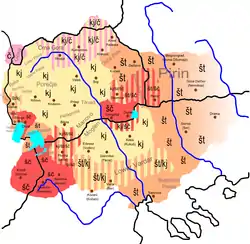
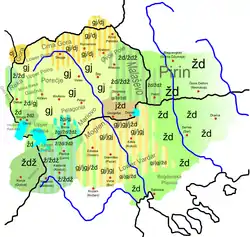
| Place → | Labial | Dental | Alveolar | Postalveolar | Palatal | Velar | ||
|---|---|---|---|---|---|---|---|---|
| Manner ↓ | hard | soft | ||||||
| Nasal | m | n̪1 | ɲ | |||||
| Plosive | voiceless | p | t̪ | k | c1 | |||
| voiced | b | d̪ | ɡ | ɟ1 | ||||
| Affricate | voiceless | t̪͡s̪ | t͡ʃ | |||||
| voiced | d̪͡z̪ | d͡ʒ | ||||||
| Fricative | voiceless | f | s̪ | ʃ | x4 | |||
| voiced | v | z̪ | ʒ | |||||
| Approximant | l̪2 | ɫ2, 3 | j | |||||
| Trill | r3 | |||||||
^1 /c/ and /ɟ/ are officially dorsal-palatal plosives, and some speakers pronounce them that way. They have various other pronunciations, depending on dialect. In some Northern Macedonian dialects they are alveolo-palatal affricates [t͡ɕ] and ([d͡ʑ], while in the urban Prilep subdialect of the Prilep-Bitola dialect, they have merged into /t͡ʃ/ and /d͡ʒ/, respectively.
^2 While the non-velarised dental lateral /l/ (transliterated ⟨ł⟩) and the velarised alveolar lateral /ɫ/ (transliterated ⟨l⟩) occur mainly before front and non-front vowels, respectively (where they are both written ⟨л⟩), they contrast in minimal pairs such as ⟨бела⟩ /ˈbɛɫa/ ('white') and ⟨беља⟩ /ˈbɛla/ ('trouble').
^3 The alveolar trill (/r/) is syllabic between two consonants; for example, ⟨прст⟩ [ˈpr̩st] 'finger'. The dental nasal (/n/) and alveolar lateral (/ɫ/) are also syllabic in certain foreign words; e.g. ⟨њутн⟩ [ˈɲutn̩] 'newton', ⟨Попокатепетл⟩ [pɔpɔkaˈtɛpɛtɫ̩] 'Popocatépetl', etc.
^4 The velar fricative /x/ does not occur natively in the language. It has been introduced or retained in Standard Macedonian under the following circumstances: (1) new foreign words: ⟨хотел⟩ /xɔˈtɛɫ/ 'hotel', (2) toponyms: Ohrid, (3) Church Slavonicisms: ⟨дух⟩ /dux/ 'spirit', (4) new literary words: ⟨доход⟩ /ˈdɔxɔt/ 'income', and (5) to disambiguate between potential homophones: ⟨храна⟩ /ˈxrana/ 'food' vs. ⟨рана⟩ /ˈrana/ 'injury, wound'.[5]
Phonological processes
At morpheme boundaries (represented in spelling) and at the end of a word (not represented in spelling), voicing opposition is neutralized.
Stress
The word stress in Macedonian is antepenultimate, meaning it falls on the third from last syllable in words with three or more syllables, and on the first or only syllable in other words. This is sometimes disregarded when the word has entered the language more recently or from a foreign source. The following rules apply:
- Disyllabic words are stressed on the second-to-last syllable.
For example, ⟨дете⟩ [ˈdɛtɛ] 'child', ⟨мајка⟩ [ˈmajka] 'mother' and ⟨татко⟩ [ˈtatkɔ] 'father'.
- Trisyllabic and polysyllabic words are stressed on the third-to-last syllable.
For example, ⟨планина⟩ [ˈpɫanina] 'mountain', ⟨планината⟩ [pɫaˈninata] 'the mountain' and ⟨планинарите⟩ [pɫaniˈnaritɛ] 'the mountaineers'.
Exceptions include:
- Verbal adverbs (i.e. words suffixed with ⟨-jќи⟩): e.g. ⟨викајќи⟩ [viˈkajci] 'shouting', ⟨одејќи⟩ [ɔˈdɛjci] 'walking'.
- Foreign loanwords: e.g. ⟨клише⟩ [kliˈʃɛ] 'cliché', ⟨генеза⟩ [ɡɛˈnɛza] 'genesis', ⟨литература⟩ [litɛraˈtura] 'literature', ⟨Александар⟩ [alɛkˈsandar], 'Alexander', etc.
References
- Friedman (2001), p. 10.
- Lunt (1952), pp. 10–11.
- Friedman (2001), p. 11.
- Lunt (1952), pp. 11–12.
- Friedman (2001:11)
Bibliography
- Bojkovska, Stojka (2008), Grammar of the Macedonian language, Skopje: Prosvetno Delo
- Friedman, Victor (2001), "Macedonian", in Garry, Jane; Rubino, Carl (eds.), Facts about the World's Languages: An Encyclopedia of the Worlds Major Languages, Past and Present, New York: Holt, pp. 435–439
- Friedman, Victor (2001), Macedonian, SEELRC
- Lunt, Horace G. (1952), Grammar of the Macedonian Literary Language, Skopje
Macedonian language (македонски јазик) | ||
|---|---|---|
 | ||
| Dialects | ||
| Other topics | ||