Criticism of suburbia
Criticism of suburbia dates back to the boom of suburban development in the 1950s and critiques a culture of aspirational homeownership.[1] In the English-speaking world, this discourse is particularly prominent in the United States and Australia being prevalent both in popular culture and academia.
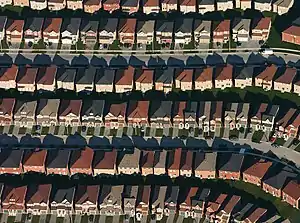
In the United States
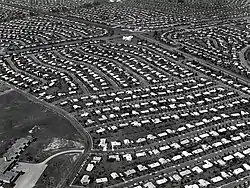
In Australia
Sprawling cities define the urban Australian landscape. The iconic "quarter-acre" block is often cited as fundamental to the Australian Dream; it has both cultural and political currency.[3] In 1901, the year of Australian Federation, "almost 70 per cent of Sydney’s population were living in the suburbs".[4]
There is a profound cynicism that exists in much commentary on suburbia that is promoted by "intellectuals and others seeking to delineate the suburb"[5] which has been characterised by "conformity, control and some sense of false consciousness".[6]
Suburbia bashing
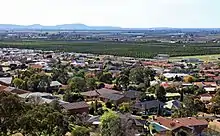
Despite the fact the majority of Australians still live in the suburbs, or maybe because of it, negative discourse about suburbia, often termed "suburbia bashing", perseveres in the mainstream media.[7] Dame Edna Everage typifies this as she demonstrates both "nostalgia and disdain for the Australian suburb and suburban life".[5]
Prominent journalist Allan Ashbolt satirised the suburb that represented Australian nationalism, rooted in the post-World War II era, as passive and uninspired, inscribed strongly in spatial terms. In 1966, he described Australian reality accordingly:
"Behold the man – the Australian of today – on Sunday morning in the suburbs when the high decibel drone of the motor-mower is calling the faithful to worship. A block of land, a brick veneer, and the motor-mower beside him in the wilderness – what more does he want to sustain him."[8]
Ashbolt, among others, represent a "tradition of abuse of the suburbs and of the majority of Australians" in Australian mainstream media.[9]
Suburbia vs the Australian bush
Suburbia bashing is entrenched in questions of national identity. Disparaging commentary about the suburbs often appears in contrast to the national mythology of the Australian bush. The landscape that is portrayed in the tourism advertisements, by poets and painters, does not represent the experience of the majority of Australians. The suburb and the bush are counterposed, "the bush (cast as the authentic Australian landscape) with the city (regarded as blighted foreign import)".[10] The bush landscape is a masculine construction of a more "authentic notion of Australian national identity" exemplified by the poetry of Henry Lawson.[4] Conversely, the suburb is feminised, epitomised by Dame Edna for more than fifty years, and more recently, by comedic team Jane Turner and Gina Riley in Kath & Kim.[4]
Australian ugliness
Architect and cultural critic, Robin Boyd, also criticised suburbia, referring to it as the "Australian ugliness".[1] Boyd observed a "pursuit of respectability" in suburban spaces.[1] Boyd writes of a contrived and superficial sense of place, centered on a "fear of reality":
"The Australian ugliness begins with fear of reality, denial of the need for the everyday environment to reflect the heart of the human problem, satisfaction with veneer and cosmetic effects. It ends in betrayal of the element of love and a chill near the root of national self-respect."[11]
The ugliness that Boyd describes is qualified as "skin deep".[12] However, in the tradition of suburbia bashing, he proposes that there is an emptiness of spirit that can be read through an uninformed appreciation for aesthetics.
More recently there has been suggestion of a "new Australian ugliness".[13] New suburban developments have seen the proliferation of what have become known as "McMansions". McMansions epitomise the suburbia that is attacked by Boyd for both its monotony and "featurism"[1] Journalist Miranda Devine refers to an elitist perception that those who live in such suburban assemblages display a "poverty of spirit and a barrenness of mind" that is derived from a politics of aesthetics and taste, as expressed by Boyd fifty years ago.[7] In this "new Australian ugliness" some commentators attribute a rise in consumer culture: "There’s a concern about over-consumption. But there’s little thought of why – beyond advertising-driven gullibility".[13] Academic Mark Peel has rejected notions of gullible "consuming" residents of new suburbs by explaining his own "choice" to move to Melbourne's outer suburbs.[13]
Peel alludes to a discourse of suburbia that is elitist, and is based on matters of taste which have translated into a socio-cultural divide. When Miranda Devine refers to the elites, she refers to an inner-city population.[7] The divide is between the urbanites and the suburbanites, and the conflict is over national identity.
See also
References
- Boyd (1960).
- Adams (2006), pp. 601–602.
- Horin (2005).
- Turnball (2008), pp. 15–32.
- Healy (1994).
- Simons (2005), p. 28.
- Devine (2004).
- Ashbolt (1966), p. 353.
- Simons (2005), pp. 11–36.
- Gleeson (2006).
- Boyd (1960), p. 225.
- Boyd (1960), p. 1.
- Peel (2007).
Bibliography
- Adams, L. J. (1 September 2006). "Sundown Towns: A Hidden Dimension of American Racism". Journal of American History. 93 (2): 601–602. doi:10.2307/4486372. ISSN 0021-8723. JSTOR 4486372.
- Ashbolt, Allan (December 1966). "Godzone 3: Myth and Reality". Meanjin Quarterly. 25.4: 353.
- Boyd, Robin (1960). The Australian Ugliness. Melbourne: Penguin Books.
- Devine, Miranda (24 October 2004). "Copping the bile in Kellyville". The Sun-Herald.
- Gleeson, Brendan (2006). The Australian Heartlands: Making Space for Hope in the Suburbs. Sydney: Allen and Unwin.
- Healy, Chris (1994). "xv". In Ferber, Sarah; Healy, Chris; McAuliffe, Chris (eds.). Beasts of Suburbia: Reinterpreting Cultures in Australian Suburbs. Melbourne: Melbourne University Press.
- Horin, Adele (4 August 2005). "The end of the mythical quarter-acre block". The Age.
- Peel, Mark (16 September 2007). "McMansions: The inside story of life on the outer". The Age.
- Simons, Margaret (2005). Schultz, Julianne (ed.). "Ties that Bind". Griffith Review: People Like Us. 8, Winter: 11–36.
- Turnball, Sue (2008). "Mapping the Vast Suburban Tundra: Australian comedy from Dame Edna to Kath and Kim". International Journal of Cultural Studies. 11.1: 15–32.