Sikandar Shah Miri
Sikandar Shah, who was also known as Sikandar Butshikan ("Sikandar, the Iconoclast"),[1] was the sixth sultan of the Shah Miri dynasty of Kashmir from 1389 to 1413.[2]
| Sikandar Shah | |||||
|---|---|---|---|---|---|
| Sultan of Kashmir Sultan al-Eazim | |||||
| 7th Sultan of the Shah Mir Sultanate | |||||
| Reign | 1389–1413 CE | ||||
| Coronation | 1389 | ||||
| Predecessor | Qutub-ud-Din | ||||
| Successor | Ali Shah | ||||
| Born | 1353 | ||||
| Died | 1413 | ||||
| |||||
| House | Shah Miri dynasty | ||||
| Religion | Sunni Islam | ||||
Sources
The only contemporaneous source that exists is portions of the Rajatarangini, which was written by Jonaraja and his disciple Srivara.[3][4]
Extant Persian sources, including Baharistan-i-shahi, Tohfatu'l-Ahbab and Tarikh-i-Kashmir corpus, were written relatively later. These were later used by authors starting from Abul Fazl, the first chronicler from outside Kashmir and Nizamuddin Ahmad to independent Persian chroniclers to colonial historians and Kashmiri Pandits, with different ideological proclivities, to produce varying strands of histories suiting different sociopolitical goals.[5]
Ascension
Because Sikandar was a minor at the time of his ascension to the throne, his mother Queen Sura (var. Subhata) had to act as a regent for some time.[2][4] During this regency, Sura consented to Prime Minister Rai Magre (var. Uddaka), who burned his own daughter and son-in-law Muhammad, son of a fellow minister Sahaka, on charges of conspiring against Sikandar.[4][7] Before Sikandar came to power, Magre went on to assassinate Haybat, Sikandar's younger brother, and Sahaka.[4][7]
Military campaigns
Except for a successful invasion of Ladakh under the command of Rai Magre, Sikandar did not annex any new territory.[2] Soon after this victory, Magre instigated a rebellion and assassinated Shobha's brother before turning against Sikandar with his loyal proteges.[4][7] The rebellion was ably suppressed and Magre was imprisoned, whence he committed suicide.[4][7]
A successful war was waged against Firuz, the ruler of Ohind (var. Udabhandapura, Sahibhanga) c. 1400 after he refused to recognize Sikandar's suzerainty. Sikandar went on to marry Firuz's daughter Mira (prob. Raksasavivaha) whilst giving away one of his daughters from Shobha for marriage to Firuz.[2] Another successful campaign was mounted against Pala Deo (var. Billadeva), the Rajah of Jammu, after he refused to pay taxes; Jasrath Khokhar was installed as a vassal and Sikandar again entered into a matrimonial alliance with his daughter whilst giving away another of his daughters from Shobha for marriage to Pala Deo.[2][4]
In December 1398, Sikandar was ordered to pay homage to Timur by his ministers during his camp on the banks of the Indus river, which though accepted by Sikandar, was not met after being judged by Timur to be way above Sikandar's capacities.[2][8] While the two did not meet, they shared a mutual admiration; Timur had gifted two elephants to Sikandar.[2][4]
Sociopolity
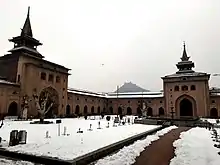
A welfare state was apparently installed; oppressive taxes were abolished whilst free schools and hospitals were opened for public use.[2] Waqfs were endowed to shrines, mosques (Khanqah-e-Moula, Jamia Masjid etc.) were commissioned, numerous Sufi preachers were provided with jagirs and installed in positions of authority; feasts were regularly held.[11][2][4][12] Economic condition was good enough.[4]
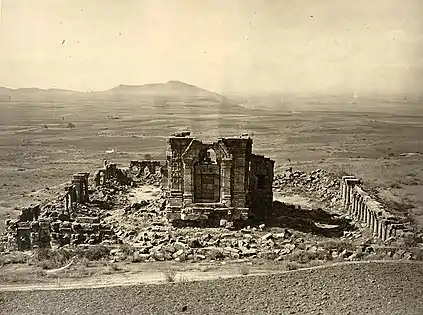
Sikandar's rule terminated Kashmir's long-standing syncretic and tolerant culture, and in its rigorous abidance of Sharia, he seems to have severely oppressed the Kashmiri Hindu population.[13][14][2][15][16][17] Music, dance, gambling, and intoxicants were prohibited and the office of Shaikhu'l-Islam was established to enforce these rules.[2] Brahmans were forcibly converted to islam, Hindu and Buddhist shrines of worship were destroyed, Sanskrit literature were purged, Jizya was imposed on those who objected to the abolition of hereditary varnas, and caste marks were prohibited.[2][14][18][9][4]
Motivations and analysis
Upon a literary reading of Rajatarangini, Sikandar's zeal behind the Islamisation of society is attributable to a Sufi preacher Mir Muhammad Hamadani, who arrived in the region from Huttalàn (present-day Tajikistan) and stayed for about 12 years during his term, advocating for the creation of a monolithic society based on Islam as the common denominator.[8][14][9] Sikandar's counsel, a neo-Brahman convert called Suhabhatta (var. Saifuddin), is held to have played a guiding role in the execution of those exclusionary orthodox policies by "instigating" the Sultan.[14][18][4][lower-alpha 1] Baharistan-i-shahi and Tohfatu'l-Ahbab deemed Sikandar as the noblest ruler, who cleansed Kashmir of all heretics and infidels under Hamadani's influence.[4][19]
Chitralekha Zutshi, Richard G. Salomon and others however reject the idea only religious motives lay behind Sikandar's actions and call for a nuanced contextual reading of Rajatarangini, a work that was commissioned by Sikandar's successor, who wished to bring back the Brahminical elite into the royal fold and establish Sanskrit as an integral part of the vernacularizing world of the cosmopolitan Sultanate.[20][1][7] According to Zutshi and Salomon, Sikandar's policies were guided by realpolitik[7] and, like with the previous Hindu rulers, were essentially an attempt to secure political legitimacy by asserting state power over Brahmans and gaining access to wealth controlled by Brahminical institutions.[20] The first stone sculpture of Kashmir and one of the finest in its history, a four-armed Brahma that has been dated to 1409, was sculpted during Sikandar's reign by a son of a Buddhist Sanghapati.[21]
Walter Slaje disagrees, in part, given the differential rituals of destruction undertaken by Hindu and Muslim kings with the latter rendering sites inoperable for long passages of time by massive pollution or outright conversion.[18][9] Slaje concludes the fierce opposition of Hindus to Muslim rulers, including Sikandar, primarily stemmed from their aversion to the slow disintegration of caste society under Islamic influence.[18][9] Fringe revisionist scholars completely reject the narratives of persecution, accusing the Brahman chroniclers of wanton bias and myth-making, stemming from their personal jealousy at losing socioeconomic dominance.[20][1]
Personal life
Sikandar is believed to have had a puritanical temperament, and abstained from wine, festivities, and music.[2]
Issues, death, and succession
Sikandar had at least four sons—Firuz, Mira who might had been adopted or exiled, Mir Khan, Shahi Khan, and Muhammad Khan (Shobha).[4] Sikandar also had at least two daughters from Sobha.[4]
Sikandar apparently met a prolonged and painful death, probably from elephantiasis, in April 1413. After his death, Sikandar's eldest son Mir'was anointed as the Sultan, having adopted the title of Ali Shah.[4] Two years later, Mir was succeeded by Shadi Khan, who adopted the name Zain-ul-Abidin.[14][1]
Legacy
Under Ali Shah's regime, Suhabhatta became the Prime Minister and persecution severely increased with forced conversions becoming commonplace, Hindu customs being banned, and Brahmans being prohibited to leave the territory.[4] With Suhabhatta being long dead from tuberculosis, a regime of tolerance were re-introduced under Zain-ul-Abidin; Hindu artists were provided with state-patronage, temples were rebuilt, Brahmans-in-exile were brought back, and neo-Muslims were allowed to convert back.[2][14][3][16][4] Tohfatu'l-Ahbab, writing in the 16th century, blamed the poor state of Islam in the valley on Zain.[19]
Despite these changes, the Islamisation of elite politics meant very few caste groups other than Brahmans took the opportunity of re-conversion[14] and a largely irreversible change set-in in post-Sikandar Kashmir.[18][16]
Notes
- Suhabhatta's daughter was also married off to Mir Hamadani.
References
- Obrock, Luther James (2015). Translation and History: The Development of a Kashmiri Textual Tradition from ca. 1000-1500 (Thesis). UC Berkeley.
- Hasan, Mohibbul (2005). Kashmīr Under the Sultāns. Aakar Books. pp. 59–95. ISBN 978-81-87879-49-7.
- Slaje, Walter (2004). Medieval Kashmir and the Science of History. South Asia Institute, University of Texas at Austin.
- Slaje, Walter (2014). Kingship in Kaśmīr (AD 1148‒1459) From the Pen of Jonarāja, Court Paṇḍit to Sulṭān Zayn al-‛Ābidīn. Studia Indologica Universitatis Halensis - 7. Germany. ISBN 3869770880.
- Zutshi, Chitralekha (7 July 2014). "A Literary Paradise : The Tarikh Tradition in Seventeenth- and Eighteenth-Century Kashmir". Kashmir's Contested Pasts: Narratives, Sacred Geographies, and the Historical Imagination. Oxford University Press. doi:10.1093/acprof:oso/9780199450671.003.0003. ISBN 978-0-19-945067-1.
- Local notice
- Salomon, Richard; Slaje, Walter (2016). "Review of Kingship in Kaśmīr (AD1148–1459). From the Pen of Jonarāja, Court Paṇḍit to Sulṭān Zayn al-ʿĀbidīn. Critically Edited by Walter Slaje with an Annotated Translation, Indexes and Maps. [Studia Indologica Universitatis Halensis 7], SlajeWalter". Indo-Iranian Journal. 59 (4): 393–401. doi:10.2307/26546259. ISSN 0019-7246.
- Ogura, Satoshi (2015). "INCOMPATIBLE OUTSIDERS OR BELIEVERS OF A DARŚANA?: REPRESENTATIONS OF MUSLIMS BY THREE BRAHMANS OF ŠĀHMĪRID KAŠMĪR". Rivista degli studi orientali. 88 (1/4): 179–211. doi:10.2307/24754113. ISSN 0392-4866.
- Slaje, Walter (2019). "What Does it Mean to Smash an Idol? Iconoclasm in Medieval Kashmir as Reflected by Contemporaneous Sanskrit Sources". Brahma's Curse : Facets of Political and Social Violence in Premodern Kashmir. Studia Indologica Universitatis Halensis - 13. pp. 30–40. ISBN 978-3-86977-199-1.
- Bilham, Roger; Bali, Bikram Singh; Bhat, M. Ismail; Hough, Susan (1 October 2010). "Historical earthquakes in Srinagar, Kashmir: Clues from the Shiva Temple at Pandrethan". doi:10.1130/2010.2471(10). Cite journal requires
|journal=(help) - Zutshi, Chitralekha (2003). "Contested Identities in the Kashmir Valley". Languages of Belonging: Islam, Regional Identity, and the Making of Kashmir. Permanent Black. ISBN 978-81-7824-060-2.
- Ahmad, Khalid Bashir (2017). "Malice". Kashmir: Exposing the Myth Behind the Narrative. London: SAGE. p. 32. doi:10.4135/9789353280253.
- Aggarwal, Neil (1 July 2008). "Kashmiriyat as Empty Signifier". Interventions. 10 (2): 222–235. doi:10.1080/13698010802145150. ISSN 1369-801X.
- AHMAD, AZIZ (1979). "CONVERSIONS TO ISLAM IN THE VALLEY OF KASHMIR". Central Asiatic Journal. 23 (1/2): 3–18. ISSN 0008-9192.
- Slaje, Walter (2019). "A Glimpse into the Happy Valley's Unhappy Past: Violence and Brahmin Warfare in Pre-Mughal Kashmir". Brahma's Curse : Facets of Political and Social Violence in Premodern Kashmir. Studia Indologica Universitatis Halensis - 13. p. 5. ISBN 978-3-86977-199-1.
- Witzel, Michael (September 1991). The Brahmins of Kashmir (PDF).
- Accardi, Dean (2017), Zutshi, Chitralekha (ed.), "Embedded Mystics: Writing Lal Ded and Nund Rishi into the Kashmiri Landscape", Kashmir: History, Politics, Representation, Cambridge: Cambridge University Press, pp. 247–264, ISBN 978-1-107-18197-7, retrieved 3 February 2021
- Slaje, Walter (19 August 2019). "Buddhism and Islam in Kashmir as Represented by Rājataraṅgiṇī Authors". Encountering Buddhism and Islam in Premodern Central and South Asia. De Gruyter. doi:10.1515/9783110631685-006. ISBN 978-3-11-063168-5.
- Zutshi, Chitralekha (2014). "Garden of Solomon : Landscape and Sacred Pasts in Kashmir's Sixteenth-Century Persian Narratives". Kashmir's Contested Pasts : Narratives, Sacred Geographies, and the Historical Imagination. Oxford University Press. ISBN 9780199450671.
- Zutshi, Chitralekha. "This book claims to expose the myths behind Kashmir's history. It exposes its own biases instead". Scroll.in. Retrieved 1 February 2021.
- Bhan, Jawahar Lal (2010). Kashmir Sculptures: An Iconographical Study of Brāhmanical Sculptures. 1. Delhi, India: Readworthy Publications. pp. 68–69.
 |
Wikiquote has quotations related to: Sikandar Shah Miri |
Authority control  | |
|---|---|
| General | |
| National libraries | |