Supriyo Datta
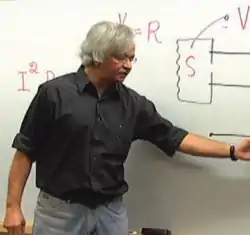
Supriyo Datta (b.1954) is an Indian born American researcher and author. A leading figure in the modeling and understanding of nano-scale electronic conduction,[1] he has been called "one of the most original thinkers in the field of nanoscale electronics."[2]
Supriyo Datta | |
|---|---|
 | |
| Born | 1954 |
| Nationality | United States |
| Alma mater | Indian Institute of Technology Kharagpur University of Illinois at Urbana–Champaign |
| Known for | Spintronics Non-Equilibrium Green Function (NEGF) method Molecular Electronics Negative Capacitance Probabilistic p-Bits |
| Awards | Presidential Young Investigator Award IEEE Leon K. Kirchmayer Award Frederick Terman Award IEEE Cledo Brunetti Award Procter Prize |
| Scientific career | |
| Fields | Quantum transport Mesoscopic physics |
| Institutions | Purdue University |
| Signature | |
 | |
As an author, his books are widely used as original research and design work in the field of nanotechnology and electronic devices.[3]
Early life and education
Dr. Datta did his schooling from Hindi High School in Kolkata, India. He was first in the whole West Bengal Board of Secondary Education exam in 1970. Datta received his B.Tech with the President of India gold medal from the Indian Institute of Technology in Kharagpur, India in 1975. He then received both his MS and PhD from the University of Illinois at Urbana-Champaign in 1977 and 1979 respectively.
In 1981, he joined Purdue University, where he is (since 1999) the Thomas Duncan Distinguished Professor in the School of Electrical Engineering.
Career
He started his career in the field of ultrasonics and was selected by the Ultrasonics group as its outstanding young engineer to receive an IEEE Centennial Key to the Future Award and by the ASEE to receive the Terman Award for his book on Surface Acoustic Wave Devices.
Since 1985 he has focused on current flow in nanoscale electronic devices and is well known for the approach he pioneered for the description of quantum transport far from equilibrium, combining the non-equilibrium Green's function (NEGF) formalism of many-body physics with the Landauer formalism from Mesoscopic physics.
He was elected as a member into the National Academy of Engineering in 2012 for quantum transport modeling in nanoscale electronic devices .
In 1990 he proposed the use of spin-orbit coupling to control electron spin with an electric field rather than a magnetic field. This was experimentally demonstrated in 1997 and is widely used in the field of spintronics. This "proposal planted the idea that spin could be used in its own right as a means to carry and manipulate information — and gave birth to the new field of spintronics."* Milestone 20 in the history of spin'
In 2008, along with Sayeef Salahuddin he proposed the concept of negative capacitance devices , which is now considered a prime candidate for reducing dissipation and extending Moore's law.
Awards
In 2011 he received the William Procter prize for Scientific Achievement William Procter Prize for Scientific Achievement
He is a Fellow of the American Physical Society (APS) as well as the Institute of Electrical and Electronics Engineers (IEEE) and has received two IEEE technical field awards: the 2002 IEEE Cledo Brunetti Award[4] and the 2008 IEEE Leon K. Kirchmayer Graduate Teaching Award.[5]
He is included in Purdue's Book of Great Teachers and won the "Herbert Newby McCoy Award", given by Purdue University to the faculty member ... making the greatest contribution of the year to science.[6][7]
He received the Frederick Emmons Terman Award from the American Society of Engineering Education in 1994,[8] and the Presidential Young Investigator Award from the National Science Foundation, 1984.
Books
- Lessons from Nanoelectronics ISBN 9789814335287
- Quantum Transport: Atom to Transistor ISBN 978-0-521-63145-7
- Electronic Transport in Mesoscopic Systems: Cambridge Studies in Semiconductor Physics and Microelectronic Engineering ISBN 978-0-521-59943-6
- Quantum Phenomena:Modular Series on Solid State Devices, Vol 8 ISBN 978-0-201-07956-2
- Surface Acoustic Wave Devices ISBN 978-0-13-877911-5
References
- Supriyo Datta at IEEE
- Biography at Sigma Xi
- Author Bibliography Amazon.com
- "IEEE Cledo Brunetti Award Recipients" (PDF). IEEE. Retrieved March 23, 2011.
- "IEEE Leon K. Kirchmayer Graduate Teaching Award Recipients" (PDF). IEEE. Retrieved March 23, 2011.
- "The Herbert Newby McCoy Award". Purdue University. Archived from the original on March 23, 2012. Retrieved March 23, 2011.
- "Past McCoy Award Recipients". Purdue University. Archived from the original on June 8, 2010. Retrieved March 23, 2011.
- "Past Frederick Emmons Terman Award Winners". American Society for Engineering Education. Retrieved March 23, 2011.
External links
- 23 milestones in the history of spin compiled by Nature
- Milestone 20: Information in a Spin: Proposal of Spin-FET, compiled by Nature
- Supriyo Datta at Sigma Xi
- Supriyo Datta at nanoHUB
- Indian Institute of Technology Distinguished Alumni
- Nanohub.org Profile
- NanoHUB-U Course Fundamentals of Nanoelectronics
- Profile at Purdue University
Authority control  | |
|---|---|
| General | |
| National libraries | |
| Other | |