Suryakant Tripathi
Suryakant Tripathi "Nirala" (21 February 1896 – 15 October 1961) was an Indian poet, novelist, essayist and story-writer who wrote in Hindi. He also drew many sketches.
Suryakant Tripathi | |
|---|---|
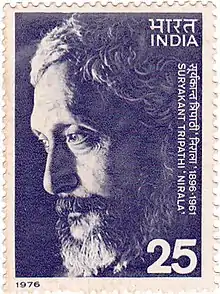 Tripathi on a 1976 stamp of India | |
| Born | 21 February 1896 Midnapore, Bengal Presidency, British India |
| Died | 15 October 1961 (aged 65) Allahabad, Uttar Pradesh, India |
| Pen name | Nirala |
| Occupation |
|
| Nationality | Indian |
| Period | Chhayavaad |
| Notable works | Saroj Smriti, Raam Ki Shaktipuja |
| Spouse | Manohara Devi |
 Literature portal Literature portal | |
Biography
Nirala's life, barring short periods, was one long sequence of misfortunes and tragedies. His father, Pandit Ramsahaya Tripathi, was a government servant and was a tyrannical person. His mother died when he was very young. Nirala was educated in the Bengali medium at Mahishadal Raj High School at Mahishadal, Purba Medinipur.[1]
After his marriage at a young age (his age is 20), Nirala learned Hindi at the insistence of his wife, Manohara Devi. Soon, he started writing poems in Hindi, instead of Bengali. After a bad childhood, Nirala had a few good years with his wife. But this phase was short-lived as his wife died when he was 20, and later his daughter (who was a widow) also expired. Nirala lost half of his family, including his wife and daughter, in 1918 Spanish flu influenza outbreak.[2][3]
Most of his life was somewhat in the bohemian tradition. He wrote strongly against social injustice and exploitation in society. Since he was more or less a rebel, both in form and content, acceptance did not come easily. What he got in plenty was ridicule and derision. All this may have played a role in making him a victim of schizophrenia in his later life and he was admitted to Central Institute of Psychiatry, Ranchi.[4]
Work
Many of Nirala's poems have been translated by the late scholar, David Rubin, which are available in the collections, A Season on the Earth: Selected Poems of Nirala (Columbia University Press, 1977), The Return of Sarasvati: Four Hindi Poets (Oxford University Press, 1993), and Of Love and War: A Chayavad Anthology (Oxford University Press, 2005). Nirala : Aatmhanta Astha was a critical analysis of his works written by Doodhnath Singh.[5]
Legacy
Today, a park, Nirala Uddyan, an auditorium, Nirala Prekshagrah, and a degree college, Mahapran Nirala Degree College, in the Unnao District are named after him.[6]
In popular culture
The Films Division of India produced a short documentary film on his life, titled Suryakant Tripathi Nirala, directed by Rajiv Kumar it covers his works and achievements.[7]
Reception
Eugenia Vanina notes ‘Mahārāj Śivājī kā patr Mirzā Rājā Jai Siṅgh ke nām’ to endear its audience into Hindu Nationalism.[8]
Works
Poetry
- Ram Ki Shakti Puja (राम की शक्ति पूजा)
- Dhwani (ध्वनि)
- Apara (अपरा)
- Saroj Smriti (सरोज स्मृति)
- Parimal (परिमल)
- Priyatam (प्रियतम)
- Anaamika (अनामिका, 1938)
- Geetika (गीतिका)
- Kukurmutta (कुकुरमुत्ता, 1941)
- Adima (अणिमा)
- Bela (बेला)
- Naye Patte (नये पत्ते)
- Archana (अर्चना)
- Geet Gunj (गीतगुंज)
- Aradhana (आराधना)
- Tulsidas (तुलसीदास, 1938)
- Janmabhumi (जन्मभूमि)
- Jago Phir Ek Bar (जागो फिर एक बार)
- Bhikshuk (भिक्षुक)
- Todti Patthar (तोड़ती पत्थर)
Novels
- Apsara (अप्सरा)
- Alka (अलका)
- Prabhavati (प्रभावती)
- Nirupama (निरुपमा)
- Chameli (चमेली)
- Choti ki Pakad (चोटी की पकड़)
- Indulekha (इन्दुलेखा)
- Kale Karname (काले कारनामे)
Collections of stories
- Chhaturi Chamar (चतुरी चमार)
- Sukul ki Biwi (सुकुल की बीवी, 1941)
- Sakhi (साखी)
- Lily (लिली)
- Devi (देवी)
Essay-collections
- Prabandha-Parichaya (प्रबंध परिचय)
- Bangbhasha ka Uchcharan (बंगभाषा का उच्चारण)
- Ravindra-Kavita-Kannan (रवीन्द्र-कविता-कानन)
- Prabandh-Padya (प्रबंध पद्य)
- Prabandh-Pratima (प्रबंध प्रतिमा)
- Chabuk (चाबुक)
- Chayan (चयन)
- Sangraha (संग्रह)
Prose
- Kullibhat (कुल्लीभाट)
- Billesur Bakriha (बिल्लेसुर बकरिहा)
Translations
- Anand Math (आनन्दमठ)
- Vish-Vriksh (विष वृक्ष)
- Krishnakant ka Vil (कृष्णकांत का विल)
- Kapal Kundala (कपाल कुण्डला)
- Durgesh Nandini (दुर्गेश नन्दिनी)
- Raj Singh (राज सिंह)
- Raj Rani (राज रानी)
- Devi Chaudharani (देवी चौधरानी)
- Yuglanguliya (युगलांगुलीय)
- Chandrasekhar (चन्द्रशेखर)
- Rajni (रजनी)
- Sri Ramkrishna Vachnamrit (श्री रामकृष्ण वचनामृत)
- Bharat mein Vivekanand (भारत में विवेकानंद)
- Rajyog (राजयोग)
References
- "Mahishadal Raj College". College Admission. Retrieved 9 April 2019.
- "How literature has helped us make sense of pandemics".
- "References to death and disease in Hindi literature". 12 April 2020.
- निराला, नज़रुल, मजाज़ भी रहे हैं रांची पागलखाने में – BBC News हिंदी. Bbc.com. Retrieved on 13 December 2018.
- "Nirala : Aatmhanta Astha". Rajkamal Prakashan. Retrieved 14 January 2018.
- Famous Personalities Archived 16 October 2013 at the Wayback Machine Unnao district Official website.
- "SURYAKANT TRIPATHI NIRALA | Films Division". filmsdivision.org. Retrieved 12 June 2021.
- Vanina, Eugenia (14 September 2020). "'Blackened face': Emotional Community and the Hindu Nationalist Interpretation of History". Emotions: History, Culture, Society. 4 (1): 66–90. doi:10.1163/2208522X-02010078. ISSN 2206-7485.
External links
- Nirala at Kavita Kosh – A large collection of Hindi Poetry
Authority control  | |
|---|---|
| General | |
| National libraries | |
| Other | |