Social sustainability
Social sustainability is the least defined and least understood of the different ways of approaching sustainability and sustainable development. Social sustainability has had considerably less attention in public dialogue than economic and environmental sustainability. There are several approaches to sustainability. The first, which posits a triad of environmental sustainability, economic sustainability, and social sustainability, is the most widely accepted as a model for addressing sustainability. The concept of "social sustainability" in this approach encompasses such topics as: social equity, livability, health equity, community development, social capital, social support, human rights, labour rights, placemaking, social responsibility, social justice, cultural competence, community resilience, and human adaptation.
.jpg.webp)
A second approach suggests that all of the domains of sustainability are social: including ecological, economic, political and cultural sustainability. These domains of social sustainability are all dependent upon the relationship between the social and the natural, with the "ecological domain" defined as human embeddedness in the environment. In these terms, social sustainability encompasses all human activities.[2] It is not just relevant to the focussed intersection of economics, the environment and the social.[3]
Definitions
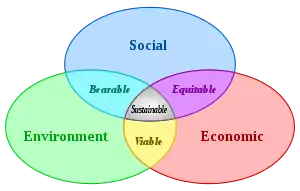 |
| Venn diagram of sustainable development: at the confluence of three constituent parts[4] |
According to the Western Australia Council of Social Services (WACOSS):[5] "Social sustainability occurs when the formal and informal processes; systems; structures; and relationships actively support the capacity of current and future generations to create healthy and liveable communities. Socially sustainable communities are equitable, diverse, connected and democratic and provide a good quality of life."
Another definition has been developed by Social Life,[6] a UK-based social enterprise specialising in place-based innovation. They define social sustainability as "a process for creating sustainable, successful places that promote wellbeing, by understanding what people need from the places they live and work. Social sustainability combines design of the physical realm with design of the social world – infrastructure to support social and cultural life, social amenities, systems for citizen engagement and space for people and places to evolve."[7]
Dimensions

Social Life have developed a framework for social sustainability[8] which has four dimensions: amenities and infrastructure, social and cultural life, voice and influence, and space to grow.[7]
Nobel Laureate Amartya Sen gives the following dimensions for social sustainability:[9]
- Equity - the community provides equitable opportunities and outcomes for all its members, particularly the poorest and most vulnerable members of the community
- Diversity - the community promotes and encourages diversity
- Interconnected/Social cohesions - the community provides processes, systems and structures that promote connectedness within and outside the community at the formal, informal and institutional level
- Quality of life - the community ensures that basic needs are met and fosters a good quality of life for all members at the individual, group and community level (e.g. health, housing, education, employment, safety)
- Democracy and governance - the community provides democratic processes and open and accountable governance structures.
- Maturity - the individual accept the responsibility of consistent growth and improvement through broader social attributes (e.g. communication styles, behavioural patterns, indirect education and philosophical explorations)
The different aspects of social sustainability are often considered in socially responsible investing (SRI). Social sustainability criteria that are commonly used by SRI funds and indexes to rate publicly traded companies include: community, diversity, employee relations, human rights, product safety, reporting, and governance structure.[10][11]
Design has been identified as a key strategic tool for achieving social sustainability.[12]
| Library resources about Social sustainability |
Application and verification
The UN Guiding Principles on Business and Human Rights state that countries have the obligation to “respect, protect, and fulfill human rights and fundamental freedoms” and that business enterprises are required to comply with all applicable laws and respect human rights.[13] Both production and procurement of goods and services should be documented to verify satisfaction of these international principles and laws.[14]
The UN Guiding Principles also include a reporting framework,[15] which teaches companies how to report their interaction with human rights issues. In addition resources like Free2Work,[16] the Global Reporting Initiative, and Business and Human Rights Resource Centre all provide information on organizational disclosures and performance in social sustainability.[17] Certifications from internationally recognized and accredited organizations are available to aid in verifying the social sustainability of products and services. The Forest Stewardship Council (paper and forest products),[18] and Kimberly Process (diamonds) are examples of such organizations and initiatives.[19]
Application of social sustainability requires stakeholders to look at human and labor rights, prevention of human trafficking, and other human rights risks.[20] These issues should be considered in production and procurement of various worldwide commodities. Many industries have organizations in place that aid in verifying the social sustainability of products and services.[21] The Equator Principles (financial industry), Fair Wear Foundation (garments), and Electronics Industry Citizenship Coalition are examples of such organizations and initiatives. Resources are also available for verifying the life-cycle of products and the producer or vendor level.[20]
Case Studies from Australia and the Asia Pacific
Promoting Traditional Knowledge in Conservation: The Role of The Borobudur Conservation Office
The Borobudur Conservation Office (BCO) engages with various communities across Indonesia to explore traditional conservation methods based on plant-derived materials. BOC researchers embed traditional knowledge into its social and natural context by ethnographic methods. Resulting publications have inspired scientific research on plant-derived traditional materials. Findings have led to the production of biodegradable and conservation grade essential oil mixes used by both traditional custodians and conservation professionals.[22]
Connecting objects, communities and cultural knowledge
Two-way knowledge sharing between community-run museums and conservation professionals enhances the interpretation and social/historical value of cultural material. The collaboration between conservation experts and the Returned and Services League LifeCare War Museum in Narrabeen and Islamic Museum of Australia in Melbourne is grounded within the contact zone theory framework.[23]
For mutual benefit: cultural materials conservation and local government—a case study
The partnership between the Bathurst Regional Council and the Grimwade Centre at the University of Melbourne is presented as a model for community-based conservation. This partnership has been mutually beneficial for the regional community and the professional conservation community as the various projects presented a learning opportunity for emerging conservators while at the same time providing the community access to conservation expertise.[24]
Partnering with Aboriginal and Torres Strait Islander communities for the conservation of First Nations cultural heritage
Collaboration with Aboriginal and Torres Strait Islander communities in Australia is grounded in the key document A Guide to applying The AIATSIS Code of Ethics for Aboriginal and Torres Strait Islander Research (2020).[25] The code emphasizes the need to respect and recognise Aboriginal and Torres Strait Islander peoples’ right to be involved in any activity such as research and conservation that may have an impact on Indigenous communities. The code outlines the four principles which frame collaboration and partnership projects with Indigenous communities:
- Indigenous self-determination
- Indigenous leadership
- Impact and value
- Sustainability and accountability
The fourth principle of sustainability states the need for collaboration and partnership to address the present and future needs of Aboriginal and Torres Strait Islander peoples. In determining these needs, the four pillars of sustainability are considered:
- Environmental
- Cultural
- Social
- Economically
Any research or conservation project needs to recognise the importance of the connection to land and water for Indigenous peoples’ identity and survival. Partnership and research activities should ideally contribute to this connection or at the least not harm it.
Other ethical considerations in working with Indigenous people are:
- Data / knowledge collected during the project should be made available for use by Indigenous communities
- Material should be returned to the community for archiving or safe keeping
- Researchers are to be held accountable for the quality and impact of their research on communities
- The relationship with the community must ideally be nurtured beyond the scope of the immediate projects and long-term benefits of the relationship must be considered
Case studies from Australia
Boorun's Canoe
Boorun's Canoe was an art project which involved the building and floating of a traditional bark canoe. The conservator worked with the Aboriginal Elder and his family members from the beginning of the process through to the acquisition of the canoe by Museum Victoria and the relationship extended into the continued care of this heritage object. The project enabled the intergenerational transfer of cultural knowledge and demonstrated the positive outcomes of respectful and culturally sensitive collaboration with Indigenous communities.[26]
Reconstructing the archive: Access, documentation, conservation
Two case studies based on research conducted by phenomenological methodology are presented. The artist-run archive of Warlayirti Artists' Centre in Balgo and the performative works of the Australian artist Brook Andrew aim to disrupt the hegemony of text-based colonial archives to reclaim control of Indigenous subjectivities. Reconstruction is put forward as an ethical conservation approach in the preservation of such performative artworks and archives. Key to this approach is the artist interview tool which helps to incorporate the artist’s view of reconstruction to the conservation process.[27]
Bark paintings conservation: Eucalyptus tetrodonta properties, bark harvesting and various mounting systems in the Northern Territory
A review of the evolution of the bark painting mounting methods that are developed and/or used by the Museum and Art Gallery of the Northern Territory (MAGNT) is provided. The review references the traditional bark harvesting and preparation processes demonstrated by traditional owners. The aluminium mounting technique is recommended based on the traditional knowledge of the qualities of the bark.[28]
The Significance of Continuity and Change: Understanding and Preserving Aboriginal Catholic Church Art in Wadeye
This case study highlights the broader challenges in conserving art held in remote Indigenous communities. Funding for the conservation of Indigenous artworks which are at risk of irreversible deterioration is very much dependent on these works fulfilling the primary and comparative criteria of the Significance 2.0 framework. The article discusses the limitations of this framework in the context of the Old Church Paintings by the Indigenous artist Nym Bunduck.[29]
References
- http://citiesprogramme.com/archives/resource/circles-of-sustainability-urban-profile-process Liam Magee; Andy Scerri; Paul James; James A. Thom; Lin Padgham; Sarah Hickmott; Hepu Deng; Felicity Cahill (2013). "Reframing social sustainability reporting: Towards an engaged approach". Environment, Development and Sustainability.
- James, Paul; with Magee, Liam; Scerri, Andy; Steger, Manfred B. (2015). Urban Sustainability in Theory and Practice: Circles of Sustainability. London: Routledge.
- Liam Magee; Andy Scerri; Paul James; James A. Thom; Lin Padgham; Sarah Hickmott; Hepu Deng; Felicity Cahill (2013). "Reframing social sustainability reporting: Towards an engaged approach". Environment, Development and Sustainability.
- Adams, W.M. (2006). "The Future of Sustainability: Re-thinking Environment and Development in the Twenty-first Century." Report of the IUCN Renowned Thinkers Meeting, 29–31 January 2006. Retrieved on: 2009-02-16.
- "Home | Social Life". www.social-life.co. Retrieved 2019-06-19.
- "Design for Social Sustainability | Social Life". www.social-life.co. Retrieved 2019-06-19.
- KLD Research. Environmental, Social and Governance Rating Criteria. 2007
- The Combined Code on Corporate Governance, June 2008
- Corsini, L. & Moultrie, J. (2019) Design for social sustainability: using digital fabrication in the humanitarian and development sector. Sustainability. https://doi.org/10.3390/su11133562
- United Nations Human Rights, Office of the Commissioner. "Guiding Principles on Business and Human Rights" (PDF). United Nations, New York and Geneva. Retrieved 10 March 2016.
- "Verifying Delivery of Sustainable Products and Services - GSA Sustainable Facilities Tool". sftool.gov. Retrieved 2016-03-10.
- "UN Guiding Principles Reporting Framework". www.ungpreporting.org. Retrieved 2016-03-10.
- Free2Work
- "Social Sustainability - GSA Sustainable Facilities Tool". sftool.gov. Retrieved 2016-03-10.
- "In Ivory Coast, the school as a bulwark against child labour". ICI Cocoa Initiative. Retrieved 2019-06-19.
- "Social Sustainability Initiatives, Guidelines, and Standards - GSA Sustainable Facilities Tool". sftool.gov. Retrieved 2016-03-10.
- "Resources for Verifying Sustainable Products – GSA Sustainable Facilities Tool". sftool.gov. Retrieved 2016-03-10.
- "Social Sustainability Initiatives, Guidelines, and Standards – GSA Sustainable Facilities Tool". sftool.gov. Retrieved 2016-03-10.
- Bakhri, Saiful (2020-07-02). "Promoting Traditional Knowledge in Conservation: The Role of The Borobudur Conservation Office". AICCM Bulletin. 41 (2): 95–105. doi:10.1080/10344233.2020.1867360. ISSN 1034-4233.
- Lewincamp, Sophie; Sloggett, Robyn (2016-01-02). "Connecting objects, communities and cultural knowledge". AICCM Bulletin. 37 (1): 3–13. doi:10.1080/10344233.2016.1206288. ISSN 1034-4233.
- Sloggett, Robyn; Middleton, Janelle (2018-01-02). "For mutual benefit: cultural materials conservation and local government—a case study". AICCM Bulletin. 39 (1): 65–73. doi:10.1080/10344233.2018.1544328. ISSN 1034-4233.
- Studies, Australian Institute of Aboriginal and Torres Strait Islander (2021-06-04). "Code of Ethics". aiatsis.gov.au. Retrieved 2021-11-10.
- Hamilton, Samantha; Paton, Steaphan (2015-07-03). "Boorun's Canoe". AICCM Bulletin. 36 (2): 105–115. doi:10.1080/10344233.2015.1111642. ISSN 1034-4233.
- Meredith, Ainslee; Sloggett, Robyn; Healy, Jacqueline (2016-01-02). "Reconstructing the archive: Access, documentation, conservation". AICCM Bulletin. 37 (1): 14–25. doi:10.1080/10344233.2016.1205837. ISSN 1034-4233.
- Nolan, Lisa (2018-07-03). "Bark paintings conservation: Eucalyptus tetrodonta properties, bark harvesting and various mounting systems in the Northern Territory". AICCM Bulletin. 39 (2): 96–106. doi:10.1080/10344233.2018.1491090. ISSN 1034-4233.
- Waters-Lynch, Isabelle; Sloggett, Robyn; Crocombe, Mark; Melpi, Leo (2015-06-01). "The Significance of Continuity and Change: Understanding and Preserving Aboriginal Catholic Church Art in Wadeye". AICCM Bulletin. 36 (1): 13–22. doi:10.1179/1034423315Z.0000000006. ISSN 1034-4233.
Sources
- Hicks, 1997 D.A. Hicks, The inequality-adjusted human development index: a constructive proposal, World Development 25 (8) (1997), pp. 1283–1298.
- Hinterberger, F., et al. (1999) Sustainable Human Development Index. A suggestion for Greening the UN Indicator of Social and Economic Welfare, Wuppertal Institute, Wuppertal.
- Magee, Liam, Andy Scerri, Paul James, James A. Thom, Lin Padgham, Sarah Hickmott, Hepu Deng, Felicity Cahill (2013). "Reframing social sustainability reporting: Towards an engaged approach". Environment, Development and Sustainability.CS1 maint: multiple names: authors list (link)
- Magee, Liam; James, Paul; Scerri, Andy (2012). "Measuring Social Sustainability: A Community-Centred Approach". Applied Research in the Quality of Life. 7 (3): 239–61. doi:10.1007/s11482-012-9166-x.
- Woodcraft, S., et al. (2012) Design for Social Sustainability, Social Life, London.
- Partridge, E. (2005)‘Social sustainability’: a useful theoretical framework? Paper presented at the Australasian Political Science Association Annual Conference 2005, Dunedin, New Zealand, 28–30 September 2005
- Dugarova, Esuna; et al. (2014). "Social Drivers of Sustainable Development". UNRISD, Geneva. Cite journal requires
|journal=(help) - United Nations Development Programme (various years) Human Development Report, Oxford University Press, Oxford.
- World Bank (1992) World Development Report 1992: Development and the Environment, Oxford University Press, New York.
- World Commission on Environment and Development (1987) Our Common Future, Oxford University Press, Great Britain.
- World Economic Forum (2002) Environmental Sustainability Index, Columbia University .
External links
- UNDP
- SocialSustainable.org - Newsfeed website with global Social & Sustainability topics
- AICCM Sustainable Collections Wiki

