Swedish Rhapsody (numbers station)
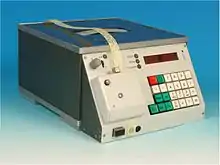
Swedish Rhapsody is a well known numbers station, operated by the Służba Bezpieczeństwa (Later Agencja Wywiadu) that used AM broadcasting and operated between the late 1950s and 1998. It was used to send coded messages to intelligence agents in the Western Bloc. It is notorious for its use of what was once believed to be the voice of a young girl speaking in German, only revealed to be that of a special machine used by the East German Stasi known as the "Sprach-Morse-Generator".[1]
| Broadcast area | Poland |
|---|---|
| Frequency | Several shortwave frequencies between 5.733 and 11.525 MHz |
| Programming | |
| Language(s) | German |
| Format | Numbers station |
| Affiliations | Służba Bezpieczeństwa (Speculated) |
| Ownership | |
| Owner | Służba Bezpieczeństwa (Speculated) |
The numbers station is named for its signature melody, Swedish Rhapsody No. 1 by Hugo Alfvén, recorded from a music box manufactured by Reuge, although Agencja Wywiadu claimed that the melody is the "Luxembourg Polka". It was well known by listeners to follow a rigid schedule, with interruptions and mistakes on the part of the operators being rare.[2]
Although the station was of unknown origin during the Cold War, declassified documents released by the Polish Government in 2014 revealed that the station was indeed operated by the government of the Polish People's Republic, and it's secret police force, the Służba Bezpieczeństwa. The Stasi "Sprach-Morse Generator" which provided the automated voice was of East German origin, and known to be used in similar coded broadcasts sent by the Main Directorate for Reconnaissance. Although the East German broadcasts are similar, the voice used for the Swedish Rhapsody was created by tweaking the audio on the Sprach machine, which confused listeners into thinking that the voice was that of a young girl. The documents further reveal that the station was broadcasting from at least the 1970's and transmitted on numerous shortwave frequencies, which were often changed depending on the time of the year. The messages were sent as numbers in groups of five, spoken in german, which were preceded by the voice shouting "Achtung!" (German for "attention!"). The messages were to be decrypted using a one-time pad.[3]
After the dissolution of the Soviet Union in 1991 the original station ceased operations. However, as late as 1998 a similar station could be heard broadcasting, likely for NATO agents in Eastern Europe.[4][5][6][7]
References
- Staal, Peter (19 July 2010). "Number Stations Revealed - Final: Swapping datacards and the interior".
- https://priyom.org/number-stations/german/g02
- http://numbersoddities.nl/N&O-200.pdf#page=3
- https://priyom.org/number-stations/german/g02
- "G02 – Swedish Rhapsody". www.numbers-stations.com . 12 February 2016. Retrieved 5 November 2017.
- "5 Creepy Number Stations That No One Can Explain". The Ghost Diaries. May 2015. Retrieved 5 November 2017.
- "SEEMS LEGIT: Static, Strange Voices, And The Mysterious Purpose Of Numbers Stations". xoJane. Time Inc. 12 November 2013. Retrieved 5 November 2017.