Switched video
Switched video or switched digital video (SDV), sometimes referred to as switched broadcast (SWB), is a telecommunications industry term for a network scheme for distributing digital video via a cable. Switched video sends the digital video in a more efficient manner so that additional uses may be made of the freed up bandwidth. The scheme applies to digital video distribution both on typical cable TV systems using QAM channels, or on IPTV systems.
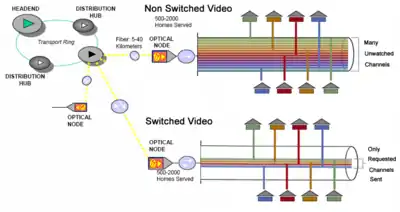
Description
In hybrid fibre-coaxial systems, a fiber optic network extending from the operator's head end carries all video channels out to a fiber optic node which services any number of homes ranging from 1 to 2000. From this point, all channels are sent via coaxial cable to each of the homes. Note that only a percentage of these homes are actively watching channels at a given time. Rarely are all channels being accessed by the homes in the service group.
In a switched video system, the unwatched channels do not need to be sent.
In cable TV systems in the United States, equipment in the home sends a channel request signal back to the distribution hub. If a channel is not currently being transmitted on the coaxial line, the distribution hub allocates a new QAM channel and transmits the new channel to the coaxial cable via the fiber optic node. For this to work, the equipment in the home must have two-way communication ability. Switched video uses the same mechanisms as video on demand and may be viewed as a non-ending video on demand show that any number of users may share.
Technical
Two-way communication is handled differently between cable and IPTV schemes. IPTV uses Internet communication protocols but requires an entirely new video distribution infrastructure. Cable companies in the United States elected the less costly approach of upgrading existing infrastructure, and European operators may well take the same approach. In the upgrade approach, various proprietary schemes use specific frequencies for passing messages back to the distribution hub.
For a switched video system to work on cable systems, all digital television users in a subscription group must have devices capable of communicating to the distribution hub in a compatible manner. Unlike other features dependent on two-way communication such as video on demand, the requirement to upgrade all digital set-top boxes within a group makes conversion to switched video extremely expensive. CableLabs proposed in the CableCARD 2.0 specification that two-way communication be supported with a scheme which required more powerful hardware capable of running Java programs. Many cable companies have indicated they will build lower cost devices that do not require this OCAP programming environment, so that upgrading to a switched video system would not be as costly. Consumer electronics companies also prefer a more light weight solution for two-way communication, and so absent a standard for two-way communication, the conversion to switched video may require many years to complete.
History
BigBand Networks (acquired by Arris Group in 2011[1]) was the first pioneer in the field of switched video, and received the Technology & Engineering Emmy Award in 2008 for innovation in the HFC market.[2]
Major vendors like Arris Group and Cisco also provide SDV solutions for the cable operators. There is also an emerging market for back office applications to analyze and control the performance of SDV systems. Smaller vendors are starting to offer alternate solutions fully compatible with the major vendors technology.
References
- "ARRIS ACQUIRES BIGBAND NETWORKS IN ALL CASH TRANSACTION".
- "Winners of the 59th Technology and Engineering Emmy Awards". Archived from the original on 2008-05-09. Retrieved 2011-03-28.
External links
- Definition of switched video - PC Magazine Overview
- Switched Digital Video Architecture Guide - Cisco White Paper
- How Switched Digital Video Works - HowStuffWorks.com Outline
- Using Bandwidth More Efficiently with Switched Digital Video - Motorola White Paper (archived)