Sjafruddin Prawiranegara
Sjafruddin Prawiranegara (also written Syafruddin Prawiranegara; 28 February 1911 – 15 February 1989) was an Indonesian statesman and economist. He served as the head of government in the Emergency Government of the Republic of Indonesia, as Minister of Finance in several cabinets, and was the first Governor of Bank Indonesia between 1951 and 1958. He was also the prime minister of the Revolutionary Government of the Republic of Indonesia (a shadow government set up in opposition to the central government of Indonesia).
Syafruddin Prawiranegara | |
|---|---|
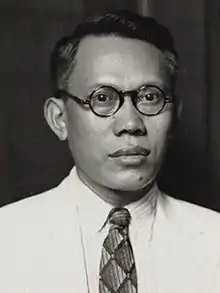 Sjafruddin Prawiranegara, c. 1940s | |
| Head of the Emergency Government of the Republic of Indonesia[lower-alpha 1] | |
| In office 22 December 1948 – 13 July 1949 | |
| Preceded by | Sukarno |
| Succeeded by | Sukarno |
| 5th Minister of Finance | |
| In office 2 October 1946 – 26 June 1947 | |
| Prime Minister | Sutan Sjahrir |
| Preceded by | Surachman Tjokroadisurjo |
| Succeeded by | Alexander Andries Maramis |
| In office 20 December 1949 – 20 March 1951[lower-alpha 2] | |
| Prime Minister | Mohammad Hatta Mohammad Natsir |
| Preceded by | Lukman Hakim |
| Succeeded by | Jusuf Wibisono |
| 5th Minister of Prosperity | |
| In office 29 January 1948 – 19 December 1948[lower-alpha 3] | |
| Prime Minister | Mohammad Hatta |
| Preceded by | Adenan Kapau Gani |
| Succeeded by | Ignatius Joseph Kasimo Hendrowahyono |
| 1st Governor of Bank Indonesia | |
| In office 15 July 1951[lower-alpha 4] – 1958 | |
| Preceded by | A. Houwink (De Javasche Bank) |
| Succeeded by | Lukman Hakim |
| Personal details | |
| Born | 28 February 1911 Serang Regency, Banten, Dutch East Indies |
| Died | 15 February 1989 (aged 77) Jakarta, Indonesia |
| Political party | Masyumi |
| Spouse(s) | T. Halimah Syehabuddin Prawiranegara |
| Signature |  |
Originating from Banten with Minangkabau ancestry, Sjafruddin did not become active in politics until after his education in law. By 1940, he was working at a tax office, and became engaged in nationalist movements. Due to his work and closeness to Sutan Sjahrir, he became involved in the Republican government as a finance minister during the Indonesian National Revolution of 1945–1949. In this capacity, he formulated and distributed the Oeang Republik Indonesia, a predecessor to the Indonesian Rupiah. By 1948, due to risks of a Dutch assault, Mohammad Hatta placed him in Bukittinggi, where he activated the contingency plans and formed the Emergency Government of the Republic of Indonesia on 22 December 1948. For seven months in West Sumatra, he became the head of government of Indonesia, allowing the government to continue functioning and ensuring continued resistance. He returned the mandate to Sukarno in July 1949.
In a fully independent Indonesia, Sjafruddin continued his work as finance minister under the Masyumi party until 1951. One of the party's leaders and its most prominent economic policymaker, he maintained a conservative approach to government budgets and established a foreign exchange certificate system. Most famously, his "Sjafruddin Cut" policy aimed to reduce money supply by physically cutting Dutch-issued banknotes in half. He then became the first governor of Bank Indonesia, where his general accomodative approach to foreign capital and opposition to nationalization caused tensions with the Sukarno government and economists such as Sumitro Djojohadikusumo.
His opposition to Sukarno's Guided Democracy along with events in late 1957 caused a significant split between Sjafruddin and the Sukarno government, and by February 1958 he had become the leader of the Revolutionary Government of the Republic of Indonesia based in West Sumatra. The rebellion was soon defeated, and Sjafruddin surrendered to the government by 1961. Imprisoned until 1966, he continued to become a vocal critic of the New Order government for its utilization of Pancasila until his death in 1989. He was declared a National Hero of Indonesia in 2011.
Early life and career
Sjafruddin was born in Anyer Kidul, Serang Regency, Banten on 28 February 1911, of a Bantenese-Minangkabau mother and Bantenese father.[1][3] Nicknamed "Kuding" as a child, his father R. Arsyad Prawiraatmadja was a district chief who originated from a family of officials in Banten and was a member of the Sarekat Islam and Budi Utomo organizations. On the other hand, his great-grandfather from his mother's side was a descendant of the royalty in the Pagaruyung Kingdom, who was exiled to Banten after the Padri War.[3][4]
He began his education at an Europeesche Lagere School in Serang, then continuing to a Meer Uitgebreid Lager Onderwijs in Madiun. In 1931, he graduated from an Algemene Middelbare School in Bandung. He wanted to continue his study in Leiden, but his family could not afford this, so he instead studied at the Rechtshoogeschool in Jakarta and earned a Meester in de Rechten degree in September 1939.[3][4] During his studies, he founded the Unitas Studiosorum Indonesiensis, a student organization which was sponsored by the Dutch authorities and tended to avoid engaging in politics, unlike the more radical Perhimpoenan Peladjar-Peladjar Indonesia.[5][6]
After graduating, he became an editor of the newspaper Soeara Timur, and between 1940 to 1941 was chairman of the Perserikatan Perkumpulan Radio Ketimuran ("Eastern Radio Association"). Sjafruddin, who had developed strong nationalist sentiments, did not fit with the moderate demands presented by the 1936 Soetardjo Petition (made by Soetardjo Kartohadikusumo, the sponsor of Soeara Timur), and in 1940 refused to join the Stadswacht militia.[1][7] Despite his education in law and his general interest of literature, he took a job at the colonial finance department as a tax inspector's adjutant in Kediri after a one-year job training. He retained this job during the Japanese occupation of the Dutch East Indies of 1942–1945, during which he was initially promoted to head of the Kediri tax office before he was relocated to Bandung.[1][7][8] During the occupation period, Sjafruddin often visited Sutan Sjahrir, and was regarded by some as a member of Sjahrir's non-cooperative resistance, although he denied it.[9] Along with Mohammad Natsir, he also organized a number of educational courses which were directed against the occupation policy.[10]
Political career
Early revolution
Shortly after the proclamation of Indonesian independence, he joined the Central Indonesian National Committee on 24 August 1945, becoming one of the members of its Working Committee. In a later interview, he noted that some considered him a follower of Sjahrir within the group, but he did not consider himself as such.[7][11] In 1946, he joined Masjumi, the Islamic political party. He was close to Sjahrir, which led to his appointment as deputy minister of finance in Sjahrir's second cabinet from 12 March 1946 to 2 October 1946, Minister of Finance for Sjahrir's third cabinet from 2 October 1946 to 27 June 1947, as well as being Minister of Prosperity under Hatta's non-party cabinet starting from 29 January 1948.[7][12] Sjahrir had offered Sjafruddin a post as Minister of Finance in his first cabinet, but Sjafruddin rejected citing his perceived inexperience. In a later interview, Sjafruddin remarked that once he became Junior Minister and saw how Minister of Finance Soerachman Tjokroadisurjo worked, he thought he "can do [the Finance Minister's duties] better than that".[13]
Early in the revolution, Sjafruddin emphasized the need for revolutionaries to maintain a pragmatic stance. In a newspaper article, he criticized the Pemuda groups for pressuring the government with excessive demands, supported Sjahrir's realpolitik approach and praised Vladimir Lenin and Joseph Stalin as "realists", despite himself being a Muslim. The article came as a response to Sudirman's speech which espoused militancy and downplayed the lack of equipment of the Indonesian military. Sjafruddin also denounced a number of leaders which called for pemuda to fight Allied forces with bambu runcing as "criminal".[14] Sjafruddin also persuaded Hatta to issue the Oeang Republik Indonesia (ORI), the predecessor to the modern Indonesian Rupiah, both to finance the Indonesian government during the revolution and to generate a degree of legitimacy to the international community.[15] When Hatta hesitated, Sjafruddin remarked to him that "if [Hatta] was caught by the Dutch he would be hanged not as a forger but as a rebel". In late 1946, he was the first Indonesian finance minister to distribute the ORI – although the signatures were that of A. A. Maramis who had organized its printing the previous year.[13][16] In 1947, he participated in Economic Council for Asia and the Far East at Manila, where he learned of the international impression that the Indonesian revolutionaries were communists. Once he returned, he published a booklet in mid-1948 which attempted to clarify the unusual coalition between Masyumi and the Indonesian Communist Party.[17]
Emergency government
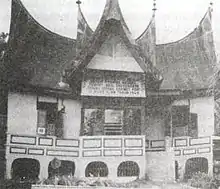
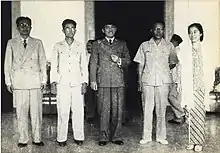
By November 1948, the prospects of a potential second Dutch offensive following Operation Product against the Republicans had caused the Indonesian government to prepare a contingency plan. Mohammad Hatta brought Sjafruddin to Bukittinggi, and returned to Yogyakarta, leaving Sjafruddin to form an emergency government should Yogyakarta and other Republican leaders fall into Dutch hands. This happened on 19 December 1948, and after being informed of Yogyakarta's fall by Colonel Hidayat Martaatmadja, Sjafruddin was initially unable to believe that the Indonesian government would fall so quickly and that both Sukarno and Hatta had been captured. He was also initially uncertain of the authenticity of the news, and of his legal authority to form a government.[19][20] He convened a meeting with local Republican officials such as Teuku Muhammad Hasan and Mohammad Nasroen, but their meeting was cut short by Dutch aircraft flying low over the city.[21]
In order to evade the Dutch attacking Bukittinggi, he retreated further inland, towards the town of Halaban, where he was joined by a number of Republican officials and military leaders. There he eventually announced the formation of the Emergency Government of the Republic of Indonesia (PDRI) on 22 December, with himself as head. The PDRI further announced the formation of a commissariat in Java, which were to be headed by Republican leaders which evaded capture such as Soekiman Wirjosandjojo and I.J. Kasimo.[19][22] He adopted the title "Head" instead of "President" which Sukarno had given him mandate for as the mandate had not reached him by 22 December.[23] In addition to Head of Government, the emergency cabinet also had Sjafruddin as ministers of defense, foreign affairs,[lower-alpha 5] and information.[25] Still on 22 December, Dutch forces captured Bukittinggi and Payakumbuh, threatening the PDRI at Halaban and convincing them to withdraw further.[26] Shortly after the pronouncement, Sjafruddin's group left Halaban, with the military leadership heading north towards Aceh.[27]
Sjafruddin and the civilian leadership had initially planned to move to Pekanbaru, but Dutch air attacks, difficult roads, and Dutch capture of a number of towns in the route compelled the group to briefly split up at Sungai Dareh, then regroup at the village of Bidar Alam, near Jambi. Sjafruddin arrived there on 9 January 1949, and the split groups followed up in the following weeks.[28] Sjafruddin used a generator-powered radio transmitter of the Indonesian Air Force to maintain contact with both the international world (for example, congratulating Jawaharlal Nehru for his inauguration as Indian Prime Minister) and the scattered members of PDRI.[27][28] In order to ensure continued supplies of food and military supplies for the guerilla units still operating in Sumatra, Sjafruddin established a supply section, which controlled the Republican trade of agricultural products and opium to the Malay peninsula.[29] On one occasion on 14 January 1949, Sjafruddin and a large number of PDRI's civilian and military leaders attended a meeting at the village of Situjuh Batur. Sjafruddin left after the meeting, but a number of leaders (such as Chatib Sulaiman) stayed the night there and were killed in a Dutch ambush at the dawn of 15 January.[30][31]
As the Republican forces conducting guerrilla warfare in Java and Sumatra, led by Sudirman, recognized Sjafruddin's PDRI as the legitimate Republican government, the PDRI critically allowed the Indonesian fighters to continue having a unifying authority.[24] Eventually, frustrated with continued Indonesian resistance, the Dutch approached Sukarno and Hatta in order to negotiate, bypassing Sjafruddin's emergency government. This angered him, as he believed that Sukarno and Hatta had no legal authority at that time and that the PDRI should be considered the legal representation. Many leaders, including Sudirman, were also displeased as neither Sukarno nor Hatta consulted the PDRI leaders while negotiating the Roem–Van Roijen Agreement, and pressed Sjafruddin to reject it.[32][33][34] Sjafruddin was eventually convinced to agree to the outcome of the agreement after some convincing by Mohammad Natsir, Johannes Leimena and Abdul Halim – Hatta had also went to meet Sjafruddin, but he went to Aceh as the captured Republican leaders thought that the PDRI was based there.[32][33] Eventually, escorted by troops from the United Nations, he left his hideout, and returned to Java with Natsir. In a speech before his departure, Sjafruddin indicated his misgivings with the agreement, but recognizing the need of presenting a united Indonesian front, he returned his mandate to Sukarno in Yogyakarta on 13 July 1949.[35]
Deputy PM and finance minister
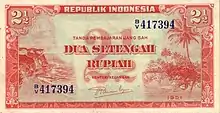
Following Sjafruddin's return to Yogyakarta, he was appointed as Deputy Prime Minister for Sumatra in the Second Hatta Cabinet, and was stationed at Kutaraja.[1] He was given extensive powers in this position, due to tenuous control and communication that the Republican government had on Sumatra.[36] During the PDRI period, Sjafruddin had been approached by Acehnese leaders, who requested that the region be split off into its own province.[37] By May 1949, he had officially appointed Daud Beureu'eh as military governor of Aceh.[38][36] In a visit to Aceh on August 1949, he faced significant pressure in order to form a province, to a point where a government statement later described that "the autonomous province of Aceh was created through force majeure".[36] In December 1949, he released a decree which separated Aceh from North Sumatra to form its own province, but this decree was revoked by the central government under Mohammad Natsir's premiership. This caused significant anger amongst Acehnese leaders such as Daud Beureu'eh, and only successive visits by Sjafruddin, Assaat, Hatta, and finally Natsir himself calmed down the situation.[37][39] Additionally, Sjafruddin also assured officials who had worked for the Dutch that the Republican government would not permit reprisals.[40]
Within the Republic of the United States of Indonesia Cabinet, Sjafruddin returned to his previous office as Minister of Finance, a post which he would later retain in the succeeding Natsir Cabinet.[41] In the Masyumi-heavy cabinets between December 1949 and June 1953 (at the end of the Wilopo Cabinet), Sjafruddin's economic views and outlook enjoyed significant influence in the government, with Sjafruddin being Masyumi's primary outlet of economic policy.[42] One policy of Sjarifuddin was a foreign exchange certificate policy, which granted such certificates at half of the nominal value of exports. This could in turn be sold to importers, who would have to present the certificate with a face value equivalent to the nominal value of their imports.[43]
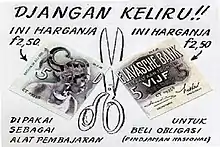
Additionally, as a result of the Dutch–Indonesian Round Table Conference, the Indonesian government was saddled with heavy debts and obligations, and the economy was plagued with heavy inflation due to a shortage of goods and an oversupply of currency. By 1950, there were three currencies circulating – one issued by the Republican government, one issued by the Netherlands Indies Civil Administration (NICA), and the other issued by De Javasche Bank before the Japanese occupation. In order to reduce the money supply, Sjafruddin announced on 10 March 1950 that all NICA and De Javasche Bank notes with a face value above 5 guilders were to be physically cut in half – a policy known as the "Sjafruddin Cut" (Gunting Sjafruddin).[43][44][45] The left halves of the notes remained legal tender until 9 April 1950, with a nominal value of half its face value and to be exchanged with new notes, while the right halves were exchanged with 30-year government bonds yielding 3 percent.[43][46] Outside of paper money, the same "cut" also applied to bank accounts, with half of all bank account values (excepting an amount of 200 guilders for accounts with less than 1,000 guilders) being transferred into a government loan account.[44][47] According to Sjafruddin in a later interview, beyond reining inflation, this also served to create a uniform currency system for the whole country and remove unwanted Dutch currency from circulation.[13][45] Claims from De Javasche Bank stated that the policy reduced the money supply by 41 percent, and that the prices of food and textiles still rose in 1950 after the execution of the Sjafruddin Cut.[41]
Both policies resulted in significant criticism from the political opposition. This was especially the case with the Sjafruddin Cut, which was constantly attacked by the Indonesian Communist Party.[43] It also caused controversy due to the dating of the order – which happened at the end of the month, when most salaried workers still held cash.[46] While government income increased during his early tenure, expenses also rose, and hence he failed to close the government deficit.[48] Indonesian government finances later improved during the Natsir era due to a boom caused by the Korean War, resulting in a budget surplus. In this period, the "Economic Urgency Plan" was devised by minister of trade and industry Sumitro Djojohadikusumo, to Sjafruddin's opposition, to develop import substitution industries and restrict some industries to native Indonesian entrepreneurs.[41][49] Despite the better financial situation, Sjafruddin maintained the government budget strictly, maintaining an unpopular colonial-era tax, refusing to raise salaries of civil servants, and rejecting calls to provide funding to political parties. This was compounded by a number of Dutch officials he maintained within the finance ministry who held significant powers.[50][51]
Generally, Sjafruddin's policies and views were considered more accommodating than his contemporaries.[52] With regards to his religious views and upbringing, Sjafruddin disagreed with the interpretation of bank interest as riba.[53] In a 1948 pamphlet, he espoused "Religious Socialism", which promoted a liberal free market economy and reserved nationalization for a later-stage, more developed economy.[52] This resulted in a number of disagreements and public debates between him and the more nationalistic Sumitro.[41] Unlike Sumitro, who endorsed state intervention to develop an industrial base, Sjafruddin doubted that state-owned enterprises would be efficient or productive.[54] Sjafruddin also argued for a more gradual process of nationalization,[49] arguing that foreign capital was advantageous for the country's economy and that rejecting it would be counterproductive.[55] After his replacement by Jusuf Wibisono, Sjafruddin began to criticize the Sukiman Cabinet's economic policies, writing in a June 1951 pamphlet that economic decline from the government's policies was "only temporarily hidden by the pseudo-welfare of high export prices".[56] During 1952, a split occurred in Masyumi, the party remaining under modernist politicians such as Sjafruddin and Natsir, while more traditional Islamist members merged into Nahdlatul Ulama (NU).[57]
Bank Indonesia governor
By 1951, the Indonesian government had nationalized De Javasche Bank, and converted it from a joint-stock company into a public body.[58] Sjafruddin opposed the nationalization on the grounds that the bank's Indonesian personnel were too unexperienced to manage it.[59] Despite this, he was appointed as the inaugural governor of the central bank, later renamed Bank Indonesia (BI), on 30 April 1951 to replace the previous resigning governor A. Houwink.[59] Sjafruddin held relatively similar economic and monetary policy views with the previous Dutch administrators – such as his belief in the lack of necessity to nationalize the bank – and according to Sjafruddin's claim, Houwink agreed with his selection. In the first annual report of BI, Sjafruddin argued for the bank to continue commercial banking activities, citing a shortage of access to banking systems and a lack of a capital market in Indonesia at that time.[58] In designing BI's statutes, Sjafruddin placed a clause which would manage the bank's reserves of gold and foreign currency at 20 percent of currency issued. This was criticized by contemporary economists, most prominently Sumitro who had been appointed as the new Finance Minister, and the reserve requirement failed to fulfill its intended purpose.[60]
While in his tenure, Sjafruddin criticized the Indonesian government's lack of clarity on the distinction between "domestic" and "foreign" capital. Sjafruddin was of the opinion that the distinction between the two laid in whether profits were remitted abroad or not – in other words, that Chinese Indonesian entrepreneurs would be "domestic". This was in contrast to positive discrimination policies for indigenous Indonesians favored by Sumitro.[61] During the Ali Sastroamidjojo premiership between 1953 and 1955, Sjafruddin was also a prominent critic of the government economic and monetary policies.[62] In 1956, approaching the end of Sjafruddin's first term as governor, the Indonesian National Party (PNI) proposed to replace him with PNI member, BI deputy governor and former PDRI minister Lukman Hakim, who Sjafruddin had a close relationship with. Sjafruddin maintained his post after NU opted to back his second term, aided by favours given to NU-related businesses by fellow Masyumi member and sitting finance minister Jusuf Wibisono.[63][64]
PRRI rebellion
Prelude
By late 1957, the Indonesian economic and political situation had deteriorated, and Dutch firms were often blamed for the malaise.[65][66] The general public opinion was firmly against Sjafruddin's position which still accommodated foreign capital.[67] Sentiments against the Netherlands rose significantly following Dutch success in blocking the West New Guinea dispute from being discussed at the United Nations General Assembly on 29 November 1957, and immediately afterwards Sukarno ordered labor unions and army units to take over Dutch businesses.[65][66] Sjafruddin himself alongside other Masyumi leaders were investigated for possible links with an assassination attempt on Sukarno on 30 November 1957 in Cikini as some of the assassins were members of Masyumi's youth wing.[66] Despite of this, Sjafruddin remained critical of the takeovers, and the lack of a clear plan on how they would be executed.[65] Throughout December 1957, Masyumi leaders Sjafruddin, Natsir, and Burhanuddin Harahap were subjected to accusations by the media of being complicit in the assassination, and they were harassed by phone calls and by paramilitary groups. They all opted to depart Jakarta for their own and their families' safety, and by January 1958 Sjafruddin was in Padang.[66]
While on the way there, he and other Masyumi leaders (and Sumitro, who had left Jakarta after being accused of corruption) attended a meeting with a number of dissident officers such as Maludin Simbolon. Following debates (the military commanders allegedly wanted to declare Sumatra's independence, which the civilian leaders opposed), the group released a statement which called the Djuanda Cabinet unconstitutional, and called for a cabinet led by Hatta and Hamengkubuwono IX to be formed.[68] Sjafruddin also stopped over at Palembang and held discussions with the potential dissident Colonel Barlian, who was the regional commander of the armed forces in South Sumatra. Barlian refused to commit his forces to support a potential rebellion.[69] Sjafruddin also wrote an open letter to Sukarno, which voiced his opposition to the "fascist" Guided Democracy and called for a return to the 1945 Constitution.[69] While Natsir and Harahap claimed to have specific reasons to be in Sumatra, Sjafruddin openly admitted to having fled Jakarta, writing another open letter to Sukarno on 23 January 1958, saying that "he was not ready to die stupidly".[70]
The rebellion
.jpg.webp)
On 15 February 1958, the Revolutionary Government of the Republic of Indonesia (PRRI) was declared in Padang by Lt. Col Ahmad Husein, with Sjafruddin being named as its prime minister.[71][72] He also doubled as the minister of finance in the PRRI government.[72] However, Sjafruddin refused to sign the declaration.[73] The Indonesian government under prime minister Djuanda Kartawidjaja issued an order to arrest Sjafruddin and the other civilian leaders the following day, and within a week aerial attacks were launched against cities in West Sumatra.[72] By April, government forces had landed in Padang and secured it with little to no resistance. Once he learned of the PRRI military collapse, Sjafruddin vowed in anger to "stay here in the jungle" and adding that "it won't be the first time". By 5 May, the PRRI capital at Bukittinggi had been captured by the Indonesian government.[74]
Within four months, the government's military actions had completely defeated the PRRI militarily, the leaders had failed to gain significant popular support for the movement, and while it initially received some backing from the United States, the military aid was soon withdrawn.[lower-alpha 6] By the middle of 1958, the group had been forced into a low-intensity guerrila warfare based in the jungles of Sumatra.[75] Despite continued defeats, Sjafruddin then still refused to attempt a compromise with the Jakarta government. On the first anniversary of the PRRI, he gave a speech still attacking Sukarno for working with Communists, and urged for a federal state.[76] In a last-ditch political attempt, the Masyumi leadership and the dissident military leaders announced the "United Republic of Indonesia" at Bonjol on 8 February 1960.[76][77] In the proclaimed state, Sjafruddin was named president, but little other details beyond the state's constitution was prepared.[76] The declaration did not amount to much, and the Indonesian government continued to pressure the PRRI, capturing rebel held towns in Sumatra's highlands. By July 1960, the rebel stronghold at Koto Tinggi where Sjafruddin and the other Masyumi/PRRI leaders resided had been captured, forcing them to flee and disabling their capacity to lead the rebellion.[78]
Army Chief of Staff Abdul Haris Nasution, in order to further split the government of the PRRI, announced an amnesty program for rebelling troops in late 1960. In April and May 1961, PRRI's troops began surrendering to the government, although the PRRI still controlled much of the rural regions of West Sumatra.[77][78] Sjafruddin and Natsir appointed Maludin Simbolon to represent the PRRI in negotiating with the central government, but the military leaders opted to surrender separately. Between June and 17 August 1961, nearly all of the PRRI's troops and military commanders surrendered, leaving the civilian leaders little options.[78] Sjafruddin himself had been negotiating with Nasution since July, and alongside Assaat and Burhanuddin Harahap he submitted to military authorities near Padangsidempuan on 25 August 1961.[78][79] He did so after advising his own remaining followers to "cease hostilities" in a radio broadcast on 17 August.[78][80] Sjafruddin also surrendered the PRRI's assets in form of 29 kg of gold bullion. This left only Natsir and Colonel Dahlan Djambek as PRRI's remaining leadership, and after Djambek's death on 13 September, Natsir too surrendered on 25 September, ending the PRRI rebellion.[81]
Sjafruddin was initially not imprisoned, due to a 1961 declaration of amnesty for PRRI members by Sukarno, and for a time he stayed around Medan. However, in March 1962, he was brought to Jakarta, and then held as a prisoner in Kedu for two years before being transferred to a military prison in Jakarta in 1964.[82] He was eventually released on 26 July 1966.[79]
Post rebellion
Upon release, Sjafruddin left active politics and he tended to express himself more through religious organizations such as the Indonesian Pesantren Foundation and the Mubaligh Corps.[83] He also maintained an interest in economics, founding the Indonesian Association of Muslim Businessmen in July 1967,[84] and he generally supported the economic policies of the technocrats under Suharto such as Widjojo Nitisastro and Mohammad Sadli.[79] He then used Friday sermons in mosques to preach against corruption under Suharto.[85] He opposed the government monopoly on hajj pilgrimages,[86] and in 1970, he founded a hajj association, which facilitated pilgrims who wanted to build up savings to go to Mekkah outside the official government route. While successful for a time, financial mismanagement resulted in around 300 pilgrims being abandoned in 1976 and requiring an intervention from the government.[87] He also opposed the government-backed Parmusi and the newly formed Islamic parties, comparing them unfavorably with the Indonesian Communist Party.[88][lower-alpha 7] Due to his vocal criticism of the Suharto government, he was detained for a time starting in April 1978.[89]
In 1980, he further lead the Petition of Fifty, alongside among others Abdul Haris Nasution and former PRRI colleagues Natsir and Harahap. The petition questioned Suharto's use of Pancasila as a political weapon and of the conduct of the Indonesian National Armed Forces.[90] Additionally, between 1974 and 1982, Pancasila was gradually pushed as the sole guiding principle for all groups in Indonesia, including religious ones. The trend disturbed Sjafruddin, and on 7 July 1983 he wrote a widely circulated open letter to Suharto to protest against the provision in the draft law that endorsed the concept.[91] Following the 1984 Tanjung Priok riots and massacre, he was one of the authors and signatories of a "white paper" which attributed the riots to government policy, especially regarding the increased use of Pancasila as a political tool.[92][93] Due to these activities, Suharto banned Sjafruddin from leaving the country except for medical treatment.[85] Still, he continued to criticize the government – for example, he was investigated in June 1985 due to a sermon he gave at a mosque in Tanjung Priok.[83]
Personal life
He married Tengku Halimah, daughter of the district chief of Buahbatu and a descendant of a King of Pagaruyung, whom he met in Bandung, on 31 January 1941.[3] The couple had eight children.[94] During the PDRI months, his family remained in Yogyakarta under protection of Hamengkubuwono IX, while during the PRRI period they followed Sjafruddin to West Sumatra.[85]
During Sjafruddin's imprisonment, his family was homeless for a time due to the seizure of their house. For some time, they stayed at the homes of family and friendly Masyumi politicians, and one of his children could only enroll at a Catholic school thanks to I. J. Kasimo's intervention. Eventually, once Deputy Prime Ministers Johannes Leimena and Soebandrio became aware of his family's situation, their home was returned and Leimena provided the family with basic needs. Once Sukarno also learned of the family's problems, he gave the family two cars.[95]
Death and legacy
He died in Jakarta of a heart attack on 15 February 1989.[3] Having suffered from bronchitis, at around 6 PM that day he had collapsed in his home and was rushed to Pondok Indah Hospital.[96] He was buried in a simple grave at Tanah Kusir Cemetery in South Jakarta.[97] In the years preceding his death, he had become more frail, and in a 1988 letter to George McTurnan Kahin after Hamengkubuwono IX's death he wrote "I was more than ever aware that the time is nearing that the Angel of Death will fetch me and join me with all other friends and comrades in arms who have preceded us."[85]
In Sjafruddin's obituary, Kahin wrote that Sjafruddin was "never tainted by corruption" and had a "reputation for honesty, forthrightness, and solid integrity".[3] Journalist Rosihan Anwar called him an idealist, and despite his Muslim background, had a strong socialist ideal close to that of Sjahrir.[97] Anwar also quoted Sjafruddin as saying, shortly prior to his death, that Indonesia was being colonized by itself.[97]
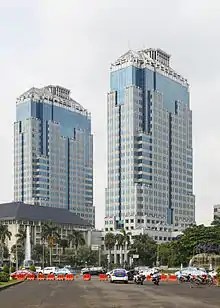
He was made a National Hero of Indonesia on 8 November 2011 by President Susilo Bambang Yudhoyono, after being rejected twice in 2000 and 2009.[98] One of the two buildings that comprise the Bank Indonesia headquarters is named after him.[99] A number of modern political figures, such as MPR speaker Zulkifli Hasan, deputy speaker Lukman Hakim Saifuddin and Constitutional Court Chief Justice Jimly Asshiddiqie have argued for the formal recognition of Sjafruddin as Indonesia's second president.[100][101][102]
Notes
- Also as Minister of Finance and Information.[1]
- As part of the Republic of the United States of Indonesia Cabinet between 20 December 1949 and 6 September 1950. In the Republic of Indonesia, Lukman Hakim served as Minister of Finance between 27 December 1949 and 15 August 1950.
- Upon the effective dissolution of the cabinet due to Operation Kraai. Legally, the cabinet was not formally disbanded.
- As Governor of De Javasche Bank, until it was renamed to Bank Indonesia on 1 July 1953.[2]
- Alexander Andries Maramis, at that time located in India, was later appointed foreign affairs minister.[24]
- At that time, parts of the United States Seventh Fleet and the 3rd Marine Division were posted off the coast of Sumatra. The US State Department under John Foster Dulles had expected a wider insurrection, but was disappointed by the limited extent of the rebellion and the poor military performance of PRRI.[75]
- Quoted from Prawiranegara in a 1971 interview: "The present Islamic parties are as bad as the Communists. No, that is not right, for the Communists are willing to make sacrifices."[88]
References
- Sejarah Departemen Penerangan RI (in Indonesian). Ministry of Information. 1986. p. 172. Archived from the original on 25 November 2021. Retrieved 14 November 2021.
- Ministry of Finance 1991, p. 193.
- Kahin 1989, p. 101.
- Belajar Dari Partai Masjumi (in Indonesian). Pustaka Al Kautsar. 2 January 2014. pp. 18–20. ISBN 978-979-592-674-0. Archived from the original on 25 November 2021. Retrieved 14 November 2021.
- Anderson 2006, p. 439.
- Legge 2010, pp. 76–77.
- Kahin 1989, p. 102.
- Assyaukanie 2009, p. 61.
- Legge 2010, pp. 110–111.
- Madinier 2015, p. 58.
- Legge 2010, p. 211.
- Anderson 2006, p. 321.
- Kian Wie Thee 2003, pp. 78–79.
- Anderson 2006, pp. 310–311.
- Kian Wie Thee 2003, pp. 69–70.
- Ministry of Finance 1991, p. 19.
- Madinier 2015, pp. 102–103.
- Subdisjarah 2001, p. 45.
- Kahin 1999, pp. 138–140.
- Bahar 2018, p. 98.
- Subdisjarah 2001, pp. 33–34.
- Subdisjarah 2001, p. 35.
- "Sjafruddin Prawiranegara: Sebenarnya Saya Seorang Presiden". Historia (in Indonesian). 18 December 2015. Archived from the original on 14 November 2021. Retrieved 14 November 2021.
- Kahin 1999, p. 140.
- Subdisjarah 2001, p. 129.
- Subdisjarah 2001, p. 36.
- Kahin 1999, p. 141.
- Subdisjarah 2001, pp. 60–62.
- Kahin 1999, p. 151.
- Kahin 1999, pp. 122–123.
- Bahar 2018, pp. 146–147.
- Kahin 1999, pp. 153–155.
- Subdisjarah 2001, p. 123.
- Bahar 2018, p. 209.
- Kahin 1999, p. 155.
- van Dijk 1981, p. 288.
- Djumala, Darmansjah (30 July 2013). Soft Power untuk Aceh (in Indonesian). Gramedia Pustaka Utama. pp. 25–26. ISBN 978-979-22-8755-4. Archived from the original on 25 November 2021. Retrieved 14 November 2021.
- Madinier 2015, p. 160.
- Kahin 1999, p. 170.
- Kahin 1999, p. 156.
- Glassburner 1962, pp. 122–124.
- Glassburner 1962, p. 114.
- Raditya, Iswara N. (10 March 2020). "Gunting Uang ala Menkeu Syafruddin demi Atasi Krisis Ekonomi". tirto.id (in Indonesian). Archived from the original on 14 November 2021. Retrieved 14 November 2021.
- "Indonesia: The Magic Scissors". Time. 27 March 1950. Archived from the original on 14 November 2021. Retrieved 14 November 2021.
- Lindblad 2008, p. 41.
- Ministry of Finance 1991, p. 13.
- "Putusan Menteri Keuangan Republik Indonesia Serikat No : P.U./1. Jakarta Tanggal 19 Maret 1950 tentang Uang kertas" (PDF) (in Indonesian). Government of Indonesia. Archived (PDF) from the original on 16 November 2021. Retrieved 16 November 2021.
- Ministry of Finance 1991, p. 50.
- Friend 2009, p. 82.
- Feith 2006, pp. 169–170.
- Madinier 2015, p. 193.
- Glassburner 1962, pp. 120–121.
- Assyaukanie 2009, p. 78.
- Ministry of Finance 1991, p. 56.
- Assyaukanie 2009, pp. 79–80.
- Feith 2006, p. 222.
- Lindblad 2008, p. 42.
- Wolters 2012, pp. 125–126.
- Madinier 2015, p. 197.
- Wolters 2012, p. 129.
- Lindblad 2008, p. 142.
- Feith 2006, p. 370.
- Notodidjojo, Soebagijo Ilham (1980). Jusuf Wibisono, karang di tengah gelombang (in Indonesian). Gunung Agung. p. 160. Archived from the original on 25 November 2021. Retrieved 14 November 2021.
- Madinier 2015, p. 220.
- Lindblad 2008, p. 186.
- Kahin 1999, pp. 204–205.
- Madinier 2015, p. 247.
- Madinier 2015, p. 251.
- Kahin 1989, p. 103.
- Madinier 2015, pp. 249–250.
- Madinier 2015, p. 252.
- Kahin 1999, p. 211.
- Madinier 2015, p. 253.
- Kahin 1999, pp. 217–218.
- Madinier 2015, pp. 254–258.
- Kahin 1999, pp. 222–224.
- Madinier 2015, pp. 259–260.
- Kahin 1999, pp. 225–226.
- Kahin 1989, p. 104.
- van Dijk 1981, p. 338.
- Kahin 1999, p. 227.
- "Orde Lama, Syahrir, Natsir, Hamka:Penjara Tanpa Proses Hukum". Republika (in Indonesian). 19 January 2019. Archived from the original on 14 November 2021. Retrieved 14 November 2021.
- Ahsan, Ivan Aulia. "Sejarah 15 Februari 1989: "Presiden" Syafruddin Prawiranegara Wafat". tirto.id (in Indonesian). Archived from the original on 14 November 2021. Retrieved 14 November 2021.
- Assyaukanie 2009, p. 87.
- Kahin 1989, p. 105.
- Prawiranegara, Sjafruddin (1978). Bebaskanlah perjalanan haji dari monopoli pemerintah! (in Indonesian). Bulan Bintang. Archived from the original on 25 November 2021. Retrieved 14 November 2021.
- Cerita Jemaah Haji Indonesia Tahun 1970-an Ketika Ibadah Haji Mulai Dengan Pesawat (in Indonesian). Tempo Publishing. 1 January 2020. pp. 63–70. ISBN 978-623-262-180-0. Archived from the original on 25 November 2021. Retrieved 14 November 2021.
- Kahin 1999, pp. 255, 350.
- Budiyarso, Edy (2000). Menentang tirani: aksi mahasiswa '77/'78 (in Indonesian). Gramedia Widiasarana Indonesia bekerja sama dengan Bank Naskah Gramedia. p. 177. ISBN 978-979-669-975-9. Archived from the original on 25 November 2021. Retrieved 14 November 2021.
- Friend 2009, pp. 179–180.
- Friend 2009, p. 181.
- Friend 2009, p. 192.
- "Priok 12 September 1984: Ketika Aspirasi Dijawab Peluru dan Penjara". Republika (in Indonesian). 17 September 2017. Archived from the original on 17 November 2021. Retrieved 17 November 2021.
- "Sederhana Hingga Akhir Hayat". Tempo (in Indonesian). 1 August 2006. Archived from the original on 14 November 2021. Retrieved 14 November 2021.
- Mukhti, M. F. (14 April 2018). "Nasib Keluarga Ketika Sjafruddin Prawiranegara Dipenjara". Historia (in Indonesian). Archived from the original on 14 November 2021. Retrieved 14 November 2021.
- "Meninggal Serangan Jantung". Tempo (in Indonesian). 25 February 1989. Archived from the original on 23 November 2021. Retrieved 23 November 2021.
- "Sjafruddin Prawiranegara, Mantan Presiden yang Dikejar-kejar". detiknews (in Indonesian). 16 August 2006. Archived from the original on 14 November 2021. Retrieved 14 November 2021.
- "Sjafruddin Prawiranegara Jadi Pahlawan Nasional". Republika (in Indonesian). 8 March 2012. Archived from the original on 14 November 2021. Retrieved 14 November 2021.
- "Nama Gubernur BI di Menara Kembar BI Thamrin" (in Indonesian). Bank Indonesia. 1 December 2020. Archived from the original on 25 November 2021. Retrieved 14 November 2021.
- "Ketua MPR: Syafruddin Prawiranegara Harusnya Jadi Presiden Ke-2". liputan6.com (in Indonesian). 10 November 2015. Archived from the original on 18 November 2021. Retrieved 18 November 2021.
- "Sjafruddin Prawiranegara Harus Diakui Sebagai Presiden RI ke-2". JPNN (in Indonesian). 8 February 2011. Archived from the original on 18 November 2021. Retrieved 18 November 2021.
- "Mengenal Presiden kedua RI, Syafruddin Prawiranegara". Okezone (in Indonesian). 8 November 2011. Archived from the original on 18 November 2021. Retrieved 18 November 2021.
Bibliography
- Rupiah di tengah rentang sejarah: 45 tahun uang Republik Indonesia, 1946–1991 (in Indonesian). Ministry of Finance of Indonesia. 1991.
- Peran TNI-AU pada masa pemerintah darurat Republik Indonesia tahun 1948–1949 (in Indonesian). Subdisjarah. 2001.
- Anderson, Benedict Richard O'Gorman (2006). Java in a Time of Revolution: Occupation and Resistance, 1944–1946. Equinox Publishing. ISBN 978-979-3780-14-6.
- Assyaukanie, Luthfi (2009). Islam and the Secular State in Indonesia. Institute of Southeast Asian Studies. ISBN 978-981-230-889-4.
- Bahar, Saafroedin (2018). Etnik, Elite dan Integrasi Nasional: Minangkabau 1945–1984 Republik Indonesia 1985–2015 (in Indonesian). Gre Publishing. ISBN 978-602-7677-56-2.
- Feith, Herbert (2006). The Decline of Constitutional Democracy in Indonesia. Equinox Publishing. ISBN 978-979-3780-45-0.
- Friend, Theodore (July 2009). Indonesian Destinies. Harvard University Press. ISBN 978-0-674-03735-9.
- Glassburner, Bruce (1962). "Economic Policy-Making in Indonesia, 1950–57". Economic Development and Cultural Change. 10 (2): 113–133. doi:10.1086/449948. ISSN 0013-0079. JSTOR 1151906. S2CID 153885755.
- Kahin, George McT. (October 1989). "In Memoriam: Sjafruddin Prawiranegara (1911–1989)". Indonesia. Ithaca, New York: Cornell Modern Indonesia Project. 48 (48): 101–106. ISSN 0019-7289. JSTOR 3351269.
- Kahin, Audrey (1999). Rebellion to Integration: West Sumatra and the Indonesian Polity, 1926–1998. Amsterdam University Press. ISBN 978-90-5356-395-3.
- Kian Wie Thee, ed. (2003). Recollections: The Indonesian Economy, 1950s–1990s. Singapore: Institute of Southeast Asian Studies. ISBN 978-981-230-174-1.
- Legge, J. D. (2010). Intellectuals and Nationalism in Indonesia: A Study of the Following Recruited by Sutan Sjahrir in Occupied Jakarta. Equinox Publishing. ISBN 978-602-8397-23-0.
- Lindblad, J. Th (1 January 2008). Bridges to New Business: The Economic Decolonization of Indonesia. Brill. ISBN 978-90-04-25397-1.
- Madinier, Remy (31 August 2015). Islam and Politics in Indonesia: The Masyumi Party between Democracy and Integralism. NUS Press. ISBN 978-9971-69-843-0.
- van Dijk, C. (1981). "Aceh, the Rebellion of the Islamic Scholars". Rebellion under the Banner of Islam. 94. Brill. pp. 269–339. ISBN 978-90-04-28725-9. JSTOR 10.1163/j.ctvbqs6vx.12.
- Wolters, W.G. (2012). "Decolonizing money: Central banks in the Philippines and Indonesia". Beyond Empire and Nation. Brill. pp. 109–136. ISBN 978-90-6718-289-8. JSTOR 10.1163/j.ctt1w8h2zm.8.
|  | |
Italic: Acting | ||
Authority control  | |
|---|---|
| General | |
| National libraries | |
| Other | |