Syed Sharfuddin Sharf Al Hussaini
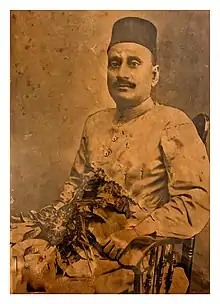
Syed Abul Fatah Sharfuddin Sharaf Al Hussaini (Urdu: سید ابو الفتح شرف الدین شرف الحسینی; 1878–1960), locally known as Suba Mian (Bengali: সুবা মিঞা) and by his pen name Sharaf, was a notable Urdu poet from Dacca in present-day Bangladesh.[1]
Syed Sharfuddin Sharf Al Hussaini | |
|---|---|
 | |
| Born | January 25, 1878 Bengal Presidency |
| Died | March 30, 1960 (aged 82) East Pakistan |
| Pen name | Sharaf |
| Occupation | Poet |
| Genre | Ghazal, Rubaʿi, Noha, Salam, Qasida, Mussadas |
Early life and family
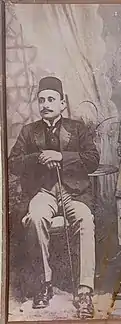
Syed Abul Fath Sharfuddin Sharaf Al Hussaini was born in 25th January, 1878. Nassakh, the noted historian of Urdu literature, wrote his name as Abul Fatah Sharfuddin. Poet Sharful Hussaini lived in Begum Bazar now situated in Old Dhaka, which was adjacent to the erstwhile Hakim Habibur Rahman Road. His father, Syed Faquihuddin Hussain Al Hussaini belonged to the oldest aristocratic families of Dacca. His forefathers were Hussaini Syeds from Medina (present-day Saudi Arabia). During the reign of Mughal emperor Jahangir, his ancestor Syed Fida Hussain settled in the city of Delhi in North India. Fida's son, Syed Ghulam Hussain, and his grandsons Syed Faizuddin Hussain and Syed Muzaffar Hussain lived in Delhi before entering Bengal and settling in Calcutta and later Dacca. Faizuddin served as a Kotwal for the Naib Nazim of Dhaka. Sharaf's grandfather Syed Muzaffar Husain had such close relations with the Nawab family of Dhaka that he was often considered a part of the family and was eventually buried in the Nawab family graveyard in Begum Bazar.[1]
Education
Born into a well-educated family, his foundation of knowledge was formed by spending time with them. His mother, Fatima Khanam, devoted special attention to his upbringing. He learned his primary Urdu and Persian lessons from his father who was among the few aristocratic persons of noble distinction who learned Arabic and Persian from “Madrasa-e-Mohsiniya” and completed his doctorate degree of Islamic Law and successfully became a “Maulvi” with full distinction under his teacher Ubaidullah Al Ubaidi Suhrawardy.
After the death of his father he went to Nawab Syed Muhammad Khan Bahadur alias Nanhe Syed, the cousin of his mother at Patna for further education. He was a famous correspondent of the humorous newspaper “Awadh Punch” of Lucknow. The company of Syed Muhammad Azad infused the poetic spirit in Sharaf. In those days Azimabad was the center of literary activities. He had the company of the celebrated poets and scholars namely, Shad Azimabadi, Nawab Hussain “Khiyal”, “Asar” Azimabadi, Syed Abul Ghafur “Shahbaz” etc as a constant source of inspiration to him. This literary environment led him to the “valley of poetry” and he started composing poems. In the early stages he consulted Syed Muhammad Azad on his verses. He is the disciple of “Shahbaz”, the author of “Life of Nazeer”, etc. He often went to Delhi, Agra and Lucknow. As a result he had a close friendly relation with Altaf Hussain Hali, Nawab Sail Dehlavi, Arzoo Lucknavi, Safi Lucknavi and Bekhub Dehlavi etc.
Works
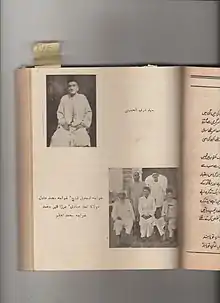
His first collection of poems was published in Kolkata, “Gulistan-e-Sharaf” was printed in Sitar-e-Hind, Press, Beniapukur, Kolkata in 1937. This collection consists of his poems in almost all branches of Urdu poetry including Noha, Gazal, Qasida, Salam and Mussadas. His Persian poem “Sair-e-Kolkata” is also included in it. The entire collection has been compiled in metric order. The collection contains a “Foreword” by Syed Akhtar Hasan, M.A (alig.) and an “Introduction” in the Persian by the author himself. The last pages of the Anthology consists of attributes from Nawab Sail Dehlavi, Arzu Lucknavi and Bekhud Dehlavi, etc. who admired his poetic talent and appreciated the maturity of his verses.
Recognition
About Sharaf, Allama Arzoo Lucknavi wrote :
“In the anthology of Sharaf all sorts of poems have been compiled. It shows that the poet has the ability of expressing himself in all forms of poetry. Study of the entire anthology reveals two more characteristics:
- Sharaf’s taste and temperament continued to change to fit in with the revolutions taking place in the country.
- His poems manifest the gradual evolution of his poetic genius from preliminary stages go the stages of perfection and consummation.
Thus, Gulistan-e-Sharif is the mirror in which the evolution of his poetry has been fully reflected, from the very outset. In this regard he is the poet of the selective and distinctive caliber."
During his stay at Patna, the late Sharful Hussaini had the opportunities of seeing Mir Anees and Mirza Dabeer reciting their respective poems. On the occasion of Muharram, Mir Anees used to come to Vilayat Ali Khan at Patna to recite his “Marsiya" and Mirza Dabeer to Nawab Imambandi Begum. Sharaful Hussaini attended these functions punctually and regularly. The manner of his reciting poems resembled that of Mir Anees He was proud of it that he was the only one person in Bengal, correctly imitating the reciting manner of Mir Anees.
Others
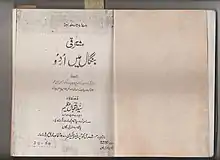
As mentioned in the foregoing lines, his first anthology, “Gulistan-e-Sharaf” was published in his lifetime. The compilation of the second anthology, entitled “Dabistan-e-Sharaf” was complete. He himself compiled the anthology and got it written beautifully by a calligraphist. The “Forward” was by the pen of late Sher-e-Bangla Maulvi A.K Fazlul Huq.
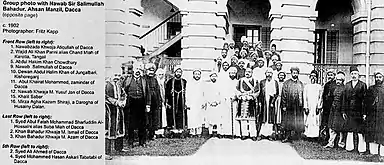
He did not limit himself from writing poems only. Rather he took part in governmental and social affairs of Bangladesh as well. By the authority of Dhaka Commission he served as an Honorary Magistrate of Bengal from 1907-1928, for almost 22 years.
Death
He died on 30 March 1960 at the age of 84. He was buried in family graveyard, situated at the back yard of his residence in Begum Bazar. One of his grandson Syed Zafrul Hussaini and great grandson Syed Faizanul Hussaini are still trying to compile his works and republish them to fill the void of Urdu poetry in Bangladesh.
See also
References
- Hossaini, Faizan (25 May 2021). "Memories of my father". The Daily Star (Bangladesh).
- Kaniz-e-Butool (2012). "Urdu". In Islam, Sirajul; Miah, Sajahan; Khanam, Mahfuza; Ahmed, Sabbir (eds.). Banglapedia: the National Encyclopedia of Bangladesh (Online ed.). Dhaka, Bangladesh: Banglapedia Trust, Asiatic Society of Bangladesh. ISBN 984-32-0576-6. OCLC 52727562. Retrieved 14 December 2021.
- Abdullah, Muhammad. মুসলিম সুধী (in Bengali). Islamic Foundation Bangladesh. p. 249.
External links
 Media related to Syed Sharfuddin Sharf Al Hussaini at Wikimedia Commons