1947 Sylhet referendum
The 1947 Sylhet referendum was a referendum held in the British Raj's District of Sylhet to decide whether it would remain in Assam and join the Dominion of India, or leave Assam for East Bengal and thus join the Dominion of Pakistan. The referendum decided in favour of joining Pakistan; however, the district's Karimganj subdivision joined India's Assam.[1] And now Karimganj is considered as a district of Assam.
| |||||||||||||||||||
Should Sylhet join the province of East Bengal in Pakistan? | |||||||||||||||||||
| Location | District of Sylhet, Assam Province, British Raj | ||||||||||||||||||
|---|---|---|---|---|---|---|---|---|---|---|---|---|---|---|---|---|---|---|---|
| Results | |||||||||||||||||||
| |||||||||||||||||||


| History of Bangladesh |
|---|
 |
 Bangladesh portal Bangladesh portal |
History
Prior to British arrival in the region in 1765, the Sylhet Sarkar was a part of the Mughal Empire's Bengal Subah. Initially, the Company Raj incorporated Sylhet into its Bengal Presidency. 109 years later however, on 16 February 1874, Sylhet was made a part of the non-regulation Chief Commissioner's Province of Assam (North-East Frontier) in order to facilitate Assam's commercial development. This transfer was implemented despite a memorandum of protests being submitted to the Viceroy, Lord Northbrook, on 10 August from the district's Bengali-majority population which consisted of both Hindus and Muslims.[2] These protests subsided when Northbrook visited Sylhet to reassure the people that education and justice would be administered from Calcutta in Bengal,[3] as well as when the Hindu zamindars of Sylhet realised the opportunity of employment in Assam's tea estates and a market for their produce.[4]
After the first partition of Bengal in 1905, Sylhet was briefly re-incorporated with eastern Bengal, as a part of the new province's Surma Valley and Hill Districts division. However, this was short-lived as Sylhet once again became separated from Bengal in 1912, when Assam was reconstituted into a chief commissioners' province.[5] By the 1920s, organisations such as the Sylhet Peoples' Association and Sylhet-Bengal Reunion League mobilised public opinion demanding Sylhet's reincorporation into Bengal.[6] However, the leaders of the Reunion League, including Muhammad Bakht Mauzumdar and Syed Abdul Majid who were involved in Assam's tea trade, later opposed the transfer of Sylhet and Cachar to Bengal in September 1928 during the Surma Valley Muslim Conference; supported by Abdul Majid's Anjuman-e-Islamia and Muslim Students Association.[7]
Background
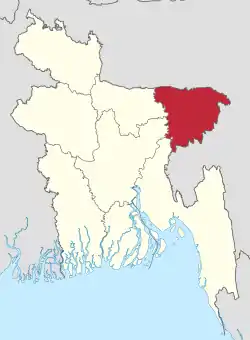
The partition of India was to happen along religious lines. The Muslim-majority areas would form Pakistan while the Hindu-majority areas would form India.[8] Sylhet was a Muslim-majority Bengali-speaking district in Assam which was a Hindu-majority Assamese-speaking province. The Government of Assam believed removing Sylhet would make the state more homogeneous and stronger as a result. Assam's Chief Minister Gopinath Bordoloi said in 1946 that his wish was to "hand over Sylhet to East Bengal".[9] The Government of British Raj declared on 3 July 1947 that a referendum would be held to decide the future of Sylhet on 6 July 1947. H. C. Stock was appointed the commissioner of the referendum.[1]
Result
The majority of the population voted in favour of joining Pakistan. This was implemented via Article 3 of the India Independence Act of 18 July 1947. The Radcliffe line published on 17 August 1947 gave some areas of Sylhet — mainly the Karimganj — to India, while the rest of Sylhet joined East Bengal, even though Karimganj had a majority Muslim population which had opted for Pakistan unlike some other areas in Sylhet like Moulvibazar.[10] The putative cause of this was the plea of a group led by Abdul Matlib Mazumdar.
India received three and a half thanas of Sylhet.[11][12] Along with Karimganj, Zakiganj was also to be a part of the Dominion of India but this was prevented by a delegation led by Sheikh Mujibur Rahman.[13] Thus, most of the Sylhet district of joined East Pakistan which subsequently became independent as Bangladesh in 1971.[14]
The result of the referendum was welcomed by Assamese Hindus.[15]
References
- Chowdhury, Dewan Nurul Anwar Husain (2012). "Sylhet Referendum, 1947". In Islam, Sirajul; Miah, Sajahan; Khanam, Mahfuza; Ahmed, Sabbir (eds.). Banglapedia: the National Encyclopedia of Bangladesh (Online ed.). Dhaka, Bangladesh: Banglapedia Trust, Asiatic Society of Bangladesh. ISBN 984-32-0576-6. OCLC 52727562. Retrieved 15 December 2021.
- Tanweer Fazal (2013). Minority Nationalisms in South Asia. Routledge. pp. 53–54. ISBN 978-1-317-96647-0.
- Hossain, Ashfaque (2013). "The Making and Unmaking of Assam-Bengal Borders and the Sylhet Referendum". Modern Asian Studies. 47 (1): 262. doi:10.1017/S0026749X1200056X. JSTOR 23359785.
It was also decided that education and justice would be administered from Calcutta University and the Calcutta High Court respectively.
- Hossain, Ashfaque (2013). "The Making and Unmaking of Assam-Bengal Borders and the Sylhet Referendum". Modern Asian Studies. 47 (1): 262. doi:10.1017/S0026749X1200056X. JSTOR 23359785.
They could also see that the benefits conferred by the tea industry on the province would also prove profitable for them. For example, those who were literate were able to obtain numerous clerical and medical appointments in tea estates, and the demand for rice to feed the tea labourers noticeably augmented its price in Sylhet and Assam enabling the Zaminders (mostly Hindu) to dispose of their produce at a better price than would have been possible had they been obliged to export it to Bengal.
- William Cooke Taylor, A Popular History of British India. p. 505
- Tanweer Fazal (2013). Minority Nationalisms in South Asia. Routledge. pp. 54–55. ISBN 978-1-317-96647-0.
- Bhuyan, Arun Chandra (2000). Nationalist Upsurge in Assam. Government of Assam.
- "History - British History in depth: The Hidden Story of Partition and its Legacies". bbc.co.uk. BBC. Retrieved 20 November 2016.
- Daniyal, Shoaib. "With Brexit a reality, a look back at six Indian referendums (and one that never happened)". Scroll.in. Retrieved 20 November 2016.
- Qureshi, Murad (14 August 2017). "Sylhet's own Brexit – Partition referendum of 1947". Murad Qureshi. Retrieved 1 June 2021.
- "Recovering Sylhet". Himal Southasian. 22 November 2012. Retrieved 20 November 2016.
- "Assam Election Results - What does it mean for Bangladesh?". The Daily Star. 21 May 2016. Retrieved 20 November 2016.
- Ali, AMM Shawkat (15 August 2004). "Bangabandhu's death anniversary special: As I look back".
- LaPorte, R (1972). "Pakistan in 1971: The Disintegration of a Nation". Asian Survey. 12 (2): 97–108. doi:10.1525/as.1972.12.2.01p0190a.
- Fazal, Tanweer (18 October 2013). Minority Nationalisms in South Asia. Routledge. p. 56. ISBN 978-1-317-96647-0.