Ta-Lo
Ta-Lo (Chinese: 大罗; pinyin: Dà luó), also known as Daluo Tian and the Great Canopy Heaven, is a fictional realm appearing in American comic books published by Marvel Comics. Based on the realm of the same name from Taoism and Confucianism, Ta-Lo is home to the Xian and other beings adapted from Chinese culture, traditional religions and mythology. Ta-Lo first appeared in Thor #301 (November 1980) by Mark Gruenwald, Ralph Macchio and Keith Pollard, and features in stories that follow the Marvel Comics superhero Thor.[1]
| Ta-Lo | |
|---|---|
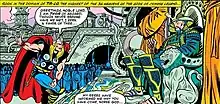 Ta-Lo in Thor #301 (November 1980). Art by Keith Pollard. | |
| First appearance | Thor #301 (November 1980) |
| Race(s) | Xian |
| Publisher | Marvel Comics |
Ta-Lo and its inhabitants made their live-action debut in the Marvel Cinematic Universe (MCU) film Shang-Chi and the Legend of the Ten Rings (2021).
Description
Ta-Lo is the highest of the 36 heavens of the gods of Chinese legend.[2] Along with its 35 lesser heavens, in addition to Fengdu (the Taoist underworld), it comprises a small "pocket" dimension adjacent to Earth. Interdimensional nexuses between Ta-Lo and Earth exist at each of the Five Great Mountains: Tai Shan in the East, Hua Shan in the West, Bei Heng Shan in the North, Nan Heng Shan in the South, and Song Shan in the Center.[3]
Inhabitants
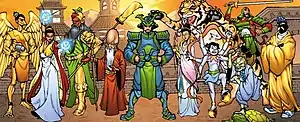
The Xian (also known as the Taoist gods) are a race of superhumanly powerful humanoid beings who have been worshipped by Chinese and other East Asian cultures from 2000 BC into modern times. The Xian all possess certain superhuman physical attributes. Although many Xian begin their existence as mortals, upon eating the Peaches of Immortality ("P'an-t-ao") and achieving apotheosis, they are transformed into true immortals who cease to age and cannot die by conventional means. The Xian also possess additional superhuman powers derived from balancing the positive and negative "chi" energy within their physical forms. For instance, the thunder god Lei Gong possesses a drum and mallet that he uses to produce destructive blasts of thunder. Whereas most other Earth-based pantheons of gods are akin to familial clans, the Xian are analogous to a vast government bureaucracy with a strict hierarchy and clearly defined roles and powers.[3]
Prominent members of the Xian include Guan Yu (god of war), Kui Xing (god of paperwork and examinations), Lei Gong (god of thunder), Nezha (god of mischief), Shou-Hsing (god of health and longevity), Tian-Mu (goddess of lightning), Xi Wangmu (goddess of immortality), Yen-Lo Wang (god of death), Yu Huang (god of heaven), and Zhu Rong (god of fire).[3]
Ta-Lo and its associated heavens are also inhabited by beings other than the Xian, such as fenghuang, dragons, haetae (known in China as guardian lions), and qilin.[3]
Fictional history
According to ancient myths, Yuanshi Tianzun, the Primeval Lord of Heaven, emerged from Wuji, the primordial nothingness, as a result of the merging of the pure breaths of the Earth Mother Gaea (known as "Yin" to the Xian) and the Demiurge (known as "Yang" to the Xian). By preserving the universal balance of Yin and Yang, Yuanshi Tianzun reigned as the supreme administrator of Ta-Lo, and eventually began bestowing P'an-t'ao, the Peaches of Immortality, to mortals whom he deemed worthy of godhood. These newly apotheosized Xian began to assist Yuanshi Tianzun in administrating the Heavens and Earth, and the Xian known as Yu Huang (the Jade Emperor) was personally selected by Yuanshi Tianzun to serve as his successor.[3]
In approximately 1000 AD, Yu Huang met with his fellow Godheads from other Earth-based pantheons to discuss the threat posed by the Third Host of the extraterrestrial Celestials. Yu Huang and the other Godheads confronted the Celestials, who then threatened to sever the dimensional passages connecting their respective realms (including Ta-Lo) to Earth unless the Godheads promised not to interfere with the Celestials' plan to judge humanity's worthiness.[4]
In modern times, after nearly all the Asgardian gods were killed in a subsequent Celestial invasion, Thor traveled to Ta-Lo to obtain the life energies needed to resurrect his fellow Asgardians, which Yu Huang gave him.[2]
Later, after the Asgardian Sky Father Odin had died, Yu Huang was among the Council of Godheads members who deemed Thor unworthy to serve as Odin's replacement as the new Sky Father of the Asgardian people.[5]
Soon after, when the megalomaniacal Egyptian pharaoh Akhenaten was rendered nearly omnipotent and omniscient by the "Heart of the Infinite," the Xian god of longevity Shou-Hsing was among the gods summoned by the Olympian god Zeus to the Council of Godheads to address the threat. The Heliopolitan god Horus, who was most familiar with Akhenaten, used the Eye of Ra to spy on him, but Akhenaten detected the gods and destroyed Shou-Hsing as well as several other Godheads. However, Thanos later obtained the Heart of the Infinite and altered the timeline so that Akhenaten was never imbued with its power, thus diverging Shou-Hsing's death into an alternate reality.[6]
Later, Yu Huang attended the Council of Godheads meeting convened by the Olympian goddess Athena, where it was decided to send a team of Earth gods led by Hercules on a preemptive strike against the extraterrestrial Skrull gods who threatened Earth.[7]
Most recently, when the chi-powered robot known as "the One," believing itself to be Iron Fist's father Wendell Rand, opened an artificial portal between Earth and the Heavens in an attempt to retrieve Rand's deceased wife Heather Rand from the afterlife, the Xian fire god Zhu Rong emerged in Manhattan to punish the mortals for upsetting the universal order. By focusing his chi energy into his fist and launching himself into Zhu Rong, Iron Fist was able to defeat the fire god.[8]
In other media

Ta Lo appears in the 2021 Marvel Cinematic Universe (MCU) film Shang-Chi and the Legend of the Ten Rings, in which it is a mystical heavenly dimension inhabited by various Chinese mythological creatures, including its guardian dragon, the Great Protector. In addition to the fenghuang, haetae, and qilin from the comics, the MCU version of Ta Lo is also populated by huli jing and hundun.[9] Ta Lo can be accessed from Earth through a portal located in China, which is protected by an enchanted bamboo forest which parts on the first day of the Qingming Festival.
When asked in an interview to define the cinematic version of Ta Lo and explain where it fits into the MCU's expanding cosmos, Shang-Chi director Destin Daniel Cretton responded, "The one thing to remember is that Ta Lo is not confined to the little village that we see [in the movie]. Ta Lo is a big world in and of itself, which is a fun place to imagine exploring in the future."[10]
See also
References
- Dominick, Nora. "41 "Shang-Chi" Details That Are Small, Amazing, And Make This Marvel Movie Even More Epic". BuzzFeed. Retrieved September 12, 2021.
- Mark Gruenwald & Ralph Macchio (w), Keith Pollard (p). Thor 301 (November 1980), Marvel Comics
- Anthony Flamini, Greg Pak, Fred Van Lente & Paul Cornell (w), Kevin Sharpe (p), Kevin Sharpe (i). Thor & Hercules: Encyclopaedia Mythologica 1 (July 2009), Marvel Comics
- Mark Gruenwald & Ralph Macchio (w), Keith Pollard (p). Thor 300 (October 1980), Marvel Comics
- Dan Jurgens (w), Ben Lai (p). Thor v2, 61 (May 2003), Marvel Comics
- Jim Starlin (w), Al Milgrom (i). Marvel: The End 2 (May 2003), Marvel Comics
- Greg Pak & Fred Van Lente (w), Rafa Sandoval (p). Incredible Hercules 117 (July 2008), Marvel Comics
- Kaare Andrews (w). Iron Fist: The Living Weapon 10 (March 2015), Marvel Comics
- Mondor, Brooke (September 6, 2021). "All of the Incredible Creatures In Shang-Chi Explained". Looper. Archived from the original on September 12, 2021. Retrieved September 12, 2021.
- Downey, Mason (September 7, 2021). "What Is Shang-Chi's Ta Lo And Where Does It Fit Into The MCU?". GameSpot. Archived from the original on September 7, 2021. Retrieved September 11, 2021.
| Supporting characters | |||||||||
|---|---|---|---|---|---|---|---|---|---|
| Antagonists |
| ||||||||
| Locations | |||||||||
| Items | |||||||||
| Bibliography | |||||||||
| In other media |
| ||||||||
| Alternative versions | |||||||||
| Related articles | |||||||||
| |||||||||

| Supporting characters | |
|---|---|
| Teams | |
| Enemies | |
| Locations | |
| Publications | |
| Other media | |
| |