Takeuti–Feferman–Buchholz ordinal
In the mathematical fields of set theory and proof theory, the Takeuti–Feferman–Buchholz ordinal (TFBO) is a large countable ordinal, which acts as the limit of (largest number definable using) Buchholz's psi function and Feferman's theta function.[1][2] It was named by David Madore,[2] after Gaisi Takeuti, Solomon Feferman and Wilfried Buchholz. It is written as in Buchholz's psi function,[3] an OCF invented by Wilfried Buchholz,[4][5][6] and in Feferman's theta function, an OCF invented by Solomon Feferman.[7][8] It is the proof-theoretic ordinal of ,[9] a subsystem of second-order arithmetic, -comprehension + transfinite induction,[3] IDω, the system of ω-times iterated inductive definitions[10] and KPI, Kripke-Platek set theory with a recursively inaccessible universe.[10]


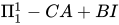

Despite being one of the largest large countable ordinals and recursive ordinals, it is still vastly smaller than the proof-theoretic ordinal of ZFC.[11]
Definition
- Let represent an uncountable ordinal with cardinality .
- Let represent the th epsilon number, equal to the th fixed point of
- Let represent Buchholz's psi function
- The TFBO is equal to .


In other words, the TFBO is the smallest ordinal which cannot be expressed from , , and using sums, products, exponentials, and the function itself, the latter of which only to previously constructed ordinals less than .


References
- "Buchholz's ψ functions". cantors-attic. Retrieved 2021-08-10.
- "Buchholz's ψ functions". cantors-attic. Retrieved 2021-08-17.
- "A Zoo of Ordinals" (PDF). Madore. 2017-07-29. Retrieved 2021-08-10.
- "Collapsingfunktionen" (PDF). University of Munich. 1981. Retrieved 2021-08-10.
- "A new system of proof-theoretic ordinal functions". Annals of Pure and Applied Logic. 32: 195–207. 1986-01-01. doi:10.1016/0168-0072(86)90052-7. ISSN 0168-0072.
- Buchholz, W.; Schütte, K. (1988). "Proof Theory of Impredicative Subsystems of Analysis". undefined. Retrieved 2021-08-10.
- "[PDF] Proof Theory Second Edition by Gaisi Takeuti | Perlego". www.perlego.com. Retrieved 2021-08-10.
- Buchholz, W. (1975). "Normalfunktionen und Konstruktive Systeme von Ordinalzahlen". ⊨ISILC Proof Theory Symposion (in German). Springer: 4–25. doi:10.1007/BFb0079544.
- Buchholz, Wilfried; Feferman, Solomon; Pohlers, Wolfram; Sieg, Wilfried (1981). "Iterated Inductive Definitions and Subsystems of Analysis: Recent Proof-Theoretical Studies". Lecture Notes in Mathematics. doi:10.1007/bfb0091894. ISSN 0075-8434.
- "ordinal analysis in nLab". ncatlab.org. Retrieved 2021-08-28.
- "number theory - Can PA prove very fast growing functions to be total?". Mathematics Stack Exchange. Retrieved 2021-08-17.