Talib Jauhari
Talib Johri (27 August 1929 – 21 June 2020)[1] (Urdu: طالب جوہری) was a Pakistani Islamic scholar, poet, historian and philosopher of the Shia Sect of Islam.[2] He is widely renowned as the most prominent Shia scholar, and his sermons were broadcast on PTV Network.[3]
Allama Talib Johri علامہ طالب جوہری | |
|---|---|
 Allama Talib Jauhri | |
| Personal | |
| Born | August 27, 1929[1] |
| Died | June 21, 2020 (aged 90) |
| Religion | Islam |
| Nationality | Pakistani |
| Era | Modern era |
| Denomination | Shīʿa |
| Main interest(s) | Islamic law, Islamic philosophy, Quranic exegesis, Hadith, Ilm al-Kalam, Falsafah, Mantiq |
| Notable idea(s) | interpretation (Tafsir) of Quran |
| Muslim leader | |
| Website | allamatalibjauharifans |

Education
Talib Jauhari obtained his initial religious education from his father Maulana Muhammad Mustafa Jauhar. He then went to the holy city of Najaf, Iraq in order to receive higher religious education in Hauza – e – Ilmia Najaf Al- Ashraf Najaf, Iraq. He studied there for almost 12 years where scholars like Ayatullah al-Uzma Sayyid Mohsin Taba’Tabai, Ayatullah al-Uzma Sayyid RoohAllah Khomeni & Ayatullah al-Uzma Sayyid Baqir al-Sadr were his teachers. After receiving the equivalent education of an Ayatullah, he then returned back to Karachi during 1960’s.
Allama Talib Jauhari also studied under Sayyid Abu al-Qasim al-Khoei. He was a student of Muhammad Baqir al-Sadr. He has been a class fellow of Sayyid Ali Sistani, although Sistani was among his seniors. Zeeshan Haider Jawwadi was also one of his class fellows in Najaf."[6][7]
Books
Talib Jauhari wrote Hadees e Karabala and several books, including a detailed commentary on the Quran. His book Alamaat e Zahoor e Mehdi is considered as one of the most comprehensive book compiled and written on the topic of Imam Mehdi in Urdu language.[8] He was also a poet, and three compilations of his poetry were published during his lifetime.[9] The following is a list of his known works:
- Ahsan al Hadees (Qur'anic exegesis)
- Hadees e Karabala
Religion:
- Zikray Masoom
- Nizaam Hayat-e-Insani
- Khulafaey Isna A'shr
- Alamatay Zahooray Mehdi
Philosophy:
- Aqliyat-e-Ma'asir (2005)
Poetry:
- Harf-e-Namoo (Urdu poetry)
- Pas-e-Afaq (Urdu poetry)
- Shakh e Sada (Urdu poetry)
Recognition and awards
The Government of Pakistan awarded him the Sitara-i-Imtiaz for his contribution in the field of religious activities.[10]
Death and legacy
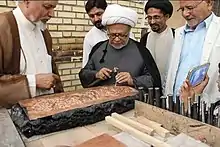
The 91-year-old Johri was admitted to a private hospital on 10 June. He is said to have been suffering from cardiovascular complications and was on ventilator since then,[11] he died on 22 June. However Chief Minister Sindh Murad Ali Shah revealed in a speech at Sindh Assembly that Talib Jauhri, Munawar Hasan and Mufti Naeem, all the three clerics died past week were due to COVID-19 during the COVID-19 pandemic in Pakistan.[12]
He was survived by three sons and three daughters.[13] Prime Minister of Pakistan Imran Khan, President Arif Alvi, Army Chief Qamar Javed Bajwa expressed sadness over his death.[14][15] Earlier in 2014 his son-in-law Syed Mubarak Raza Kazmi was killed in ‘sectarian’ attack [16] in Karachi 13/B, Gulshan-e-Iqbal.
See also
References
- "CM Murad Reveals Munawar Hassan, Talib Jauhari, Mufti Naeem Died From Coronavirus". Naya Daur. 26 June 2020. Retrieved 21 November 2021.
- "علامہ طالب جوہری کیلئے دعائے صحت". Jang News.
- https://www.ptvold.com/2020/06/allama-talib-johri-passed-away.html
- "Allama Talib Jauhari". www.allama.50megs.com.
- "Renowned religious Islamic scholar Allama Talib Johri passes away | VOSA". 22 June 2020.
- "Allama Talib Jauhari– End of a glorious era". 22 June 2020.
- "Renowned scholar Allama Talib Jauhri passes away". 22 June 2020.
- "Renowned Islamic scholar Allama Talib Johri passes away". The News International.
- "Renowned religious scholar Allama Talib Johri passes away". Geo News.
- "Known scholar Allama Talib Johri passes away". 24 News HD. 22 June 2020.
- "Allama Talib Johri passes away in Karachi". BOL News. 21 June 2020.
- "CM Murad Reveals Munawar Hassan, Talib Jauhari, Mufti Naeem Died From Coronavirus". Naya Daur. 26 June 2020. Retrieved 26 June 2020.
- "Allama Talib Jauhari, Pakistan's renowned Shia scholar, passes away | SAMAA". Samaa TV.
- "Army Chief Gen Bajwa condoles over the death of Allama Talib Jauhari". 22 June 2020.
- "President, Prime Minister others condole demise of Talib Jauhari". Daily Parliament Times. 22 June 2020.
- "Talib Jauhari's son-in-law killed in 'sectarian' attack". The News International.
External links
- "Khursheed-e-Khawar" by Hujjat-ul-Islam Maulana Saeed Akhtar from India (A book on biography of the Shia scholars of South Asia)
- Fehm-ul-Quran series by Allama Talib Jauhari on PTV
- Allama Talib Jauhari Books
- Allama Talib Jauhari Online Books
- Allama Talib Jauhri Speeches (Majaalis)
- Ahsan-al-hadees by Allama Talib Jauhari
- Allama Talib Jauhari Lectures/Majalis
- Unity and justice of God Book by Maulana Muhammad Mustafa Jauhar
- 'Truth Wisdom and Justice behind Oneness of Allah' by Maulana Jauhar
- Maulana Mushammad Mustafa Jauhar Lectures
- Allama Amjad Jauhari Majalis
- Assassination attempt on Allama Talib Jauhari
