Tamil Brahmin
Tamil Brahmins are Tamil-speaking Brahmins, predominantly living in Tamil Nadu, although a few of them have settled in other states like Telangana, Andhra Pradesh, Kerala and Karnataka and other states. Tamil Brahmins also live in Sri Lanka.[1] They can be broadly divided into three groups, Gurukkals who follow Saivism, Iyers who follow the Srauta and Smartha tradition and Iyengars who follow Sri Vaishnavism.
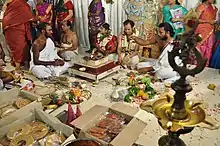 A Tamil Brahmin marriage ceremony | |
| Regions with significant populations | |
|---|---|
| Indian states of Tamil Nadu, Karnataka, Telangana, Kerala and Andhra Pradesh. Also Sri Lanka. | |
| Languages | |
| Tamil | |
| Religion | |
| Hinduism | |
| Related ethnic groups | |
| Pancha-Dravida Brahmins, Tamil people |
Groups
Tamil Brahmins are divided into three groups – Iyers, Iyengars and Gurukkal. Iyers form the majority of the Tamil Brahmin population and are Smarthas, while Iyengars are Vaishnavas and Gurukkals are Saivas.
Iyer
Iyers are Srauta-Smartha Brahmins, most of whom follow the Advaita philosophy propounded by Adi Shankara, and are concentrated mainly along the Cauvery Delta districts of Nagapattinam, Thanjavur, Tiruvarur and Tiruchirapalli where they form almost 10% of the total population. However the largest population reside in Nagercoil, making up to 13% of the city's population.[2][3][4] They are also found in significant numbers in Chennai,[5] Coimbatore, Madurai, Thiruchirappalli, Thanjavur, Palakkad, Alappuzha, Kozhikode, Ernakulam, Kannur, and Thiruvananthapuram.[6]
Iyengar
Iyengars follow the Visishtadvaita philosophy propounded by Sri Vikanasa or Sri Ramanujacharya. They are divided into two sub-sects: Vadakalai (Northern branch) and Thenkalai (Southern branch). They are devout worshippers of Vishnu.
Gurukkal
The Gurukkal are priests in Shiva, Shakthi and Vinayaka temples. They follow the Shaiva Siddhanta tradition, mainly doing pooja and other priestly works in Shitive temples. They are called "patter" in the southern parts and "gurukkal" in the northern parts of Tamil Nadu.
Notable people
- Sage Agastya, revered Indian sage of Hinduism, Tamil Siddhar in the Shaivism tradition, and author of Agattiyam, an early grammar of the Tamil language[7]
- Viswanathan Anand, Indian Chess Grandmaster
- Rukmini Devi Arundale, Classical Bharata Natyam dancer, theosophist, choreographer and an activist for animal welfare.
- Ravichandran Ashwin, Indian cricketer
- Indra Nooyi, Former CEO of PepsiCo
- K. Balachander, Indian filmmaker and playwright
- Maadhu Balaji, Indian actor
- Subramania Bharati, Indian independence activist and poet[8]
- Subrahmanyan Chandrasekhar, Nobel Prize-winning astrophysicist[9]
- Seetha Doraiswamy, Carnatic multi-instrumentalist
- Gemini Ganesan, Indian actor
- Shyamala Gopalan, biomedical scientist, Mother of U.S. Vice President Kamala Harris[10]
- Kamal Haasan, Indian actor
- Semmangudi Srinivasa Iyer, Indian Carnatic vocalist
- Shreyas Iyer, Indian cricketer
- U. V. Swaminatha Iyer, Tamil scholar and researcher[11]
- J. Jayalalithaa, politician (Former Chief Minister of Tamil Nadu), Indian actress
- Ramya Krishnan, Indian actress
- Kasthuri, Indian actress
- S. Srinivasan, Indian aeronautical engineer
- Janani Iyer, Indian actress
- Trisha Krishnan, Indian actress
- Padma Lakshmi, Indian American author, activist, model, and television host.
- R. Madhavan, Indian actor
- Hema Malini, Indian actress
- Crazy Mohan, Indian actor
- Venniradai Moorthy, Indian actor
- T. S. B. K. Moulee, Indian actor
- Shankar Mahadevan, Indian Singer and Composer
- Nachinarkiniyar, medieval Tamil scholar and commentator of the Tolkāppiyam, Pattuppāṭṭu, Kaliththokai, Kuṟuntokai and Civaka Cintamani[12]
- Nambi Narayanan, Indian aerospace engineer
- Paridhiyaar, medieval Tamil scholar and Kural commentator[13]
- Parimelalhagar, medieval Tamil scholar and Kural commentator[14]
- Sundar Pichai, CEO of Alphabet Inc.[15]
- C. Rajagopalachari, statesman, politician, Indian independence activist, last Governor-General of India, Former Chief Minister of Madras State
- Venki Ramakrishnan, Nobel Prize-winning structural biologist[16]
- C. V. Raman, Nobel Prize-winning physicist[17]
- Srinivasa Ramanujan, Indian mathematician[18]
- Cho Ramaswamy, Indian actor
- C. S. Seshadri, mathematician.[19]
- Krishnamachari Srikkanth, Indian cricketer
- Padma Subrahmanyam, Classical Bharata Natyam dancer
- Subramanian Swamy, Indian politician, economist and statistician
- Tolkappiyar, earliest known author and grammarian in Tamil language[20]
- Vaali, Indian poet and Lyricist
- S. R. Srinivasa Varadhan, mathematician and Abel Prize laureate[21]
- Vyjayanthimala, Indian actress
References
- "Team - Noolaham Foundation".
- "Brahmins seek reservation in education and employment". The Hindu. 19 September 2008. Retrieved 22 June 2019.
- G. S. Ghurye, Pg 393
- Migration and Urbanization among Tamil Brahmans, Pg 5
- Migration and Urbanization among Tamil Brahmans, Pg 15
- "Approaching societal issues through the eyes of Ambedkar". dtNext.in. 10 April 2017. Retrieved 20 May 2018.
- Companion Studies to the History of Tamil Literature, Appendix III, The Case of Akattiyam; Sanskrit and Tamil; Kankam, Pg 235–260
- Indian Literature: An Introduction. University of Delhi. Pearson Education India. 2005. pp. 125–126. ISBN 9788131705209.
- "Who was S Chandrasekhar?". The Indian Express. 19 October 2017. Retrieved 13 January 2019.
- Dhume, Sadanand (20 August 2020). "What Kamala Harris Isn't Saying About Her Mother's Background - WSJ". Wall Street Journal. Retrieved 21 January 2021.
Ms. Harris’s mother also figures in another tale told less often: of India’s small and successful Tamil Brahmin diaspora
- Viswanathan, S. (26 February – 11 March 2005). "The patriarch of Tamil". Frontline, Vol. 22, Issue 5. Retrieved 7 July 2021.
- Chitty, Simon Casie (1859). The Tamil Plutarch, containing a summary account of the lives of poets and poetesses of Southern India and Ceylon. Jaffna: Ripley & Strong. p. 57.
- M. V. Aravindan (2018). உரையாசிரியர்கள் [Commentators]. Chennai: Manivasagar Padhippagam. pp. 348–360.
- Ki. Vaa. Jagannathan (1963). திருக்குறள், ஆராய்ச்சிப் பதிப்பு [Tirukkural, Aaraicchi Pathippu] (3 ed.). Coimbatore: Ramakrishna Mission Vidhyalayam.
- "Opinion: Tamil Brahmin emigration was driven by opportunity, not socialism or identity politics". The News Minute. 26 August 2020. Retrieved 3 October 2021.
- "Common root: Tamil Nadu gets its third laureate". Times of India. TNN. 8 October 2009.
- "CV Raman Birth Anniversary 2020: Interesting Facts About The Nobel Laureate". NDTV.com. Retrieved 23 June 2021.
- Kanigel, Robert (1991). The Man Who Knew Infinity: a Life of the Genius Ramanujan. New York: Charles Scribner's Sons. pp. 11–12. ISBN 978-0-684-19259-8.
- "From Proofs to Transcendence, via Theorems and Rāgas – Bhāvanā". Retrieved 30 July 2020.
We are a Shree Vaishnavite Brahmin family
- Kamil Zvelebil (1973), The Smile of Murugan: On Tamil Literature of South India, BRILL, p. 136, ISBN 90-04-03591-5
- "Srinivasa Varadhan". Abel Prisen. Archived from the original on 5 November 2016. Retrieved 25 March 2018.
I came from a Brahmin community, viewed by the government as privileged, and there was reverse discrimination