Tarapacá
San Lorenzo de Tarapacá, also known simply as Tarapacá, is a town in the region of the same name in Chile.
San Lorenzo de Tarapacá
Tarapacá | |
|---|---|
Town | |
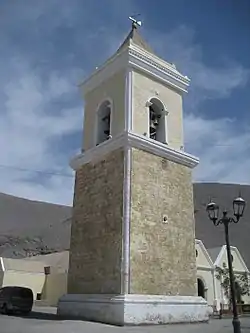 San Lorenzo Church in Tarapacá | |
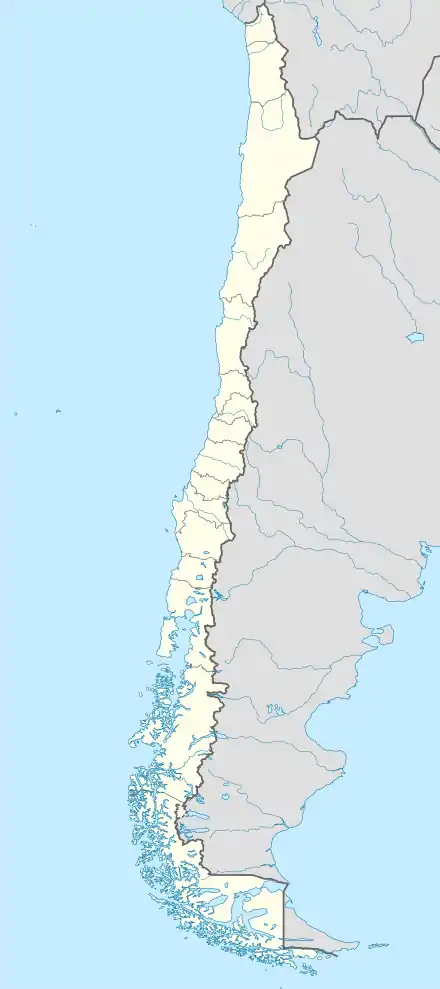  San Lorenzo de Tarapacá | |
| Coordinates: 19°54′S 69°30′W | |
| Country |  Chile Chile |
| Region | Tarapacá |
| Province | Tamarugal |
| Commune | Huara |
| Founded | 1532 |
| Elevation | 1,350 m (4,430 ft) |
| Population | |
| • Estimate (2002) | 135 |
History
The town was part of the Viceroyalty of Peru, and then of the Peruvian state, and saw itself the protagonist of the Battle of Tarapacá during the War of the Pacific. Despite the Peruvian victory, the troops located in the area relocated to nearby Arica, allowing the Chilean Army to occupy the area, creating a disadvantage, and was afterwards given to Chile under the Treaty of Ancón.[1][2] After the war, the Peruvian refugees who had formerly inhabited the town were sent by the Peruvian government to the Loreto region, in order to populate the area. The areas in which they settled were called Tarapacá and Puerto Arica, in Northern Amazonas. However, after the Salomón–Lozano Treaty, the area was ceded to Colombia, with the original inhabitants moving south to Maynas, next to the Napo River, founding another Puerto Arica and Tarapacá.
Notable people
- Ramón Castilla, President of Peru.
- Antonio Gutiérrez de la Fuente, military leader and provisional President of Peru.
- Bautista van Schouwen, Chilean marxist, founder of the Revolutionary Left Movement
References
- Esposito, Gabriele (20 Jan 2016). Armies of the War of the Pacific 1879–83: Chile, Peru & Bolivia. Bloomsbury Publishing. p. 10. ISBN 9781472814074.
- Tamayo, José (1985). Nuevo Compendio de Historia del Perú. Editorial Lumen. p. 288-289.