Tasmanian Government
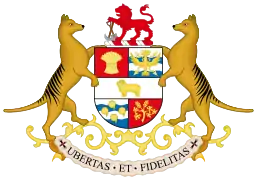
The Tasmanian Government is the democratic administrative authority of the state of Tasmania, Australia. The leader of the party or coalition with the confidence of the House of Assembly, the lower house of the Parliament of Tasmania, is invited by the governor of Tasmania to form government. The head of government is the premier of Tasmania.
| State Government | |
  | |
| Formation |
|
|---|---|
| Founding document | Constitution of Tasmania |
| State |  Tasmania Tasmania |
| Country | .svg.png.webp) Australia Australia |
| Website | tas |
| Crown | |
| Head of state (sovereign) | Monarch (Queen) |
| Vice-regal representative | Governor |
| Seat | Government House |
| Legislative branch | |
| Legislature | Parliament of Tasmania |
| Meeting place | Parliament House |
| Executive branch | |
| Head of government | Premier |
| Main body | Cabinet of Tasmania |
| Appointer | Governor on behalf of the Queen of Australia in right of the State of Tasmania. |
| Headquarters | Executive Building 15 Murray Street, Hobart |
| Main organ | Executive Council of Tasmaina |
| Departments | 8 departments |
| Judicial branch | |
| Court | Supreme Court |
| Seat | Supreme Court building, Hobart |
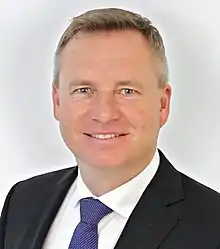
Since the 20 January 2020, the premier of Tasmania has been Peter Gutwein, leader of the Liberal Party. The current ministry of Tasmania is the Second Gutwein Ministry, formed on 19 May 2021 and comprising nine of the 13 Liberal members in the House of Assembly and one in the Legislative Council.
Constitutional framework
Tasmania is governed according to the principles of the Westminster System, a form of parliamentary responsible government based on the model of the United Kingdom. Legislative power rests with the bicameral Parliament of Tasmania, which consists of the governor of Tasmania (the sovereign), and the two chambers: the Legislative Council and the House of Assembly.[1]
Executive power rests formally with the Executive Council, which consists of the governor and senior ministers, and informally called the Cabinet. In practice, executive power is exercised by the premier of Tasmania upon the advice of the Cabinet, who are appointed by the governor, but who hold office by virtue of their ability to command the support of a majority of members of the House of Assembly.
Judicial power is exercised by the Supreme Court of Tasmania and a system of subordinate courts. As with all states, upon federation, Tasmania accepted the authority of the federal High Court of Australia to overrule the state judiciary.
Current Ministry
The current ministry of Tasmania is the Second Gutwein Ministry, formed on 19 May 2021 and comprising nine Liberal members, eight of whom sit in the House of Assembly, and one in the Legislative Council:
| Minister | Portfolio | Portrait | Party | Opposition counterpart | Portfolio | Portrait | Party | ||
|---|---|---|---|---|---|---|---|---|---|
| Peter Gutwein MP | Premier Minister for Climate Change Minister for Tourism |
.jpg.webp) |
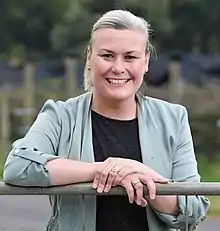
Liberal | Rebecca White MP | Leader of the Opposition Shadow Minister for Tourism Shadow Minister for Climate Change |
.jpg.webp) |
Labor | ||
| Treasurer | Shane Broad MP | Shadow Treasurer | Labor | ||||||
| Jeremy Rockliff MP | Deputy Premier Minister for Advanced Manufacturing and Defence Industries |
 |
Liberal | Anita Dow MP | Deputy Leader of the Opposition Shadow Minister for Advanced Manufacturing and Defence Industries |
 |
Labor | ||
| Minister for Health Minister for Mental Health and Wellbeing |
Bastian Seidel MLC | Shadow Minister for Health, Mental Health and Wellbeing | Labor | ||||||
| Minister for Community Services and Development | Jo Siejka MLC | Shadow Minister for Community Services and Development |  |
Labor | |||||
| Elise Archer MP | Attorney-General Minister for Justice Minister for Corrections |
Liberal | Ella Haddad MP | Shadow Attorney-General Shadow Minister for Justice Shadow Minister for Corrections Shadow Minister for Equality and Multicultural Affairs |
Labor | ||||
| Minister for the Arts | Michelle O'Byrne MP | Shadow Minister for the Arts and Creative Industries | Labor | ||||||
| Minister for Workplace Safety and Consumer Affairs | Sarah Lovell MLC | Shadow Minister for Workplace Relations | Labor | ||||||
| Jen Butler MP | Shadow Minister for Building and Consumer Affairs | .jpg.webp) |
Labor | ||||||
| Michael Ferguson MP | Minister for Science and Technology | Liberal | Shadow Minister for ICT and Science | ||||||
| Minister for Infrastructure and Transport | Rebecca White MP | Shadow Minister for Infrastructure | |
Labor | |||||
| Josh Willie MLC | Shadow Minister for Transport | Labor | |||||||
| Minister for State Development, Construction and Housing | Anita Dow MP | Shadow Minister for Housing and Construction | |
Labor | |||||
| Dean Winter MP | Shadow Minister for Economic Development | Labor | |||||||
| Leader of the House Minister for Finance |
Leader of Opposition Business Shadow Minister for Finance | ||||||||
| Guy Barnett MP | Minister for Energy and Emissions Reduction | 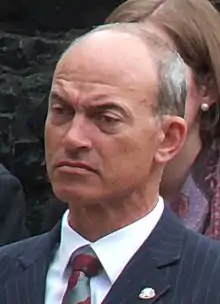 |
Liberal | Shadow Minister for Energy and Emissions Reduction | |||||
| Minister for Resources Minister for Trade |
Shane Broad MP | Shadow Minister for Resources Shadow Minister for Trade |
Labor | ||||||
| Minister for Primary Industries and Water | Janie Finlay MP | Shadow Minister for Primary Industries and Water Shadow Minister for Start Ups |
Labor | ||||||
| Minister for Veterans' Affairs | Jen Butler MP | Shadow Minister for Veterans Affairs | |
Labor | |||||
| Sarah Courtney MP | Minister for Hospitality and Events | Liberal | Rebecca White MP | Shadow Minister for Hospitality and Events | |
Labor | |||
| Minister for Children and Youth | Sarah Lovell MLC | Shadow Minister for Child Safety | Labor | ||||||
| Jo Siejka MLC | Shadow Minister for Youth Shadow Minister for Ageing |
|
Labor | ||||||
| Minister for Disability Services | Shadow Minister for Disability | ||||||||
| Minister for Education Minister for Skills, Training and Workforce Growth |
Josh Willie MLC | Shadow Minister for Education and Early Years Shadow Minister for TAFE, University and Skills and Training |
Labor | ||||||
| Jane Howlett MLC | Minister for Sport and Recreation Minister for Small Business |
Liberal | Shadow Minister for Sport | ||||||
| Minister for Racing | Dean Winter MP | Shadow Minister for Racing | Labor | ||||||
| Minister for Women | Michelle O'Byrne MP | Shadow Minister for Women | Labor | ||||||
| Roger Jaensch MP | Minister for Aboriginal Affairs Minister for Heritage Minister for State Growth |
Liberal | Shadow Minister for Aboriginal Affairs Shadow Minister for Heritage | ||||||
| Minister for Local Government and Planning | Anita Dow MP | Shadow Minister for Local Government and Planning | |
Labor | |||||
| Minister for Environment | Bastian Seidel MLC | Shadow Minister for Parks and Environment | Labor | ||||||
| Jacquie Petrusma MP | Minister for Parks | Liberal | |||||||
| Minister for Police, Fire and Emergency Management Minister for the Prevention of Family Violence |
Michelle O'Byrne MP | Shadow Minister for Police, Fire and Emergency Management Shadow Minister for the Prevention of Family Violence |
Labor | ||||||
| Source: Premier of Tasmania – Cabinet Parliament of Tasmania – Shadow Ministry | |||||||||
Tasmanian government agencies
The Tasmanian Government delivers services, determines policy, and issues regulations through a number of agencies grouped under areas of portfolio responsibility. Each portfolio is led by a Secretary, who reports to one or more government ministers, a member of Parliament. As of April 2016 there are eight government departments:[2]
- Department of Education
- Department of Health
- Department of Justice
- Department of Police, Fire and Emergency Management
- Department of Premier and Cabinet
- Department of Primary Industries, Parks, Water and Environment
- Department of State Growth
- Department of Treasury and Finance
A range of other agencies support the functions of these departments.
State-owned businesses
The Government of Tasmania also owns and operates a number of state-owned companies:[3]
- Aurora Energy: electricity and gas retailer.
- Forestry Tasmania: the manager of public forests and plantations for logging, sawmilling and woodchipping.
- Hydro Tasmania: a large generator of electricity, management of hydroelectric schemes. Also owns a mainland Australian energy retailer, Momentum Energy.
- Tasmanian Irrigation: tasked with the planning, construction and maintenance of the Tasmanian Irrigation Schemes culminating pipes, dams and pumping stations.
- Metro Tasmania: a public transportation company, running busses in the metropolitan areas of the state.
- Motor Accidents Insurance Board (MAIB): public insurance resulting from car accidents.
- Port Arthur Historic Site Management Authority: operates the tourism venture at Port Arthur, maintains the ruins of the gaol and historic site.
- Public Trustee: an independent trustee organisation.
- Tascorp: management of the other public companies' finances and government investment.
- Tasmanian Rail: freight transportation, railway management.
- TasNetworks: electricity transmission and distribution.
- TasPorts: port management and stevedoring.
- Tasracing: the operator of Tasmania's horse and dog racing venues, management of betting.
- TT-Line Company: operates the Bass Strait ferries.
Other levels of government
Federal representation of Tasmania
As a state of Australia, Tasmania is represented in the federal House of Representatives and Senate. Tasmania has five representative in the federal House of Representatives for the electoral divisions of Bass, Braddon, Denison, Franklin, and Lyons. Tasmania also has twelve Senators in line with other states.
Local government in Tasmania
29 local government elections are conducted under the Local Government Act using the Hare-Clark voting system of multi-member proportional representation. Elections for mayor, deputy mayor and half the councillor positions are held during September and October in each uneven numbered year. These include six cities (three in greater Hobart, one covering each of Launceston, Burnie, and Devonport) and twenty-three municipalities. The largest council (by number of eligible voters) is the City of Launceston and the smallest council is the Municipality of Flinders (which serves Flinders Island and the surrounds, with just over 800 electors)
References
- Constitution Act 1934 (Tas) s.10
- "Tasmanian Government Organisations". Service Tasmania. Government of Tasmania. 14 April 2016.
- "Tasmanian Government Businesses". Tasmanian Department of Treasury and Finance. Tasmanian Government.
External links
- Government of Tasmania website
- The Constitution of Tasmania in AustLII (link ineffective)
- Constitution Act 1934 (Tas) as enacted
Governments of Australian states and territories | ||
|---|---|---|
| States and mainland territories |  | |
| External territories |
| |
Authority control  | |
|---|---|
| General | |
| Other | |