Tartary
Tartary (Latin: Tartaria, French: Tartarie, German: Tartarei, Russian: Тартария, romanized: Tartariya) or Tatary (Russian: Татария, romanized: Tatariya) was a blanket term used in Western European literature and cartography for a vast part of Asia bounded by the Caspian Sea, the Ural Mountains, the Pacific Ocean, and the northern borders of China, India and Persia, at a time when this region was largely unknown to European geographers. The active use of the toponym (place name) can be traced from the 13th to the 19th century. In European sources, Tartary became the most common name for Central Asia in a series of negatively colored names that had no connection with the real polities or ethnic groups of the region; until the 19th century, European knowledge of the area remained extremely scarce and fragmentary. In modern English-speaking tradition, the region formerly known as Tartary is usually called Inner or Central Eurasia. Much of this area consists of arid plains, the main population of which in the past was engaged in animal husbandry.[1]

Tartary was not a country, but rather a European name for a region poorly understood by Europeans. Ignorance surrounding Tartary's use as a place name has spawned conspiracy theories on the internet including ideas of a "hidden past" and "mudflood". Such theories contend, falsely, that Tartary (or "Tartaria") was a lost civilization with advanced technology and culture. This ignores the well documented history of Asia, which Tartary refers to.[2] In the present day, the Tartary region covers a region spanning from central Afghanistan to northern Kazakhstan, as well as areas in present Mongolia, China and the Russian Far East in "Chinese Tartary".
Geography and history
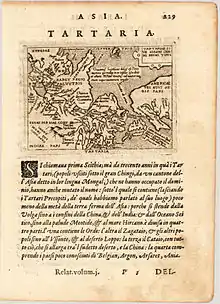
Knowledge of Manchuria, Siberia and Central Asia in Europe prior to the 18th century was limited. The entire area was known simply as "Tartary" and its inhabitants "Tartars".[3] In the Early modern period, as understanding of the geography increased, Europeans began to subdivide Tartary into sections with prefixes denoting the name of the ruling power or the geographical location. Thus, Siberia was Great Tartary or Russian Tartary, the Crimean Khanate was Little Tartary, Manchuria was Chinese Tartary, and western Central Asia (prior to becoming Russian Central Asia) was known as Independent Tartary.[3][4][5] By the seventeenth century, however, largely under the influence of Catholic missionary writings, the word "Tartar" came to refer to the Manchus and the lands they ruled as "Tartary".[6]
European opinions of the area were often negative, and reflected the legacy of the Mongol invasions that originated from this region. The term originated in the wake of the widespread devastation spread by the Mongol Empire. The adding of an extra "r" to "Tatar" was suggestive of Tartarus, a Hell-like realm in Greek mythology.[3] In the 18th century, conceptions of Siberia or Tartary and its inhabitants as "barbarous" by Enlightenment-era writers tied into contemporary concepts of civilization, savagery and racism.[7]
More positive opinions were also expressed by Europeans. Some saw Tartary as a possible source of spiritual knowledge lacking in contemporary European society. In Five Years of Theosophy, edited by Theosophist and scholar G.R.S. Mead, polymath and "seer" Emanuel Swedenborg is quoted as having advised: "Seek for the Lost Word among the hierophants of Tartary, China, and Tibet."[8]
Decline
The usage of "Tartary" declined as the region became more known to European geographers; however, the term was still used long into the 19th century.[5] Ethnographical data collected by Jesuit missionaries in China contributed to the replacement of "Chinese Tartary" with Manchuria in European geography by the early 18th century.[3] The voyages of Egor Meyendorff and Alexander von Humboldt into this region gave rise to the term Central Asia in the early 19th century as well as supplementary terms such as Inner Asia,[5] and Russian expansionism led to the term "Siberia" being coined for the Asian half of the Russian Empire.[4]
By the 20th century, Tartary as a term for Siberia and Central Asia was obsolete. However, it lent the title to Peter Fleming's 1936 book News from Tartary, which detailed his travels in Central Asia.
Tartaria conspiracy theory
The pseudohistorical conspiracy theory about Great Tartaria first appeared in Russia, popularized by Nikolai Levashov, and in Anatoly Fomenko’s New chronology. In Russian pseudoscience, known for its nationalism, Tartaria is presented as the "real" name for Russia, which was maliciously "ignored" in the West (for example, the 2011 film "Great Tartary - Empire of the Rus", posted on YouTube).[9][10] Since about 2016, conspiracy theories about the supposed lost empire of "Tartaria" have gained some steam on the English-speaking part of the Internet.
The conspiracy is based mostly in a misunderstanding of architectural history. Adherents suppose that demolished buildings such as the Singer Building, or the temporary grounds of the 1915's World's Fair were actually the buildings of a vast empire based in Tartary that has been suppressed from history. Sumptuously styled Gilded Age buildings are often held out as really having been built by the supposed Tartarian. The conspiracy is very light on details, and only vaguely describes how such a supposedly advanced civilization which had reputedly achieved world peace could have fallen and been hidden. The idea that a "mud flood" wiped out much of the world and thus old buildings is common, supported only by the fact that some buildings have basements which had windows. World War I & II are cited as a way in which Tartaria was destroyed and hidden, reflecting the reality that the extensive bombing campaigns of World War II did destroy many historic buildings. The general evidence for the theory is that there are similar styles of building around the world, such as capital buildings with domes, or star forts. However, such designs exist globally due to colonialism by empires such as Britain, Spain, and Portugal, not some lost empire such as Tartaria. The theory reflects a cultural discontent with modernism, and a supposition that traditional styles are inherently good and modern styles are bad.
References
Citations
- Connell, Charles W. (2016). Ryan, James D. (ed.). "Western Views of the Origin of the 'Tartars': An Example of the Influence of Myth in the Second Half of the Thirteenth Century". The Spiritual Expansion of Medieval Latin Christendom: The Asian Missions. The Expansion of Latin Europe, 1000–1500. New York: Routledge: 103–25. ISBN 978-0754659570.
- Dunning, Brian (February 2021). "Skeptoid #765: Tartaria and the Mud Flood". Skeptoid. Retrieved 2021-09-16.
- Elliott, "The Limits of Tartary", 625–26
- Vermeulen, "Before Boas", 88
- Sela, "L'invention", 542
- Dong, Shaoxin (2020), "The Tartars in European Missionary Writings of the Seventeenth Century", in Weststeijn, Thijs (ed.), Foreign Devils and Philosophers Cultural Encounters between the Chinese, the Dutch, and Other Europeans, 1590-1800, Leiden: Brill, pp. 82–83, ISBN 9789004418929
- Wolff, "Global Perspective", 448
- Mead, G.R.S. (2004). Five Years of Theosophy. Project Gutenberg.
- Gorshenina 2014, pp. 462–463.
- Gorshenina 2019, p. 94.
Sources
- Elliott, Mark C. "The Limits of Tartary: Manchuria in Imperial and National Geographies". The Journal of Asian Studies 59, no. 3 (August 2000): 603–46. doi:10.2307/2658945.
- Sela, Ron. "Svetlana Gorshenina. L’invention de l’Asie centrale: Histoire du concept de la Tartarie a` l’Eurasie. (Rayon histoire de la librairie Droz, no. 4.) Geneva: Droz, 2014. pp. 702". American Historical Review 2016 (April 2016): 542–43. doi:10.1353/imp.2015.0005.
- Wolff, Larry. "The Global Perspective of Enlightened Travelers: Philosophic Geography from Siberia to the Pacific Ocean". European Review of History: Revue Europeenne Dhistoire 13, no. 3 (September 2006): 437–53. doi:10.1080/13507480600893148.
- Vermeulen, Han F. Before Boas: The Genesis of Ethnography and Ethnology in the German Enlightenment. Albany, NY: University of Nebraska, 2018.
- Gorshenina, Svetlana (2014). L'invention de l'Asie centrale: histoire du concept de la Tartarie à l'Eurasie. Droz. ISBN 9782600017886. ISSN 2235-1353.
- Gorshenina, Svetlana (2019). Изобретение концепта Средней / Центральной Азии: между наукой и геополитикой (PDF). George Washington University. ISBN 978-0-9996214-4-8.
External links
 Media related to Tartary at Wikimedia Commons