Taxiphyllum barbieri
Taxiphyllum barbieri, known as Java moss, is a moss belonging to the family Hypnaceae.[1][2] Native to southeast Asia, it is commonly used in freshwater aquariums. It attaches to rocks, roots, and driftwood.
| Java moss | |
|---|---|
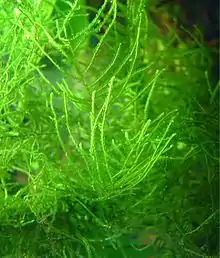 | |
Scientific classification  | |
| Kingdom: | Plantae |
| Division: | Bryophyta |
| Class: | Bryopsida |
| Subclass: | Bryidae |
| Order: | Hypnales |
| Family: | Hypnaceae |
| Genus: | Taxiphyllum |
| Species: | T. barbieri |
| Binomial name | |
| Taxiphyllum barbieri (Cardot & Copp.) Z. Iwats. | |
It was originally described as Isopterygium barbieri from Vinh, Vietnam.[3]
Cultivation and uses
The identity of Java moss is not fully resolved; formerly thought to be Vesicularia dubyana, it has been tentatively determined to be Taxiphyllum barbieri through studying stem anatomy and the shapes of the leaf cells.[4]
Java moss does not require any special attention. It accepts all kinds of water, even weakly brackish, and all kinds of light qualities. It grows best at 70 to 75° Fahrenheit (21 to 24° Celsius), but can live in temperatures of up to 85 to 90 °F (29 to 32 °C). It makes a good foreground plant. In aquariums it should be planted where there is good water current because debris gets stuck on it easily and gives it a brown fuzzy appearance. Due to its clinging nature, Java moss can also be made into a moss wall. This can be accomplished by folding a net and spreading the moss evenly across it. Then, the net can be secured together by polyester strings, and held on the aquarium wall by using suction cups. It is a slow starter until it has established itself.
It is especially popular among aquarists raising fry (baby fish) and tadpoles, to protect them from cannibalistic adults. Java moss can also provide food for the newly formed fry, which can be challenging to feed. Some shrimp like to feed on the miniature leaf like structures known as phyllids. Another benefit for newly formed fry from Java moss is increased oxygen levels in the aquarium water.[5]
Java moss can be easily propagated via division. It is suitable for both aquariums and vivariums.
See also
- Vesicularia montagnei, also known as "Christmas moss" or "Brazil moss"
References
- Goffinet, B.; Buck, W. R.; Shaw, A. J. (2008). "Morphology and Classification of the Bryophyta". In Goffinet, B.; Shaw, J. (eds.). Bryophyte Biology (2nd ed.). New York: Cambridge University Press. pp. 55–138. ISBN 978-0-521-87225-6.
- Goffinet, B.; Buck, W.R. (4 March 2014). "Classification of extant moss genera". Classification of the Bryophyta. Retrieved 1 May 2020.
- Type of Isopterygium barbieri Cardot & Copp.
- Tan, B. C., Loh, K. L., & Gan, C. W. (2005): A case of mistaken identity? What is the true identity of Java Moss and other aquarium mosses sold in Singapore shops? Singapore Scientist, 102: 8-11 Archived 2016-03-04 at the Wayback Machine
- https://sonsfish.com/library/freshwater-helpful-guides/java-moss-carpet/