Tall el-Hammam
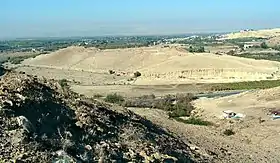
Tell el-Hammam (also Tall al-Hammam) is an archaeological site in Jordan, in the eastern part of the lower Jordan Valley close to the mouth of the Jordan River. The site has substantial remains from the Chalcolithic, Early, Intermediate and Middle Bronze Age, and from Iron Age II. There are different attempts at identifying the site with a biblical city.
Tall al-Hammam | |
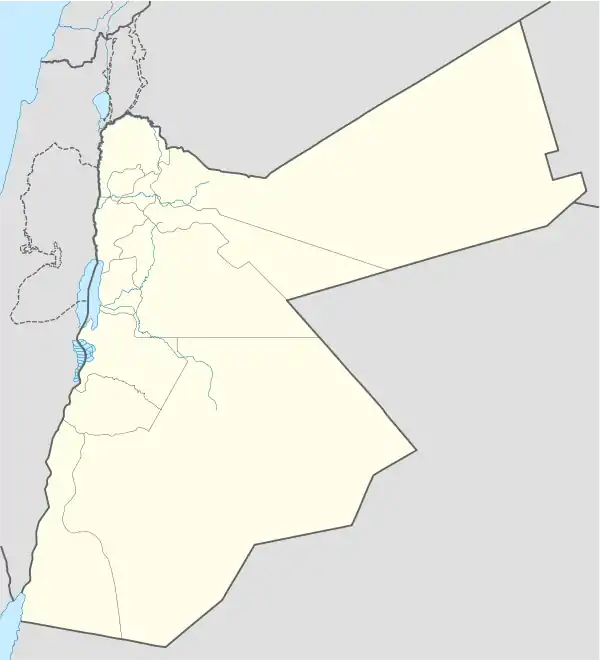 .svg.png.webp) Shown within Jordan | |
| Location | Jordan |
|---|---|
| Region | Amman Governorate |
| Coordinates | 31.8402°N 35.6737°E |
| History | |
| Cultures | Chalcolithic, Early Bronze Age, Middle Bronze Age, Late Bronze Age, Roman Age, Byzantine, Umayyad |
Possible identifications in different periods
- In the Late Bronze age, the area around Tall el-Hammam, is identified by many scholars as Abel Shittim. [1] [2]
- 1st century CE – Livias (Latin: Liviada Herod Agrippa 4 BCE).[3] The traditional location of the Roman city of Livias is identified at the small Tell er-Rameh,[4] although William F. Albright identified Livias/Bethharam with Tall Iktanu,[5] 2.75 km (1.71 mi) ESE of Tell er-Rameh. Recent excavations at Tall el-Hamman have led to the theory that Tell er-Rameh nearby was the commercial and residential centre of Livias, while the administrative centre was located at Tall el-Hammam.[6] In the Roman, Byzantine, and Umayyad periods (165 BC–AD 750) the site was part of the city of Livias (also known as Julias), an important city in Perea, rebuilt by Herod Antipas.[7]
- Byzantine Period – Livias. In 384 CE, the Spanish pilgrim Egeria (Etheria or Aetheria) testified that a presbyter (elder/bishop) had a house in Livias.[8] According to Le Quien[9] Livias was still a see in the 5th and early 6th century. Byzantine administrative records list three Bishops from Livias: Letoius, who was at the council of Ephesus in 431 CE;[10] Pancratius, who was at the council of Chalcedon in 451 CE; and Zacharias who attended the council of Jerusalem in 536 CE.[11] Theoteknos, the first theologian to articulate the doctrine of the Assumption of Mary,[12] was the most famous bishop of Livias, officiating sometime between 550 and 650 CE.
Research history
Claude Reignier Conder recorded the site in the nineteenth century and Père Mallon described it in detail in 1932. Both noted remains of a Roman bath complex that have since disappeared, which presumably gave the tell its name ("Hill of the Hot Baths").[13] Nelson Glueck visited the site in 1941 and identified Iron Age ruins, which he associated with biblical Abel-Shittim.[13]
Kay Prag briefly surveyed the site in 1975–1976 while she was working at the adjacent Tell Iktanu.[13] She returned in 1990 to conduct a complete survey and excavate parts of the Bronze Age levels.[13]
Since 2005, the site has been excavated by a joint project of the unaccredited Trinity Southwest University (Albuquerque, New Mexico) and the creationist Veritas International University's College of Archaeology & Biblical History (Santa Ana, California), headed by Steven Collins.[14][15] This group claims that Tall el-Hammam was destroyed cataclysmically by an airburst,[16] but others have raised doubts about the claim and the authors have admitted to altering the images used as evidence.[17][18]
Periods of settlement
The site was occupied in the Chalcolithic (c. 4300–3600 BCE), Early Bronze Age (c. 3600–2500 BCE), Intermediate Bronze Age (2500–1950 BCE), Middle Bronze Age (c. 1950–1550 BCE), Iron Age II–III (c. 980–332 BCE),[19] and Hellenistic, Roman, Byzantine, and Umayyad periods (163 BCE–750 CE).[20] Like most sites in the Jordan Valley, it was vacant in the Late Bronze Age (c. 1550–1200 BCE). Only some Late Bronze pottery was discovered in a tomb,[21] and a single freestanding LB2a structure in Field UA on the upper tall.[22] The "Late Bronze Gap" (first named by Flanagan at Tall Nimrin) of c. 550 years is not unique to Tall al-Hammam but characteristic of many of the sites in the Jordan valley (Hebrew kikkār) region, including Tall Iktanu, Tall Kefrein (al-Kefrayn), Tall Nimrin,[23] Tall el-Musṭāḥ, Tall Bleibel (Bulaybil), etc.[24] The most substantial findings are from the Early Bronze Age, Intermediate Bronze Age, and Middle Bronze Age.[25]
Middle Bronze Age city
During the Middle Bronze Age, the city was protected by walls enclosing an area of 85 acres (34 ha) and was divided into an upper and lower city, while the much larger general occupational area around the walled city covered 240 acres (97 ha).[26] In the Early Bronze Age, Tall el-Hammam was the largest city-state in the Southern Levant.[27] By the Middle Bronze Age, it was only smaller than Hazor (200 acres (81 ha)) and Ashkelon (150 acres (61 ha)). At this time, Jerusalem and Jericho were only 12–10 acres (4.9–4.0 ha) respectively.[28]
Early Roman, Byzantine, and early Islamic
Early Roman, Byzantine, and early Islamic remains have been excavated between 2005 and 2014. The discoveries included a large Roman bath complex (thermae, 34.2 m × 40.6 m (112 ft × 133 ft)), aqueduct (165 m (541 ft) exposed), two defensive towers, coins, glass, and Roman, Byzantine, and early Islamic pottery.[29][30]
References
- Numbers 25:1, Deuteronomy 34:9; Joshua 2:1; 3:1)
- William M. Thomson, The Land and the Book: Lebanon, Damascus, and Beyond Jordan, vol. 3, 3 vols. (New York: Harper & Brothers, 1886), 3:3:669; Nelson Glueck, Explorations in Eastern Palestine II, AASOR 15 (New Haven, CT: ASOR, 1935), 378; Nelson Glueck, 'Some Ancient Towns in the Plains of Moab,' Bulletin of the American Schools of Oriental Research 91 (1943): 7–26. 15; J. Maxwell Miller and Gene M. Tucker, The Book of Joshua, The Cambridge Bible Commentary of the English Bible (Cambridge, MA: Cambridge University Press, 1974), 199; R. K. Harrison, “Shittim,” ed. Edward M. Blaiklock, New International Dictionary of Biblical Archaeology (Grand Rapids: Zondervan, 1983), 413; Rami G. Khouri, Antiquities of the Jordan Rift Valley (Manchester, MI: Solipsist, 1988).76; Burton MacDonald, East of the Jordan: Territories and Sites of the Hebrew Scriptures, ed. Victor H. Matthews, ASOR Books 6 (Boston: American Schools of Oriental Research, 2000), 90; Selah Merrill, 'Modern Researches in Palestine,' Journal of the American Geographical Society of New York 9 (1877): 109–25 see 117; Selah Merrill, 'Modern Researches in Palestine,' Palestine Exploration Fund: Quarterly Statement 11, no. 1 (1879): 138–54, see 144
- Dina Frangié-Joly, "Umm Hadar: A Fort in the Jordan Valley (Historical and Archaeological Research), Trade Routes and Seafaring in the Near East (2011)," Aram 27, no. 1 & 2 (2015): 105–23. see 107, 109 n.17
- Morris Jastrow and Frants Buhl, "Beth–Aram," in Jewish Encyclopedia (New York: Funk & Wagnalls, 1906), 119; Siméon Vailhé, "Livias," in Catholic Encyclopedia, ed. Charles George Herbermann, trans. Mario Anello, vol. 9, 16 vols. (New York: Appleton & Company, 1913), 9:315; Nelson Glueck, "Some Ancient Towns in the Plains of Moab," Bulletin of the American Schools of Oriental Research 91 (1943): 7–26, see 11; Donner and Clippers 1967, 22; Kay Prag, "A Walk in the Wadi Hesban," Palestine Exploration Quarterly 123, no. 1 (1991): 48–61. see 60- 61; Herbert Donner, The Mosaic Map of Madaba. An Introductory Guide, Palaestina Antiqua 7 (Kampen: Kok Pharos, 1992), 39; Estee Dvorjetski, Leisure, Pleasure, and Healing: Spa Culture and Medicine in Ancient Eastern Mediterranean, JSJSup 116 (Leiden: Brill, 2007), 202; Fig. 2).
- William F. Albright, "The Jordan Valley in the Bronze Age,* Annual of the American Schools of Oriental Research 6 (1926): 13–74. see 49
- David E. Graves and D. Scott Stripling, "Re-Examination of the Location for the Ancient City of Livias," Levant 43, no. 2 (2011): 178–200
- Josephus Antiquities 20.29; Jewish War 2.168; 2.252; see also Theodosius Top. 19.1; Harold W. Hoehner, Herod Antipas: A Contemporary of Jesus Christ (Grand Rapids: Zondervan Academic, 1980).87-91
- John Wilkinson, ed., Egeria's Travels: Translated with Supporting Documents and Notes, trans. John Wilkinson, 3rd ed. (Warminster: Aris & Phillips, 1999)10.8
- Michel Le Quien, Oriens christianus in quatuor patriarchatus digestus, in quo exhibentur Ecclesiae patriarchae caeterique praesules totius Orientis (Paris: Typographia Regia, 1740), 3:655
- Egeria, Diary of a Pilgrimage, ed. and trans. George E. Gingras (Mahwah, NJ: Newman, 1970), 189 n. 135
- Emil Schürer, The History of the Jewish People in the Age of Jesus Christ (175 BCE – 135 CE), ed. G. Vermes, F. Miller, and M. Black, Rev (Edinburgh, UK: T&T Clark, 1979), 2:177 n.505.
- Antoine Wenger, L'Assomption de la T.S. Vierge dans la tradition byzantine du VIe au Xe siècle. études e documents, Archives de l'Orient Chrétien 5 (Paris: Institut français d'études byzantines, 1955)
- Prag, Kay (1991). "Preliminary Report on the Excavations at Tell Iktanu and Tell al-Hammam, Jordan, 1990". Levant. 23 (23:1): 55–66. doi:10.1179/lev.1991.23.1.55. Retrieved 2 May 2020.
- Steven Collins, Khalil Hamdan, and Gary A. Byers, "Tall al-Ḥammām: preliminary report on four seasons of excavation (2006–2009)", Annual of the Department of Antiquities, vol. 53, pp. 385–414, 2009
- Steven Collins, and H. al-Jarrah, "Tall al-Hammam season six, 2011: excavation, survey, interpretations and insights.", Annual of the Department of Antiquities of Jordan, vol. 55, pp. 581–606, 2011
- Bunch, Ted E.; LeCompte, Malcolm A.; Adedeji, A. Victor; Wittke, James H.; Burleigh, T. David; Hermes, Robert E.; Mooney, Charles; Batchelor, Dale; Wolbach, Wendy S.; Kathan, Joel; Kletetschka, Gunther; Patterson, Mark C. L.; Swindel, Edward C.; Witwer, Timothy; Howard, George A.; Mitra, Siddhartha; Moore, Christopher R.; Langworthy, Kurt; Kennett, James P.; West, Allen; Silvia, Phillip J. (December 2021). "A Tunguska sized airburst destroyed Tall el-Hammam a Middle Bronze Age city in the Jordan Valley near the Dead Sea". Scientific Reports. 11 (1): 18632. doi:10.1038/s41598-021-97778-3.
- Marcus, Author Adam (1 October 2021). "Criticism engulfs paper claiming an asteroid destroyed Biblical Sodom and Gomorrah". Retraction Watch. Retrieved 24 November 2021.
- Bik, Elisabeth (2 October 2021). "Blast in the Past: Image concerns in paper about comet that might have destroyed Tall el-Hammam". Science Integrity Digest. Retrieved 24 November 2021.
- Steven Collins, Carroll M. Kobs, and Michael C. Luddeni, An Introduction to Tall Al-Hammam with Seven Seasons (2005–2011) of Ceramics and Eight Seasons (2005–2012) of Artifacts, vol. 1 (Winona Lake, IN: Eisenbrauns, 2015) ISBN 978-1575063690.
- Collins, Steven; Hussein, Aljarrah; Byers, Gary A.; Kobs, Carroll M.; Leslie, John; abu-Shmais, Adeib; Haroun, Jehad (2011). "Tall Al-Hammam Season Six, 2011: Excavation, Survey, Interpretations and Insights". Annual of the Department of Antiquities of Jordan. 55: 581.
- Collins, Steven; Hussein, Aljarrah; Byers, Gary A.; Kobs, Carroll M.; Leslie, John; abu-Shmais, Adeib; Haroun, Jehad (2011). "Tall Al-Hammam Season Six, 2011: Excavation, Survey, Interpretations and Insights". Annual of the Department of Antiquities of Jordan. 55: 597.
- Steven Collins et al., "Tall El-Hammam Season Ten, 2015: Excavation, Survey, Interpretations And Insights," Biblical Research Bulletin 15, no. 1 (2015): 1–37, see 29.
- Flanagan, James W.; McCreery, David W.; Yassine, Khair N. (1994). "Tell Nimrin: Preliminary Report on the 1993 Season". Annual of the Department of Antiquities of Jordan. 38: 207.
- Steven Collins, Khalil Hamdan, and Gary A. Byers, "Tall El-Hammam: Preliminary Report on Four Seasons of Excavation (2006–2009)," Annual of the Department of Antiquities of Jordan 53 (2009): 385–414
- Banks, Rebecca (26 January 2017). "Endangered Archaeology as captured with the Aerial Archaeology in Jordan Project: September 2016 Season: Tell el-Hammam". Oxford: Endangered Archaeology in the Middle East & North Africa (EAMENA) – University of Oxford. Retrieved 3 May 2020.
- Collins & Scott (2013), p. 157
- Leen Ritmeyer "Chart of showing relative sizes of major cities in the Levant" Steven Collins, Carroll M. Kobs, and Michael C. Luddeni, The Tall Al-Hammam Excavations: An Introduction to Tall al-Hammam with Seven Seasons (2005–2011) of Ceramics and Eight Seasons (2005–2012) of Artifacts, vol. 1 (Winona Lake, IN: Eisenbrauns, 2015). p. 41
- Leen Ritmeyer "Chart of showing relative sizes of major cities in the Levant" Steven Collins, Carroll M. Kobs, and Michael C. Luddeni, The Tall Al-Hammam Excavations: An Introduction to Tall al-Hammam with Seven Seasons (2005–2011) of Ceramics and Eight Seasons (2005–2012) of Artifacts, vol. 1 (Winona Lake, IN: Eisenbrauns, 2015). p. 173,174
- Graves, David E.; Stripling, Scott (2011). "Re-Examination of the Location for the Ancient City of Livias". Levant. 43 (2): 178–200. doi:10.1179/175638011X13112549593122. S2CID 162399714.
- A Preliminary Report on the Tall al-Hammam Excavation Project: Roman, Byzantine, and Islamic Remains: Field LR (2005–2014). Edited by Steven Collins, Gary Byers and D. Scott Stripling. ECM, 2021. https://www.amazon.com/dp/B0947RVGX2?ref_=pe_3052080_397514860