Avenue de Tervueren
The Avenue de Tervueren (French) or Tervurenlaan (in Dutch) is a major thoroughfare in Brussels, Belgium. It was originally commissioned by King Leopold II as part of his building campaign, and finished in 1897 in time for the Brussels International Exhibition of that year. It runs from Merode in the west, connects with Marshal Montgomery Square, passes through Woluwe-Saint-Pierre and the Ring at Quatre Bras/Vier Armen, and finishes at the park in Tervuren.
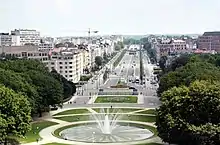 The start of the Avenue de Tervueren at the Cinquantenaire/Jubelpark, looking east towards Marshal Montgomery Square | |||
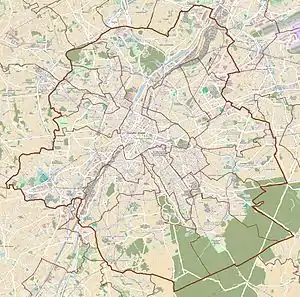  Location within Brussels | |||
| Location | Brussels-Capital Region, Belgium | ||
|---|---|---|---|
| Coordinates | 50°50′12″N 04°24′42″E | ||
| Construction | |||
| Completion | 1897 | ||
Geographically, the Avenue de Tervueren forms a continuation of the Rue de la Loi/Wetstraat, which runs from the centre of Brussels. The Rue de la Loi ends at the western end of the Parc du Cinquantenaire/Jubelpark, while the Avenue de Tervueren starts at the eastern end of the park. A tunnel starting just west of the Schuman roundabout takes the main carriageway of the Rue de la Loi under the Cinquantenaire (with a short uncovered section in the centre of the park), and emerging at Merode as the central carriageway of the Avenue de Tervueren.
Tram route 44 follows a large portion of the Avenue de Tervueren, from Montgomery station all the way to Tervuren. For much of the distance, it has a dedicated track. The road also has a cycle path for much of its length.
Events
The annual Festival of the Avenue de Tervueren takes place each May.[1] The road is closed to motor traffic from Merode down to Woluwe Park, market stalls and a flea market are set up and various family attractions and amusements draw crowds. In past years, the celebration has included fireworks, live music and events such as the cooking of a giant omelette. The celebration marks the anniversary of the road's opening.[2]
Notable buildings
The Avenue de Tervueren is home to many buildings in Art Nouveau, Beaux-Arts, Art Deco and eclectic styles. The Stoclet Palace, a UNESCO World Heritage Site, is situated on the avenue, as is the Brussels Tram Museum.
- No. 68–70: Former Institute for the Treatment of Eye Diseases of Doctor Coppez (1912) by Jean-Baptiste Dewin[3]
- No. 110: Beaux-Arts apartment building (1927) by Antoine Varlet[4]
- No. 166: Beaux-Arts hôtel particulier (1913) by Franz D'Ours[5]
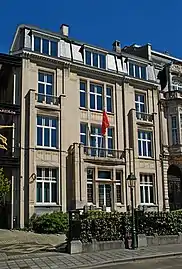 Former Institute for the Treatment of Eye Diseases of Doctor Coppez (Dewin, 1912)
 Apartment building (Varlet, 1927)
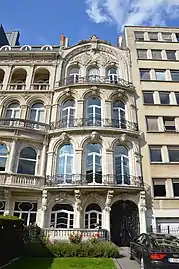 Hôtel particulier (D'Ours, 1913)
See also
References
Notes
- "AVENUE DE TERVUREN CELEBRATES ITS 15TH ANNIVERSARY". Retrieved 11 December 2012.
- "Festival of the Avenue de Tervueren". Retrieved 11 December 2012.
- "Etterbeek - Ancien Institut pour le traitement des maladies des yeux, du docteur H. Coppez - Avenue de Tervueren 68-70 - DEWIN Jean-Baptiste". www.irismonument.be. Retrieved 4 October 2020.
- "Etterbeek - Avenue de Tervueren 110". www.irismonument.be. Retrieved 4 October 2020.
- "Woluwe-Saint-Pierre - Avenue de Tervueren 164, 166 - D'OURS Franz". www.irismonument.be. Retrieved 4 October 2020.