Texas Heartbeat Act
The Texas Heartbeat Act is an act of the Texas Legislature that bans abortion after the detection of an unborn child's heartbeat, which normally occurs after about six weeks of pregnancy. It was introduced as Senate Bill 8 (SB 8) and House Bill 1515 (HB 1515) on March 11, 2021, and was signed into law by Governor Greg Abbott on May 19, 2021. The law took effect on September 1, 2021. It is the first time a state has successfully imposed a six-week abortion ban since Roe v. Wade, and the first abortion restriction to rely on enforcement by private individuals through civil lawsuits, rather than by the government through criminal or civil enforcement. The act establishes a system in which members of the public can sue anyone who performs or facilitates an illegal abortion for a minimum of $10,000 in statutory damages.[1][2][3]
| Texas Heartbeat Act | |
|---|---|
 | |
| Texas Legislature | |
| |
| Enacted | May 19, 2021 |
| Commenced | September 1, 2021 |
| Bill citation | Full Text of SB 8 with signatures of:
|
| Introduced by | Bryan Hughes |
| Status: In force | |
Separate pre-enforcement federal lawsuits were filed by abortion clinics and proponents against state officials, judges, and clerks, and by the United States Justice Department against the state under the supremacy clause.[4][5] Federal District Judge Robert L. Pitman issued an order enjoining the state from enforcing the law on October 6, 2021.[6] However, the U.S. Court of Appeals for the Fifth Circuit put an administrative stay on Pitman's order two days later, ensuring that the law would remain in effect pending further review on appeal; the U.S. Supreme Court denied to overturn the Fifth Circuit's stay.[7] In December 2021, the Supreme Court dismissed the government's lawsuit, while allowed portions of the abortion clinics' pre-enforcement suit against specific state officials involved in the enforcement of the law to continue while dismissing other state officials that were named as defendants, remanding the case back to the Fifth Circuit.
The act is also being challenged in state court in multiple suits brought by abortion providers and funders, with a temporary injunction hearing scheduled for October 4.[8] On September 23, 2021, a Lubbock, Texas news source reported that a Texas legislator, State Representative Dustin Burrows, was served with a total of 13 separate lawsuits by abortion-rights plaintiffs.[9] The same day, the Multi-District Litigation Panel for the state courts of Texas imposed a stay on all trial-court cases, pending a decision on pretrial consolidation into a single MDL court.[10]

Background
A different fetal heartbeat bill, HB 1500, was previously introduced in Texas by Phil King on July 18, 2013, in the wake of Rick Perry signing Texas Senate Bill 5 into law.[11] The bill did not pass.[12][13] The bill was jointly authored by Representatives Phil King, Dan Flynn, Tan Parker, and Rick Miller.[14] As of February 26, 2019, HB 1500 had 57 sponsors or cosponsors of the 150 members of the Texas House of Representatives.[15]
On March 11, 2021, the Texas Heartbeat Bill (Senate Bill 8 or SB 8 for short) was introduced by Senator Bryan Hughes.[16] A companion bill (HB 1515) was filed by Representative Shelby Slawson a day later in the Texas House of Representatives.
The Heartbeat Bill was a legislative priority of Republican lawmakers for the 2021 regular session, denoted 87(R).[17] Republicans hold majorities in both houses. It was included on Lieutenant Governor Dan Patrick's list of top priorities for the 2021 legislative session.[18] The Senate version was approved by both houses of the bicameral Texas legislature after the Senate concurred with House amendments.[19] Texas governor Greg Abbott signed the new legislation into law on May 19, 2021.[20]
The private civil enforcement feature of the novel type of anti-abortion legislation was engineered by former Stanford law professor Jonathan F. Mitchell. He proposed the idea in an 2018 Virginia Law Review article, The Writ-of-Erasure Fallacy,[21] then brought it to the attention to Mark Lee Dickson, an East Texas anti-abortion pastor in 2019.[22][23][24] Dickson was able to get the law enacted at a local level in Waskom, Texas, in 2019, though was mostly a symbolic move as the town had no abortion facilities. Dickson then championed for similar laws to be passed in other towns and cities in Texas over the following years, including Lubbock, where a Planned Parenthood facility halted abortion procedures following passage of the local law.[23][25] Mitchell helped Hughes draft the bill for the state action based on the municipal ordinances he had written as a means to avoid immediate judiciary scrutiny, primarily by taking the state out of enforcement of the abortion ban.[25] He also serves as an attorney for Texas Right to Life in pending litigation.
Another related act, the Human Life Protection Act (House Bill 1280), was passed simultaneously. The bill prospectively bans all abortions in Texas, without exemption, if the Roe v. Wade precedent is overturned by the Supreme Court.[26]
Provisions
The Texas Heartbeat Act allows any person to sue someone who performs or induces an abortion, or aids and abets one, once "cardiac activity" in an embryo can be detected via transvaginal ultrasound, which is usually possible beginning at around six weeks of pregnancy.[27][28][29][lower-alpha 1]
The act defines an "unborn child" as a human fetus or embryo at any stage of gestation.[30]
Although an abortion patient may not be named as a defendant, anybody who provides support for an unlawful abortion can be sued in addition to the physician performing the procedure. That includes staff members at clinics, counselors, lawyers, financiers, and those who provide transportation to an abortion clinic, including drivers of a taxi or ride-hailing companies.[2] The act incentivizes private enforcement by authorizing "statutory damages" of at least $10,000 in addition to court costs and attorney's fees if a defendant is proven liable.[27] Plaintiffs are not required to have a personal connection to the patient or abortion provider in order to bring a lawsuit under SB 8.[31]
The act insulates Texas state officials from being the target of lawsuits related to the act, effectively claiming they have sovereign immunity since the law only enables civil lawsuits by private individuals.[32] The act also sets language that requires defendants in these civil suits to prove they did not break the law, rather than typical legal practice where plaintiffs are required to show how the defendants broke the law. Further, the act attempts to make the proof of the undue burden standard related to abortion access from Roe v. Wade and Planned Parenthood v. Casey more difficult for defendants by requiring judges to consider more stringent proof of this standard.[32]
At midnight, immediately after the law went into effect, many clinics in Texas including Planned Parenthood stopped performing abortion procedures and stopped taking new appointments.[33] However, many clinics reported an increase in patients at their clinics who had completed the 24-hour waiting period and sought to have the procedure done before the midnight deadline.[34]
The act contains exceptions in the case of medical emergency, such as if the mother is at risk of death or severe irreversible bodily harm. It notably makes no exceptions for rape or incest.[35] On September 7, 2021, Governor Abbott asserted that the Act does not force raped women to carry pregnancies to term because the state would "work tirelessly to make sure that we eliminate all rapists from the streets of Texas by aggressively going out and arresting them and prosecuting them and getting them off the streets."[36]
Significance
The act is the first time since Roe v. Wade that a state has successfully outlawed abortion as early as six weeks into a pregnancy, even for a brief period of time.[2] In Texas, an estimated 85% of abortions have been performed after the six-week mark, which is often shortly after a pregnant woman misses her menstrual period, and before many women have confirmed or are aware of a pregnancy.[2][37][38]
The act is unique in that it is specifically designed to place the burden of enforcement on the populace through civil lawsuits rather than on state actors. This was engineered to deny abortion providers the opportunity to seek federal court injunctions against the enforcement of an unconstitutional statute by state officials. Since the law cannot be enforced by state officials but only by private individuals, there is uncertainty as to whom to sue in order to challenge the constitutionality of the act prior to enforcement.[39]
In light of this novel feature in the law, U.S. Supreme Court Chief Justice John Roberts wrote that "the statutory scheme before the court is not only unusual, but unprecedented. The legislature has imposed a prohibition on abortions after roughly six weeks, and then essentially delegated enforcement of that prohibition to the populace at large. The desired consequence appears to be to insulate the state from responsibility for implementing and enforcing the regulatory regime."[1] On September 9, 2021, however, the U.S. Justice Department sued the State of Texas directly in the U.S. District Court for the Western District of Texas, seeking a declaration that the law is unconstitutional, and injunctive relief.[40]
A study produced by researchers at the University of Texas at Austin claims that the bill would prohibit 80% of abortions in Texas and would disproportionately affect black women, lower-income women, and women who live far away from facilities that provide abortion care.[41]
Legal challenges
Academic opinions
On September 5, 2021, Laurence Tribe, American legal scholar and University Professor Emeritus of Constitutional Law at Harvard University, suggested ways for the United States Department of Justice to consider managing the Act: sections 241 or 242 of the federal criminal code makes it a crime to deprive individuals of any constitutional rights.[42][43] Laurence Tribe later, on September 7, 2021, also suggested using a "civil parallel of the Ku Klux Klan Act" to end the Texas Act.[44][43]
Lawyers Tribe and David Rosenberg recommended that the U.S. Attorney General launch criminal prosecutions and sue private parties under the Ku Klux Klan Act of 1871, on the grounds of deprivation of rights under color of law.[45] The two also pointed to the precedent of Larkin v. Grendel's Den, Inc.[46] as an argument against the constitutionality of delegating certain government decisions to private parties.
Conservative legal scholars, including Harvard Law Professor Stephen Sachs and Ed Whelan from the Ethics and Public Policy Center, have raised questions about the nature of relief sought by the abortion providers, their legal standing to bring suit, and the procedural and legal hurdles that make granting such relief implausible.[47][48]
The private remedies authorized by SB 8, however, can only be awarded by a state court in a lawsuit brought under SB 8, which is why Whole Women's Health and a group of abortion providers sued a Texas judge under Section 1983 of the Civil Rights Act to enjoin him and a defendant class of all other Texas trial-level judges from entertaining SB 8 lawsuits. On September 10, 2021, however, a motions panel of the Fifth Circuit Court of Appeals rejected the idea that state judges and their court clerks could be sued in federal court to prevent them from hearing SB 8 cases, characterizing the approach as absurd.[49]
In an op-ed piece for THE HILL, Alan Dershowitz, emeritus professor of law at Harvard, suggested that liberal states could enact laws offering similar bounties for citizen lawsuits against anyone who facilitates the sale or ownership of handguns.[50]
Pre-enforcement litigation by providers and advocates
A Dallas attorney filed a lawsuit and accompanying request for a restraining order in Dallas Texas District Court attempting to block the bill, arguing that the language of the law prevents attorneys from consulting with clients about abortion, even in cases of rape and incest, and is thus a violation of attorney-client privilege and victims rights of the sexually abused.[51] This action was nonsuited and refiled in Travis County (Austin, Texas), where it remains pending, along with numerous companion cases by abortion providers and funders, who are all represented by the same attorneys.
On September 3, 2021, a Travis County judge granted three Texas Planned Parenthood affiliates a temporary restraining order against Texas Right to Life, with a temporary injunction hearing set for September 13. The ruling temporarily blocks the anti-abortion group and affiliated individuals from suing them under the Act.[52] Another trial court judge later signed an agreed temporary injunction order in the same case.[53][54]
Whole Woman's Health v. Jackson
Before the new law went into effect, a group of abortion providers led by Whole Woman's Health (WWH) sued to get a preliminary injunction to stay enforcement of the law on September 1, 2021. Their suit included a state district court judge and his court clerk as representative defendants for all state judges and clerks that have jurisdiction to hear suits brought under the Heartbeat Act, in addition to other state officials include attorney general Ken Paxton, and a private individual that had publicly stated their intent to file suit against an abortion provider once SB 8 came into effect. The abortion clinics challenged the sovereign immunity portion of the law, stating that because the judges and clerks are involved with enforcement of SB 8, they can be defendants to legal challenges due to the Ex parte Young doctrine. In late August 2021, district judge Robert L. Pitman rejected a motion to dismiss the case and scheduled a hearing on the temporary injunction requested by the plaintiffs. An expedited appeal to the U.S. Court of Appeals for the Fifth Circuit led to the Fifth Circuit to ordered a stay in the district court proceedings, on the basis that the state official defendants were likely immune from being sued while the case against the private individual remained in consideration.[1][55] The plaintiffs filed an emergency application with the Supreme Court on August 30, 2021, seeking an order to block the Act from going into effect.[56] Late on September 1, 2021, nearly 24 hours after the Act had come into force, the Supreme Court denied the motion in an unsigned order, though four Justices wrote or joined dissents that stated they would have granted the injunction pending legal evaluation. The majority opinion on the motion stressed that the denial of immediate relief did not preclude other legal challenges in lower federal or Texas state courts.[57][1][58]
The Fifth Circuit issued a second order on September 10, 2021, ruling that the state judges, clerks and other officials were not proper defendants, while the case against the private individual remained and was to be evaluated by the Circuit court at a later date. Again, the plaintiffs filed a petition for a pre-judgment writ of certiorari at the Supreme Court based on the Fifth Circuit's order, again seeking an injunction on the enforcement of SB 8.[59][60][61] The Supreme Court, in its related actions to United States v. Texas, denied the plaintiff's motions in WWH v. Jackson, but certified the petition for the case, and scheduled its oral arguments alongside United States v. Texas for November 1, 2021.[62]
The Supreme Court issued its decision on December 10, 2021, upholding parts of the Fifth Circuit but reversing others. The Court ruled that the abortion clinics' lawsuits against certain state officials may proceed as they have direct involvement in the enforcement of SB8, while the lawsuits against other state officials like Paxton and judges should be dismissed due to their lack of involvement in enforcement. Regardless, the Supreme Court allowed the law to remain in effect.[63]
United States v. Texas
United States Attorney General Merrick Garland announced on September 6, 2021, that the Justice Department (DOJ) will protect abortion seekers in Texas under the Freedom of Access to Clinic Entrances Act.[64] The DOJ filed their suit against the state on September 9, 2021 in the District Court for the Western District of Texas, with the suit claiming "the law is invalid under the Supremacy Clause and the Fourteenth Amendment, is preempted by federal law, and violates the doctrine of intergovernmental immunity".[65][66] The DOJ asked for an emergency motion for a temporary restraining order or a preliminary injunction of SB8 on September 15, 2021.[67] In its defense, Texas challenged the standing of the federal government to seek remedies against private individuals and sought dismissal of their case.[68][69]
District judge Robert L. Pitman, who was also overseeing the WWH v. Jackson case, issued a preliminary injunction blocking enforcing of the Act on October 6, 2021, ruling that the United States government does have standing to challenge Texas' law.[70] Texas appealed to the Fifth Circuit Court of Appeals on October 8, 2021,[71][72] and in a per curiam decision that day, the Fifth Circuit put a hold on Pitman's order, "pending the court's consideration of the emergency motion".[73] On October 14, 2021, the motions panel granted the State's and the three aligned Intervenors' motions for emergency stay in a brief order that merely referenced the decision rationales articulated by the SCOTUS and the Fifth Circuit in the pending WWH v. Jackson case.[74] They also ordered that the appeal on the merits be jointly taken up on an accelerated basis by the same panel of the Fifth Circuit that will hear oral argument in the WWH v. Jackson appeal.
The DOJ filed an application for emergency relief from the Supreme Court on October 18, 2021.[75][76][77] On October 22, 2021, the SCOTUS declined to grant the DOJ's emergency request to lift the Fifth Circuit's stay, but did grant the petition for certiorari before judgment and set expedited oral arguments for November 1, 2021. In certifying the case, the Supreme Court limited the case to review the question of the standing raised by the state. The oral arguments for United States v. Texas will be heard alongside those for WWH v. Jackson.[78][79] Justice Sotomayor concurred in the decision to hear the case on an expedited basis, but dissented on the denial of an immediate stay order in the interim.[80]
The Supreme Court ruled in a per curiam decision on December 10, 2021, to dismiss the case as improvidently granted.[63]
SCOTUS cases relating to United States v. Texas
No. 21-588, United States, Petitioner v. Texas, et al., docketed October 14, 2021 in conjunction with consideration of application (21A85) to vacate Fifth Circuit stay presented to Justice Alito and by him referred to the Court is deferred pending oral argument on November 1, 2021.
No. 21A85, United States, Petitioner v. Texas, et al., Application to vacate stay of preliminary injunction issued by U.S. Court of Appeals for the Fifth Circuit by the United States. Submitted to Justice Alito and referred to the Court. Consideration deferred pending oral argument on November 1, 2021.
SCOTUS cases relating to Whole Woman's Health v. Jackson
No. 21-587, Penny Clarkston, Petitioner v. Whole Woman's Health, et al., docketed October 21, 2021. Petition for a writ of certiorari before judgment filed. Response due November 22, 2021. Ms. Clarkston is the District Clerk serving the 114th District Court and other district courts in Smith County, Texas. The presiding judge of the 114th District Court is the primary official-capacity defendant in Whole Women's Health v. Jackson.
No. 21-583, Stephen Brint Carlton, et al., Petitioners v. Whole Woman's Health, et al., docketed October 21, 2021. Petition for a writ of certiorari before judgment filed. Response due November 22, 2021.
No. 21-582, Mark Lee Dickson, Petitioner v. Whole Woman's Health, et al., docketed October 21, 2021. Petition for a writ of certiorari before judgment filed. Response due November 22, 2021. Mr. Dickson is a private individual and pro-life advocate, and was named as a defendant because abortion providers anticipated that he would bring SB8 actions against them.
No. 21-463, Whole Woman's Health, et al., Petitioners v. Austin Reeve Jackson, Judge, District Court of Texas, 114th District, et al. Petition for a writ of certiorari before judgment filed on September 23, 2021, GRANTED on October 22, 2021. Oral argument set for Monday, November 1, 2021. Judge Jackson is on record as being pro-life and was named as a proposed class representative for all Texas judges who might hear SB8 cases.
No. 21A24, Whole Woman's Health, et al., Applicants, v. Austin Reeve Jackson, Judge, et al., docketed August 30, 2021. Application for emergency injunction denied by the court per curiam, with separate opinions issued by Chief Justice Roberts, with whom Justice Breyer and Justice KAGAN join, dissenting; Justice Breyer, with whom Justice Sotomayor and Justice Kagan join, dissenting; Justice Sotomayor, with whom Justice BREYER and Justice KAGAN join, dissenting; and Justice Kagan, with whom Justice Breyer and Justice Sotomayor join, dissenting.
First lawsuits based on SB8 against abortion provider
On September 18, 2021, in an op-ed published by The Washington Post, San Antonio physician Alan Braid admitted that he had performed an abortion that was illegal under the Act on September 6. He stated that he performed the abortion "because I had a duty of care to this patient, as I do for all patients, and because she has a fundamental right to receive this care." He acknowledged that he would be opening himself up to liability from civil lawsuits related to the Act.[81][82]
On September 20, 2021, Oscar Stilley, a former lawyer in Arkansas, filed a lawsuit against Braid for providing the abortion.[83] Stilley told reporters that he did it in an effort to speed up the process of getting the law reviewed. Another lawsuit by Felipe Gomez of Chicago was filed against Braid the same day. Gomez argues for the law to be declared unconstitutional as the law is illegal until Roe v. Wade is reversed or modified.[84] Both lawsuits were commenced in San Antonio in the defendant's county. One is in forma pauperis. Both plaintiffs are not averse to publicity.[85] Both have also intervened in the federal case brought by the DOJ against Texas. Legal experts expect SB 8 lawsuits brought by self-described pro-choice plaintiffs to fail for lack of a controversy and thus standing.
State-court challenges to SB8 by abortion providers and funders
More than a dozen other lawsuits, some filed before the Act's September 1, 2021 effectiveness date, make various constitutional arguments. With one exception, they name state officials as defendants, including numerous GOP legislators, in addition to Texas Right to Life, one of the largest pro-life organizations in Texas. Initiated by proponents of abortion in Travis County (Austin), they seek injunctive and declaratory relief, rather than relief as authorized by SB 8 against an abortion provider or abetter.
Although the State of Texas is also named a defendant in most of these cases (as in federal court), and although the matter is of high public interest, an omnibus motion has been filed to seal the court records, which was set for hearing on October 4, 2021, at 2PM.[86] Multiple pending cases were also set for temporary injunction hearings that day.[87] Because the MDL Panel has imposed an immediate stay on further trial court proceedings in the Travis County cases, however, it is unclear what will happen next. The motion to seal court records has drawn opposition, and the temporary restraining orders have expiration dates.
On October 15, 2021, the Multi-District Litigation Panel granted Texas Right to Life's motion and assigned a retired judge to preside over the 14 cases.[88]
Aftermath
The pro-life organization Texas Right to Life established a "whistleblower reporting system" that enabled residents to anonymously report suspected violators of the bill.[89] Their website came under denial-of-service and satirical attacks featuring copypastas and eroticized fan-art of Shrek based on the prevalent internet meme,[90] as well as profuse non-pertinent and misleading information.[91][92]
On September 3, 2021, webhost GoDaddy gave the website 24 hours to find a new host before terminating their service for multiple terms-of-service violations.[93] On September 4, the website changed its domain registration to Epik, a registrar and web hosting company known for providing services to websites which have been denied service for content policy violations by other providers. The site went offline later that day, after Epik told the group they had violated their terms of service by collecting private information about third parties; the website subsequently began redirecting users to the Texas Right to Life organization's website.[94]
A non-profit organization that supports abortion-rights announced that after the law went into effect their website traffic had increased with a large number of traffic coming from Texas. Through the site, visitors can view information about abortion pills and care providers.[95]
On September 4, 2021, The Satanic Temple, a self-described nontheistic religious and human rights group, filed a letter of complaint to the US Food and Drug Administration arguing that the law violated the constitutional rights of members to free religious practice, referring specifically to the Religious Freedom Restoration Act.[96]
Additional Texas abortion legislation
On September 21, 2021, Abbott signed Senate Bill 4, which bans any person "from providing an abortion‑inducing drug to a pregnant woman without satisfying the applicable informed consent requirements for abortions," which includes providing the drugs to women seven weeks into a pregnancy. SB4 mandates that physicians who provide such drugs obey specific reporting requirements, or otherwise be charged with a state jail felony punishable by up to two years to jail and a $10,000 fine.[97][98][99]
Reactions
Ride-sharing services Lyft and Uber announced that they would cover 100% of the legal defense costs for any of their drivers sued under this new law, while dating app companies Bumble and Match Group, owner of Tinder, announced they would establish a relief fund to assist Texas women seeking abortions.[100][101]
John Gibson, the CEO of the video game developer/publisher Tripwire Interactive, tweeted in support of the bill and the Supreme Court's decision to not block its enforcement on September 4, 2021. Over the next few days, video game journalists, other developers, and members of the players' community expressed outrage at the tweet, leading to Gibson stepping down as CEO on September 6, 2021, and Tripwire distancing itself from Gibson's statement.[102]
Protests
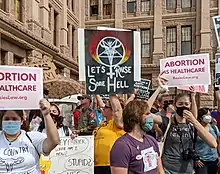
On the day the act went into effect, protesters rallied in the Texas state capital of Austin, Texas.[103] Women in Dallas protested while wearing costumes from The Handmaid's Tale, a dystopian novel about women living in a totalitarian theocracy.[104] Other small demonstrations were organized near city halls of other Texas towns.[105] The day after the bill was enacted, the hashtag #texastaliban, a critical reference to the Taliban, trended on Twitter with over 50,000 tweets.[89]
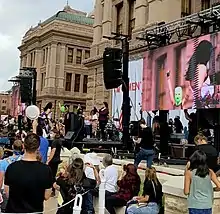
On September 3, hacktivist group Anonymous announced "Operation Jane", an initiative to oppose the law. The group subsequently hacked the website of the Republican Party of Texas, replacing it with text about Anonymous, an invitation to join Operation Jane, and a Planned Parenthood donation link.[106] On September 13, the group released a large quantity of private data belonging to Epik, including domain purchase and transfer details, account credentials and logins, payment history, employee emails, and unidentified private keys.[107] The Distributed Denial of Secrets (DDoSecrets) organization said later that day that they were working to curate the allegedly leaked data for public download, and said that it consisted of "180 gigabytes of user, registration, forwarding and other information".[108] Publications including The Daily Dot and The Record by Recorded Future subsequently confirmed the veracity of the hack and the types of data that had been exposed.[109][110]
Protests occurred in about 600 places nationwide on October 2. They were called the 2021 Women's March.[111]
Public opinion on the law is divided, with two polls showing a narrow majority support the new legislation. One poll showed that roughly 55% of Texans support the law, compared to 45% who oppose it.[112] Another poll showed a plurality of 46% of Texans supporting the law, while 43% remain opposed.[113]
The law is supported by various anti-abortion organizations including Texas Right to Life.
Political reactions
President Joe Biden criticized the act, describing it as "extreme" and saying it "blatantly violates the constitutional right established under Roe v. Wade".[114] Senator Elizabeth Warren argued that it is time to "step up and codify Roe into federal law".[89] Congressional candidate for the 28th district of Texas, Jessica Cisneros, also spoke out against the act, stating that the law puts women at risk and it has a disproportionate impact on women of color and low income women. She stated, "When laws that push access to reproductive health care out of reach take effect, it's always women of color and low-income communities that are most harmed. Others who have the resources and connections will always find a way to receive the care they need."[115]
Some Republicans, such as South Dakota governor Kristi Noem praised the act, while others (including 2021 Virginia gubernatorial candidate Glenn Youngkin and Senate minority leader Mitch McConnell) were more leery.[116] Some other states, including Florida[117] and Ohio[118] have introduced legislation with language that mimics the Texas law.
On December 11, 2021, a day after the Supreme Court effectively upheld enforcement of the law in Whole Woman's Health v. Jackson, Governor Gavin Newsom of California called for the state legislature to apply the legal framework from Texas' law to gun control, seeking a bill that would introduce a private right of action against manufacturers, distributors, and sellers of assault weapon or ghost gun supplies in the state.[119][120]
See also
Notes
- “Unlike the action potential in skeletal muscle cells, the cardiac action potential is not initiated by nervous activity”
References
- Liptak, Adam; Tavernise, Sabrina (September 1, 2021). "After Silence From Supreme Court, Texas Clinics Confront Near-Total Abortion Ban". The New York Times. ISSN 1553-8095. Archived from the original on September 1, 2021. Retrieved September 1, 2021.
- de Vogue, Ariane (September 1, 2021). "Texas 6-week abortion ban takes effect after Supreme Court inaction". CNN. Archived from the original on September 1, 2021. Retrieved September 1, 2021.
- Keshner, Andrew. "Texas abortion law: $10,000 penalty could incentivize 'bounty hunters' to make 'tens of thousands of dollars'". MarketWatch.
- Devlin Barrett; Ann E. Marimow (September 9, 2021). "Justice Department sues Texas to block six-week abortion ban". The Washington Post.
- "Complaint" (PDF). documentcloud.org. US DOJ. Retrieved September 9, 2021.
- Sneed, Tierney (October 6, 2021). "Federal judge issues order blocking Texas' 6-week abortion ban". CNN. Retrieved October 6, 2021.
- Goodman, J. David (October 9, 2021). "Most Abortions in Texas Are Banned Again After Court Ruling". The New York Times. ISSN 0362-4331. Retrieved October 9, 2021.
- "Texas Planned Parenthoods Granted Restraining Order Against Anti-Abortion Group Over New Law". Houston Public Media. September 3, 2021.
- "Lubbock lawmaker hit with 13 abortion lawsuits Thursday morning". KLBK | KAMC | EverythingLubbock.com. September 23, 2021. Retrieved September 23, 2021.
- "Order of the Multidistrict Litigation Panel". Texas Judiciary Website. September 23, 2021.
- "Texas Legislators File Radical 'Fetal Heartbeat' Bill To Ban Abortion After Just Six Weeks". Archived from the original on June 2, 2021. Retrieved June 2, 2021.
- "Texas Legislature Online – 83(2) History for HB 59". Texas Legislature Online. Texas Legislature. Archived from the original on March 11, 2018. Retrieved December 7, 2016.
- "Representative Cain Files The Texas Heartbeat Bill". house.texas.gov. Texas House of Representatives. Archived from the original on February 9, 2019. Retrieved February 9, 2019.
- "Texas Legislature Online – 86 History for HB 1500". Texas Legislature. Archived from the original on February 9, 2019. Retrieved February 9, 2019.
- Young, Stephen (February 26, 2019). "More Than a Third of the Texas House Is Backing a Stealth Abortion Ban". Dallas Observer. Archived from the original on February 26, 2019. Retrieved February 26, 2019.
Fifty-seven of the 150 member body of the Texas House have signed on as authors, co-authors or sponsors of Cain's legislation.
- Bella, Timothy (May 19, 2021). "Texas governor signs abortion bill banning procedure as early as six weeks into pregnancy". The Washington Post. ISSN 2641-9599. Archived from the original on September 1, 2021. Retrieved September 1, 2021.
- Najmabadi, Shannon (May 19, 2021). "Gov. Greg Abbott signs into law one of nation's strictest abortion measures, banning procedure as early as six weeks into a pregnancy". The Texas Tribune. ISSN 0897-2710. Archived from the original on September 1, 2021. Retrieved September 1, 2021.
- Najmabadi, Shannon (March 18, 2021). "Texas lawmakers push bill to make it easier to sue abortion providers and harder for new anti-abortion laws to be blocked by courts". The Texas Tribune. ISSN 0897-2710. Archived from the original on September 1, 2021. Retrieved September 1, 2021.
- "Texas Legislature Online - 87(R) Actions for SB 8". capitol.texas.gov. Retrieved September 13, 2021.
- Sandoval, Edgar; Montgomery, Dave (May 19, 2021). "Near-Complete Ban on Abortion Is Signed Into Law in Texas". The New York Times. San Antonio. ISSN 1553-8095. Archived from the original on September 1, 2021. Retrieved September 1, 2021.
- "The Writ-Of-Erasure Fallacy - Virginia Law Review". September 27, 2018.
- Gershman, Jacob (September 4, 2021). "Behind Texas Abortion Law, an Attorney's Unusual Enforcement Idea". The Wall Street Journal. Retrieved September 5, 2021.
- Gresko, Jessica; Paul J., Weber (September 4, 2021). "Origin story of the Texas law that could upend Roe v. Wade". Associated Press. Retrieved September 5, 2021.
- Palmeri, Tara, Did Texas just reset the 2022 campaign?, Politico, September 5, 2021
- Schmidt, Michael S. (September 12, 2021). "Behind the Texas Abortion Law, a Persevering Conservative Lawyer". The New York Times. Retrieved September 21, 2021.
- "The Capitol Ledger, Volume 3 Issue 6" (PDF). Archived (PDF) from the original on September 3, 2021. Retrieved September 2, 2021.
- Kaye, Julia; Hearron, Marc (July 19, 2021). "Even people who oppose abortion should fear Texas's new ban". The Washington Post. ISSN 2641-9599. Archived from the original on July 26, 2021. Retrieved September 1, 2021.
- Irvine, Bethany (September 2, 2021). "Why "heartbeat bill" is a misleading name for Texas' near-total abortion ban". The Texas Tribune. Retrieved October 9, 2021.
- Schats, R.; Jansen, C.A.M.; Wladimiroff, J.W. (November 1990). Marsh, Mike (ed.). "Embryonic heart activity: appearance and development in early human pregnancy". BJOG: An International Journal of Obstetrics & Gynaecology. 97 (11): 989–994. doi:10.1111/j.1471-0528.1990.tb02469.x. ISSN 1471-0528. PMID 2252878. S2CID 11449967. Retrieved October 9, 2021.
- See Definitions, Section 171.201 (7) of Chapter 171 of the Texas Health & Safety Code.
- "What banning abortion at 6 weeks really means". May 19, 2021. Archived from the original on September 1, 2021. Retrieved September 2, 2021.
- Astor, Maggie (September 9, 2021). "Here's What the Texas Abortion Law Says". The New York Times. Retrieved October 25, 2021.
- Oxner, Reese (September 1, 2021). "U.S. Supreme Court refuses to block Texas' six-week abortion ban". The Texas Tribune. Archived from the original on September 1, 2021. Retrieved September 2, 2021.
- Goins-Phillips, Tre (September 3, 2021). "Texas Clinic Boasts of Performing Nearly 70 Abortions in 17 Hours Just Before Heartbeat Bill Takes Effect". CBN News. Retrieved September 3, 2021.
- (PDF) https://webservices.sos.state.tx.us/legbills/files/RS87/SB8.pdf Missing or empty
|title=(help) - Cohen, Rebecca; Panetta, Grace (September 7, 2021). "Gov. Abbott said Texas would 'eliminate all rapists from the streets' so women don't have to worry about the new anti-abortion law having no exception for rape". Business Insider. Retrieved September 8, 2021.
- Rabin, Roni Caryn (September 1, 2021). "Answers to Questions About the Texas Abortion Law". The New York Times. Retrieved September 5, 2021.
- McCammon, Sarah. "What The Texas Abortion Ban Does — And What It Means For Other States". NPR.org. Retrieved September 5, 2021.
- Manian, Maya (2007). "Privatizing Bans on Abortion: Eviscerating Constitutional Rights through Tort Remedies". Temple Law Review. 80: 123. Archived from the original on September 3, 2021. Retrieved September 3, 2021.
- Johnson, Carrie; Sprunt, Barbara (September 9, 2021). "Justice Department Sues Texas Over New Abortion Ban". NPR News. Retrieved September 9, 2021. (includes full text of lawsuit)
- "Texas Senate Bill 8: Medical and Legal Implications" (PDF). Archived (PDF) from the original on July 14, 2021. Retrieved September 2, 2021.
- Tribe, Laurence (September 5, 2021). "Opinion: What the Justice Department should do to stop the Texas abortion law". The Washington Post. Retrieved September 6, 2021.
- The Editorial Board (September 9, 2021). "Opinion: The best way to fight the Texas abortion law". The Washington Post. Retrieved September 10, 2021.
- Tribe, Laurence; Rosenberg, David (September 7, 2021). "How a Massachusetts case could end the Texas abortion law - We successfully invoked the civil parallel of the Ku Klux Klan Act to prevent the neighbor of a Harvard Square restaurant from wielding a state-conferred veto power over the issuance of any liquor license within a 500-foot radius". Boston Globe. Retrieved September 7, 2021.
- How a Massachusetts case could end the Texas abortion law
- 459 U.S. 116 (1982)
- "Denial Should Have Been Unanimous". National Review. September 2, 2021.
- "The SB8 Endgame". November 5, 2021.
- "Whole Women's Health v. Jackson (5th Cir Sept. 10, 2021)" (PDF). U.S. Court of Appeals for the Fifth Circuit. September 10, 2021.
- Cassens Weiss, Debra (September 16, 2021). "Dershowitz: Texas abortion bounty approach could be adopted in states that want to ban handgun ownership". ABA Journal. Retrieved September 16, 2021.
- "Dallas Attorney Files Restraining Order Challenging Texas "Heartbeat" Abortion Bill". August 23, 2021. Archived from the original on August 27, 2021. Retrieved September 2, 2021.
- DeBenedetto, Paul (September 3, 2021). "Texas Planned Parenthoods Granted Restraining Order Against Anti-Abortion Group Over New Law". KERA News.
- "Agreed Temporary Injunction in Planned Parenthood v. Texas Righ to Life (Sept. 13, 2021)" (PDF). Travis County District Court. September 13, 2021.
- Jessica Schneider and Ariane de Vogue. "Texas judge issues injunction against anti-abortion group on enforcing new law". CNN. Retrieved September 16, 2021.
- "COMPLAINT FOR DECLARATORY AND INJUNCTIVE RELIEF — CLASS ACTION" (PDF). Archived (PDF) from the original on July 17, 2021. Retrieved September 2, 2021.
- Liptak, Adam (August 30, 2021). "Supreme Court Asked to Block Texas Law Banning Most Abortions". The New York Times. Washington, D.C. ISSN 1553-8095. Archived from the original on August 31, 2021. Retrieved September 1, 2021.
- Thomson-DeVeaux, Amelia (September 2, 2021). "Why Texas's Abortion Law May Go Too Far For Most Americans". FiveThirtyEight. Retrieved September 5, 2021.
- Zhang, Andrew (August 31, 2021). "666 new Texas laws go into effect Sept. 1. Here are some that might affect you". The Texas Tribune. ISSN 0897-2710. Archived from the original on September 1, 2021. Retrieved September 1, 2021.
- "Fast-Tracking the Texas Abortion Ban Faces Hurdles in US Supreme Court". National Law Journal. Retrieved September 25, 2021.
- Zimmermann, Carol (September 24, 2021). "Texas abortion providers ask court to speed up abortion law review". Catholic News Service. Retrieved September 25, 2021.
- Edwards, Schaefer. "Pro-Choice Groups Beg U.S. Supreme Court To Hurry Up And Rule On Texas Abortion Ban". Houston Press. Retrieved November 14, 2021.
- de Vogue, Ariane (October 22, 2021). "Supreme Court lets Texas 6-week abortion ban stay in place and will hear oral arguments November 1". CNN. Retrieved October 22, 2021.
- Breuninger, Kevin; Mangan, Dan (December 10, 2021). "Supreme Court will let lawsuit challenging Texas abortion law continue". CNBC. Retrieved December 10, 2021.
- Staff (September 6, 2021). "Justice Department will 'protect' abortion seekers in Texas". AP News. Retrieved September 6, 2021.
- "Docket for United States v. State of Texas, 1:21-cv-00796 - CourtListener.com". CourtListener. Retrieved September 13, 2021.
- Cassens Weiss, Debra (September 9, 2021). "DOJ sues to block Texas abortion law, cites conflict with federal constitutional duties". ABA Journal. Retrieved September 16, 2021.
- Oxner, Reese (September 15, 2021). "Federal judge will hear Texas' arguments against temporarily blocking abortion ban before ruling on Biden administration request". The Texas Tribune. Retrieved September 16, 2021.
- Lucas, Ryan and Carrie Johnson. "Texas' abortion law is back in court". NPR.org. Retrieved October 2, 2021.
- Kendall, Brent (October 1, 2021). "Federal Judge Questions Texas Abortion Law in Case Filed by Justice Department". Wall Street Journal. ISSN 0099-9660. Retrieved October 2, 2021.
- Cassens Weiss, Debra (October 7, 2021). "Federal judge who blocked Texas abortion law cites these reasons for US standing to sue". ABA Journal. Retrieved October 7, 2021.
- Office of the Attorney General (Texas) (October 8, 2021). "Emergency Motion for Stay by Appellant State of Texas in USA v. Texas, No. 21-50949 (5th Cir. 2021)" (PDF).
- "Texas AG Paxton asks federal appeals court to reinstate state's abortion law after a judge put a temporary hold on it". KXAN Austin. October 8, 2021. Retrieved October 8, 2021.
- "Appeals court puts temporary hold on judge's order blocking Texas 6-week abortion ban". CNN. Retrieved October 9, 2021.
- Cassens Weiss, Debra (October 15, 2021). "Once again, 5th Circuit keeps Texas abortion law in effect". ABA Journal. Retrieved October 15, 2021.
- Weber, Paul (October 15, 2021). "Justice Department will ask Supreme Court to halt Texas abortion law". Los Angeles Times / Associated Press. Retrieved October 15, 2021.
- Docket. "United States v. Texas, No. 21A85". Supreme Court of the United States.
- Howe, Amy (October 18, 2021). "Biden administration asks justices to block enforcement of Texas abortion law". SCOTUSblog.
- "United States v. Texas, No. 21A85 (No. 21-588), 595 U. S. ____ (Sept. 1, 2021)" (PDF). Supreme Court of the United States. October 22, 2021.
- Chung, Andrew (October 22, 2021). "U.S. Supreme Court to hear challenge to Texas abortion ban". Reuters. Retrieved October 22, 2021.
- Totenberg, Nina (October 22, 2021). "The Supreme Court keeps Texas abortion law in place, but agrees to review it". NPR. Retrieved October 22, 2021.
- Braid, Alan (September 18, 2021). "Why I Violated Texas's Extreme Abortion Ban". The Washington Post. Retrieved September 18, 2021.
- Levenson, Michael (September 18, 2021). "Texas Doctor Says He Performed an Abortion in Defiance of New State Law - In an opinion essay in The Washington Post titled "Why I violated Texas's extreme abortion ban," Dr. Alan Braid wrote, "I am taking a personal risk, but it's something I believe in strongly."". The New York Times. Retrieved September 19, 2021.
- Cassens Weiss, Debra (September 27, 2021). "Oscar Stilley, the convicted lawyer who sued a Texas abortion doctor, was disbarred over litigation conduct". ABA Journal. Retrieved September 28, 2021.
- Jordan, Freiman (September 21, 2021). "Texas doctor who wrote op-ed about intentionally violating state's abortion ban sued under new law". www.cbsnews.com. Retrieved September 21, 2021.
- Chen, Vivia (October 5, 2021). "Meet the Quirky Plaintiffs Suing Under the Texas Heartbeat Act". news.bloomberglaw.com. Retrieved October 5, 2021.
- Travis County Clerk, TRCP 76A(3) Notice, Instr. No. 202181238 (9/17/2021)
- "Civil Settings for District Court for Oct. 4, 2021" (PDF). Travis County District Clerk. Retrieved September 23, 2021.
- Texas Multidistrict Litigation Panel. "In re Texas Heartbeat Act Litigation, No. 21-0872 (MDL Panel Order October 14, 2021)". Texas Judiciary.
- "'We will keep fighting': Reaction to Supreme Court ruling that lets Texas heartbeat bill stand". September 2, 2021. Archived from the original on September 2, 2021. Retrieved September 2, 2021.
- "TikTokers flood Texas abortion whistleblower site with Shrek memes, fake reports and porn". The Guardian. September 3, 2021. Retrieved September 6, 2021.
- "'We will keep fighting': Reaction to Supreme Court ruling that lets Texas heartbeat bill stand". Dallas News. September 2, 2021. Archived from the original on September 2, 2021. Retrieved September 2, 2021.
- "Anti-abortion website attacked on eve of Texas' new abortion law". spectrumlocalnews.com. Archived from the original on September 1, 2021. Retrieved September 2, 2021.
- "GoDaddy is cutting off Texas Right to Life's abortion 'whistleblowing' website". September 3, 2021.
- Kornfield, Meryl (September 6, 2021). "A website for 'whistleblowers' to expose Texas abortion providers was taken down — again". The Washington Post.
- EDT, Fatma Khaled On 9/12/21 at 10:10 AM (September 12, 2021). "Texas women are now going online for abortion pills info after state's new ban, says nonprofit". Newsweek. Retrieved September 12, 2021.
- Nowlin, Sanford (September 4, 2021). "The Satanic Temple begins legal maneuver to skirt Texas' new abortion ban". San Antonio Current. Retrieved September 6, 2021.
- "Senate Bill 4 (2nd C.S.)". capitol.texas.gov. Retrieved November 14, 2021.
- Carma Hassan and Devan Cole. "Texas governor signs bill tightening restrictions on abortion-inducing drugs". CNN. Retrieved September 21, 2021.
- "Governor Greg Abbott Signs Texas Senate Bill 4 Tightening Restrictions On Abortion-Inducing Drug Availability". September 21, 2021. Retrieved September 21, 2021.
- O'Kane, Sean (September 3, 2021). "Lyft and Uber to cover legal fees of drivers sued under Texas anti-abortion law". The Verge. Retrieved September 3, 2021.
- Provenzano, Brianna (September 3, 2021). "Bumble and Match Have Created a Relief Fund to Help Cover Abortion Costs in Texas". Gizmodo. Retrieved September 3, 2021.
- Prieb, Natalie (September 6, 2021). "Tech company CEO steps down after comments on Texas abortion law". The Hill. Retrieved September 7, 2021.
- "Protesters rally against six-week Texas abortion ban". www.statesman.com. Archived from the original on September 2, 2021. Retrieved September 2, 2021.
- "'Handmaid's Tale'-themed protest held in Dallas as new 'heartbeat' abortion law takes effect". wfaa.com. September 2, 2021. Archived from the original on September 2, 2021. Retrieved September 2, 2021.
- "With Abortions On Hold, Some Texans Say It's Hard To Be Hopeful". KERA News. September 1, 2021. Retrieved September 3, 2021.
- Novell, Carly (September 11, 2021). "Anonymous hacks Texas GOP website, floods it with memes". The Daily Dot. Retrieved September 15, 2021.
- Goforth, Claire (September 14, 2021). "Anonymous to release massive data set of the far-right's preferred web hosting company". The Daily Dot. Retrieved September 14, 2021.
- Ropek, Lucas (September 14, 2021). "Anonymous Claims to Have Stolen Huge Trove of Data From Epik, the Right-Wing's Favorite Web Host". Gizmodo. Retrieved September 14, 2021.
- Thalen, Mikael (September 16, 2021). "'Worst I've seen in 20 years': How the Epik hack reveals every secret the far-right tried to hide". The Daily Dot. Retrieved September 16, 2021.
- Cimpanu, Catalin (September 15, 2021). "Anonymous hacks and leaks data from domain registrar Epik". The Record by Recorded Future. Retrieved September 16, 2021.
- Webber, Richard; Harte, Julia. "Texas rally launches day of U.S. protests against abortion restrictions".
- "Fight over Texas Abortion Law Divides Voters".
- Barrón-López, Laura; Miranda Ollstein, Alice; Hooper, Kelly (September 1, 2021). "Biden: Texas abortion law 'blatantly violates' Roe precedent". Politico. Archived from the original on September 2, 2021. Retrieved September 1, 2021.
- Nast, Condé (August 31, 2021). "Texas Just Banned Most Abortions". Teen Vogue. Retrieved September 6, 2021.
- "Seeing danger, some in GOP leery of Texas abortion law". Associated Press. September 3, 2021.
- "New Florida bill replicates Texas' sweeping abortion ban". Associated Press. September 22, 2021.
- "Ohio Bill Copies Texas' Abortion Ban—And Goes Further. Here's Which States Could be Next". Forbes.
- Hubler, Shawn (December 12, 2021). "Newsom Calls for Gun Legislation Modeled on the Texas Abortion Law". The New York Times. Retrieved December 12, 2021.
- "Governor Newsom Statement on Supreme Court Decision" (Press release). Sacramento, California: Office of the Governor of California. December 11, 2021. Retrieved December 12, 2021.
External links
- U.S. v. Texas, no. 21-796 (W.D. Tex. Sep. 9, 2021); complaint filed by U.S. Justice Department to invalidate the Act.
- Docket and documents for United States v. State of Texas, No. 1:21-cv-796 (W.D. Tex. Sept. 9, 2021) and Fifth Circuit Court of Appeals Docket #: 21-50949