Thacker Pass Lithium Mine
The Thacker Pass Lithium Mine is a proposed lithium clay mining development project in Humboldt County, Nevada which is the largest known lithium deposit in the US.[4][5] The project would cover 1,000 acres (400 ha), on a site 21 miles (34 km) west-northwest of Orovada, Nevada within the McDermitt Caldera.[3][4][6] The mine is proposed by Lithium Nevada, LLC - a wholly owned subsidiary of Lithium Americas Corp. At full capacity it would produce 66,000 tons annually, equivalent to 25% of the current (2021) demand for lithium globally, which is expected to triple over the next five years.[2][3][5] There has been significant exploration of Thacker Pass since 2007, and Record of Decision approving development of Thacker Pass lithium mine was announced in January, 2021.
| Location | |
|---|---|
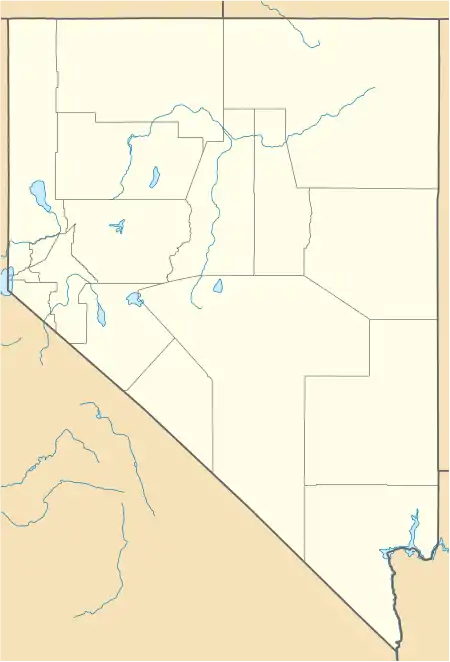  Thacker Pass Lithium | |
| Nevada | |
| Country | United States |
| Coordinates | 41°42′30″N 118°03′43″W[1] |
| Production | |
| Products | Lithium |
| Production | 66,000 tons per year (projected)[2] |
| Greatest depth | 400 feet (120 m)[3] |
| History | |
| Opened | Not yet operational |
| Owner | |
| Company | Lithium Americas Corp. |
| Website | Official website |
Development of Thacker Pass lithium mine is driven by increasing demand for lithium used in electric vehicle batteries, but the project has met resistance in the form of legal challenges and direct action.[7] Several indigenous tribes with traditional homeland in the area oppose the project. These tribes have stated that Thacker Pass is a sacred site, a massacre site, and that they were not adequately consulted by the Bureau of Land Management. Opponents of the mine have voiced concerns about rushed environmental review, threats to critical wildlife habitat, disruption of cultural sites, and links between resource extraction and missing and murdered indigenous women. Proponents of the mine have stated that the project is necessary to limit climate change by reducing carbon emissions from American cars, is benign in its social and environmental impact, and will create 300 long-term jobs in rural Nevada, paying an average of $63,000 per year.[2][3] The New York Times reported that controversy around the mine is "emblematic of a fundamental tension" around resource extraction necessary to support the renewable energy transition.
Resources
The Thacker Pass lithium deposit has Measured and Indicated resources of 13.4 million tonnes of Lithium Carbonate Equivalent (LCE).[8] The Thacker Pass Volcano-sedimentary deposit is the largest known sedimentary lithium resource in the U.S.[4] Scholarship on McDermitt Caldera lake sediments, like those occurring at Thacker Pass, have estimated total lithium resources up to 120 Mt of lithium,[9] which would be greater than five times the identified global reserves identified by the USGS[10] and suggest that measured and indicated resources at Thacker Pass represent a small portion of the overall lithium resources in the McDermitt Caldera.
Lithium Americas stated that they believe that the site has $3.9 billion of recoverable lithium.[2]
Initial project approval
In August 2019, Lithium Americas lodged a Plan of Operations for its proposed lithium clay mining development project with the Bureau of Land Management, the federal mining regulator.[11] In January 2020, the company announced the publication of a Notice of Intent to prepare an Environmental Impact Statement for the Thacker Pass lithium project.[12] On January 15, 2021, BLM issued their Record of Decision approving the Thacker Pass Lithium Mine.[13] Opponents of the mine claim the environmental review was rushed, because what is normally a multi-year review process was completed in less than a year.[14] During the permitting process for the proposed Thacker Pass lithium mine in 2020, the Bureau of Land Management consultation with the Fort McDermitt Paiute and Shoshone Tribe, the Summit Lake Paiute tribe, and the Western Winnemucca Indian Colony resulted in no issue concerning historic property within areas of potential disturbance.[15] Other tribes were not consulted during the review process, leading the Burns Paiute Tribe and the Reno-Sparks Indian Colony to intervene in a lawsuit against the Bureau of Land Management and Lithium Nevada Corporation in July 2021.[16][17][18]
Concerns
Environmental issues
The proposed Thacker Pass mine overlaps with 2,866 acres (1,160 ha) of big sagebrush habitat and known golden eagle breeding sites.[19] The Final Environmental Impact Statement (2019) found three occupied golden eagle territories overlapping the project area, a fourth closely adjoining it, and several more territories with dozens of unoccupied and occupied nests in the survey area overall.[20] The BLM has requested a take permit from the US Fish and Wildlife Service for one of these breeding pairs.[19]
The project may be disruptive to the habitat of Endangered Species Act-listed animals. A coalition of environmental groups filing a lawsuit against the mine stated that Thacker Pass is, "critically important to wildlife because it connects the Double H Mountains to the Montana Mountains. The pass also provides lower-elevation habitat that wildlife need to survive the winter." The group also stated that the area constituted, "one of the last big blocks of the sagebrush sea free of development."[21]
Additional environmental concerns include legacy contamination from groundwater pollutants such as arsenic, air pollution issues arising from sulfuric acid leaching of lithium from clay sediments, and changes in the connectivity of groundwater and surface water systems providing critical aquatic habit to the endangered Lahontan cutthroat trout and the Kings River pyrg (Pyrgulopsis imperialis), a rare springsnail not known to live anywhere else in the world.[21][22]
The Thacker Pass area has been disturbed by lithium mining exploration activities since 2007,[23] including excavation of bulk material in an open pit and drill core sampling.
Environmental justice issues
Environmental defenders occupying the site of the proposed mine have concerns about the lack of free, prior, and informed indigenous consent for the project; destruction of sacred sites and hunting and gathering areas;[24][25] human rights violations; and greenwashing of the project.[26][27]
Mine opponents have also voiced concerns about the safety of local communities, especially connections between large labor camps and missing and murdered Indigenous women (MMIW).[28] Projects that bring a large predominately male workforce from outside the local area can generate increases in drug use and violent crime.[3] In an opinion piece for a local newspaper, protest organizer Max Wilbert has cited research linking large infrastructure projects such as mines with violence against Indigenous women, and pointed to recent cases of sexual violence at the Enbridge Line 3 pipeline where contractors were arrested in a sex trafficking sting.[29]
Cultural history
Thacker Pass is the traditional homeland of several related Indigenous nations, including the Shoshone-Paiute Tribes of the Duck Valley Reservation, the Fort McDermitt Paiute and Shoshone Tribe, Lovelock Paiute Tribe, Fallon Paiute Shoshone Tribe, Pyramid Lake Paiute Tribe and the Reno-Sparks Indian Colony.[14] Members of the Fort McDermitt Paiute and Shoshone Tribe have stated that their tribe, "descends from essentially two families who, hiding in Thacker Pass, managed to avoid being sent to reservations farther away from our ancestral lands" and hence that this tribe owes its existence to the shelter provided by the Pass.[30]
Thacker Pass is called Peehee mu'huh in the Paiute language, meaning 'rotten moon'. This name derives from a massacre that occurred at this location when a band of Paiute families were killed; their rotting remains were strewn about the moon-shaped Pass and discovered by surviving members of the band during a full moon.[31][32][3]
In September 1865, Robert C. Payne's Company E, of the 1st Nevada Cavalry Battalion led an attack on a Paiute camp of about seventy people, close to the Quinn River, in what is now known as the Quinn River Valley. At least 31 people were killed. The eastern border of Thacker Pass (41°42′9″N 117°57′50″W) is between 4 and 5 miles (6.4 and 8.0 km) from the Quinn River (41°39′44″N 117°53′2″W) at its closest points.
The September 30, 1865 Owyhee Avalanche article "Indian Fight in Queen River Valley" stated: "For several days prior to the 10th instant, camp fires were noticed on the west side of the valley; therefore, on that day, Capt. Payne, of the 1st Nevada Cavalry, with eighteen men, started to call on them...The camp consisted of about seventy Indians, who were evidently preparing to make a raid somewhere, as new bows, arrows, and other implements of war, were found partially or fully completed."[33]
In 1868, three years after the attack, O.A Palmer's survey of the Quinn River Valley revealed the Indian camp locations. In particular, his field notes described those camps as located in Township 44 North, Range 36 East: "Along the line between Sec. 22, 23, and between the creek and the meadow I found the remains of an extensive Indian camp. It was at these camps that Captain R.C.Payne, with Co.E, 1st Nevada Cavalry, attacked and whipped a body of Indians on Sept 12th 1865."[34] Palmer's detailed survey map of Township 44 North showed the precise location of the remains of two Indian camps within the Quinn River Valley.[35] The survey map positions the camps at 3 miles distant from eastern edge of the McDermitt caldera rim, an entry point to Thacker Pass.
In 1881, Myron Angel's History Of The State Of Nevada states: "September 13th, at day-break, Captain Payne attacked a camp of Indians in Quin's River Valley, on Willow Creek; a running fight ensued that lasted about three hours, resulting in the killing of thirty-one Indians, and wounding of one white man."[36]
In 1916, Fairfield's Pioneer History of Lassen County, also describes Captain Payne's 1865 Willow Creek attack: "September 12th Captain Payne and Lieutenant Littlefield with eighteen men of Company E, First Nevada Cavalry, had a fight with the Indians at Willow creek in Queen's River valley. About twenty miles northwest of Buffalo Springs they reached the top of the mountain overlooking Queen's River valley, and from there saw Indian camp fires. They separated, each officer taking half of the force, and about daylight each party got to within a mile of the Indian camp and charged it."[37]
In 1923, W.H. Good surveyed Thacker Pass (Township 44 North, Range 35 East).[38] Good's detailed map of the Township did not indicate any Indian camps or other remains within the area.[39] Forty pages of survey notes cover Thacker Pass and describe a rocky landscape with intermittent sage growth. Good's descriptions of Section 25 on page 265: "Land, nearly level. Soil, sandy and rocky clay loam. Undergrowth, sage and shadscale. Poor grazing." and Section 2 on page 279: "Land, rolling and broken mountainous. Soil, rocky clay loam. Undergrowth, medium growth of sage and grass." are typical of the area.[40]
In 1929, Bill Haywood, born 4 years after Captain Payne's 1865 Willow Creek attack, also describes a massacre in his autobiography, but provides no dates. Haywood[41] states that he was told by Jim Sackett, a pensioner who participated in the massacre, that indigenous men, women and children were killed. Sackett suggests a successful surprise attack occurred at daybreak, when the camp was asleep. Sackett stated that a single indigenous man escaped on horseback in this account. Two infant children also survived and were raised by Charley Thacker. Haywood states that he met the two survivors, named Charley and Jimmy Thacker. Haywood also states that he met Ox Sam, who said that he was the one who escaped on horseback. Ox Sam stated that the indigenous people were camped at that location because they were going to the Quinn river to hunt geese and ducks.
Gregory Michno's 2007 book refers to Captain R.C Payne's attack as having occurred at Willow Creek. Michno described a thwarted surprise attack leading to extensive fighting on the plains of the Quinn River. The two-pronged assault involved 18 troopers and two officers of Company E, 1st Nevada Cavalry. Captain Payne and Lieutenant Littlefield took nine men each, one group approaching the Indian camp directly, the other skirting around and behind. The Indians spotted the advance and scattered. The ensuing fight lasted over three hours and occurred over several miles. Many were killed while running, though a mounted Paiute, attempted to protect other tribespeople from further attacks by charging directly across the plain towards Lieutenant Littlefield[42]
In the August 2011 issue of Wild West, Karen Holliday Tanner and John D. Tanner Jr wrote that Captain Payne's attack occurred on Willow Creek as a running battle. It was the last skirmish in Nevada for the volunteers, and Payne was discharged on November 18 but remained in Paradise Valley at least through mid-July 1866."[43][44] [45]
Legal challenges
In early February, 2021, a local rancher filed a lawsuit against the Bureau of Land Management over concerns about the project's water use.[46] On February 26, 2021, four environmental non-profits (Western Watersheds Project, Great Basin Resource Watch, Basin and Range Watch, and Wildlands Defense) also filed a lawsuit challenging the BLM's permitting of the project, claiming threats to sage grouse habitat, old growth sagebrush, golden eagle nests, endemic springsnails, and Endangered Species Act–listed Lahontan cutthroat trout, bighorn sheep, and pygmy rabbits.[21][22] These opponents of the mine have claimed that the review process was rushed and that the public input process was questionable.[47][46]
Regional indigenous tribes have intervened in the lawsuits against the Bureau of Land Management and Lithium Nevada Corporation. Reno-Sparks Indian Colony requested that the Bureau of Land Management consult them about the mine, stating in a letter that, "Just because regional tribes have been isolated and forced onto reservations relatively far away from Thacker Pass does not mean these regional tribes do not possess cultural connections to the Pass."[14] When the BLM rejected this request for consultation, Reno Sparks Indian Colony, Burns Paiute Tribe, and a committee of Fort McDermitt Tribal members calling themselves People of Red Mountain intervened in the lawsuits.[17][16][48] People of Red Mountain is not a federally recognized tribe so it has no legal standing.[5] The tribes are demanding consultation under the Archaeological Resource Protection Act.[49]
The Fort McDermitt Tribal Council, who had been consulted during the review process, initially had a project engagement agreement with Lithium Americas but the council responded to a petition from tribal members by voting unanimously to withdraw from that agreement and to sue the Bureau of Land Management for violations of the National Historic Preservation Act in allowing the project to proceed.[24][50] This lawsuit was never filed.
In July, 2021 Chief United States District Judge, Miranda Du ruled that Lithium America may excavate archaeological trenches at the site, as the environmental groups could not show irreparable harm would be caused by the digging.[51] The digging will be less than 1/4 acre and will be used to determine whether cultural artifacts exist within the proposed project area.[52]
In September, the judge also ruled against tribes' claims that a historical massacre occurred in Thacker Pass and refused to grant their request for a preliminary injunction to stop excavation for cultural resources. She stated that while she found their spiritual distress persuasive, they did not show sufficiently specific irreparable harm.[5] She also stated that, "the evidence before the Court does not support [plaintiffs'] claims...the 1868 field notes do not show a massacre happened within the Project area."[53]
On October 5, 2021, Tribal lawyers filed a motion asking the judge to reconsider the opinion that the massacre did not occur at Thacker Pass.[54] This motion was denied on November 8, and the judge stated: "the proffered newly discovered evidence is too speculative to support an irreparable harm finding".[55][56]
The digging will require an Archeological Resources Protection Act permit from the U.S. Bureau of Land Management permit.[57] The judge intends to rule on the overall case in early 2022.[51]
Protests
Regional indigenous tribes have protested the mine by organizing rallies, prayer runs, and similar events. Environmental defenders have been occupying Thacker Pass since the record of decision was issued in January, 2021.[58][59][60] They have indicated their intention to continue their occupation through the winter and to obstruct development of the project through direct action if necessary.[61]
On April 10, 2021, over 60 people from different reservations in the region came to Thacker Pass to demonstrate their opposition to the mine by praying, dancing, and sharing food with local people and protesters occupying the site. Indigenous people attending that event said there were sacred sites in the area including burials and also a massacre site from which the location derives its name in the Paiute language. They also demonstrated concerns about public health, water quality, air quality, and lack of indigenous consent for the project.[25]
In May, 2021, a group of Fort McDermitt Paiute-Shoshone tribal members calling themselves People of Red Mountain petitioned the United States Department of the Interior and others to halt construction of the lithium mine at Thacker Pass. Their petition states that Thacker Pass is a massacre site, contains ancestral burials, is sacred to their people, and is "essential to the survival of our traditions."[30]
On June 12, 2021, hundreds of people attended a rally in Reno, NV to protest the Thacker Pass lithium mine.[62]
Economics and politics
As of 2021 lithium demand is expected to triple over the next 5 years.[5] There is one existing lithium mine in the USA, also in Nevada.[63]
While the US holds some of the largest known reserves of lithium, the only large-scale US mine producing it (located in Silver Peak, Nevada) makes less than 5,000 tons annually, which is less than 2% of the global supply.[2] The government is concerned that, as of 2021, almost all the lithium used is imported, which the Department of Energy says is a "strategic vulnerability".[64]
Responses
| How To Survive: Episode 1, White Gold | |
|---|---|
 https://www.marketplace.org/shows/how-we-survive/white-gold/ https://www.marketplace.org/shows/how-we-survive/white-gold/ |
The New York Times reported that, "the fight over the Nevada mine is emblematic of a fundamental tension surfacing around the world: Electric cars and renewable energy may not be as green as they appear".[2]
Lithium America's CEO Alexi Zawadzki has said that Lithium Americas Corp criticized the protests and reassured concerns about environmental impact. In an opinion piece in a local newspaper, he argued that development of the Thacker Pass lithium deposit would support President Biden's economic security goals, provide jobs, and help the U.S. reach greenhouse gas emission targets.[65] According to reporting in local news, Zawadzki and the company remained in active communication with the Fort McDermitt Paiute and Shoshone tribe, and that several dozen tribal members had applied for jobs at the mine.[66]
Glenn C. Miller, Professor Emeritus of the Department of Natural Resources and Environmental Science, University of Nevada Reno wrote "The proposed Thacker Pass mine will be relatively benign in comparison to other large mines in Nevada, primarily gold and copper mines." Miller also stated that no mining below the groundwater level will occur for the first 20 years, though later mining may go below that level. Miller states that there should be an on-going discussion about how the project would change the character of the valley. Miller closes with "The Thacker Pass mine is an important mitigation measure to slowing the U.S. contribution to climate change."[67]
References
- Final Environmental Assessment Western Lithium Corporation Kings Valley Clay Mine (Technical report). March 2014. DOI-BLM-NV-W010-2013-0046-EA. Retrieved January 13, 2019.
- Penn, Ivan; Lipton, Eric (May 6, 2021). "The Lithium Gold Rush: Inside the Race to Power Electric Vehicles". The New York Times. Retrieved May 22, 2021.
- Malmgren, Evan (September 23, 2021). "The Battle for Thacker Pass". The Nation.
- Bradley, Dwight C.; Stillings, Lisa L.; Jaskula, Brian W.; Munk, LeeAnn; McCauley, Andrew D. (2017). Lithium, Chapter K of Critical Mineral Resources of the United States—Economic and Environmental Geology and Prospects for Future Supply (PDF) (Report). United States Geological Survey.
- Sonner, Scott (September 6, 2021). "Judge rejects tribes' efforts to halt digging at Thacker Pass lithium mine in Nevada". Reno Gazette Journal. Retrieved September 9, 2021.
- "Public Input Sought for Clay Mine". Reno Gazette-Journal. January 2, 2014.
- Stone, Maddie. "The Battle of Thacker Pass". Grist. Retrieved October 23, 2021.
- Lithium Americas. "Lithium Americas Expands Resource at Thacker Pass and Increases Phase 1 Capacity to Target 40,000 tpa Lithium Carbonate". Retrieved October 17, 2021.
- Castor, Stephen (January 15, 2020). "Lithium-Rich Claystone in the McDermitt Caldera, Nevada, USA: Geologic, Mineralogical, and Geochemical Characteristics and Possible Origin". Minerals. doi:10.3390/min10010068.
- Unite States Geological Survey. "USGS Mineral Fact Sheet: Lithium" (PDF). Retrieved October 17, 2021.
- Cook, Michelle (October 10, 2019). "$1.3 billion lithium mining project takes shape in rural Northern Nevada". The Humboldt Sun. Winnemucca, NV. Archived from the original on December 14, 2020. Retrieved May 3, 2020.
- Cook, Michelle (January 31, 2020). "$1.3 billion Lithium Nevada project on track for 2020 milestones". Nevada News Group. Archived from the original on January 17, 2021. Retrieved May 3, 2020.
- Humboldt River Field Office issues a Record of Decision for the Thacker Pass Lithium Mine, Bureau of Land Management, January 15, 2021, retrieved March 16, 2021
- Solis, Jennifer (June 11, 2021). "Opposition to lithium mine grows among tribes, conservationists". The Nevada Current. Retrieved June 29, 2021.
- "Kathleen Rehberg's Letter to Reno-Sparks Indian Colony" (PDF). Public Access to Court Electronic Records (PACER). Retrieved August 3, 2021.
- Solis, Jeniffer (August 28, 2021). "Tribes seek pause on development of lithium mine". The Nevada Current. Retrieved August 30, 2021.
- Scheyder, Ernest (July 28, 2021). Adler, Leslie (ed.). "UPDATE 1-Native Americans win ruling to join lawsuit against Lithium Americas project". Reuters. Retrieved July 29, 2021.
- Chadwell, Jeri (September 1, 2021). "Judge to rule on another possible injunction for Thacker Pass lithium mine". This is Reno.
- Thacker Pass Lithium Mine Project Final Environmental Impact Statement (PDF) (Technical report). Bureau of Land Management and the U.S. Fish and Wildlife Service. December 4, 2020. DOI-BLM-NV-W010-2020-0012-EIS. Retrieved March 16, 2021.
- Burea of Land Management. "Thacker Pass Lithium Mine Project Final Environmental Impact Statement: Appendix A" (PDF). Retrieved October 21, 2021.
- Great Basin Resource Watch (February 26, 2021). "Conservation and Public Accountability Groups File Legal Challenge to the Thacker Pass Lithium Mine" (PDF). Retrieved April 17, 2021.
- Sonner, Scott (March 5, 2021). "Federal lawsuit challenges construction of lithium mine approved during Trump's final days". Reno Gazette-Journal. Associated Press. Retrieved March 16, 2021.
- "Final Environmental Impact Statement Thacker Pass Lithium Mine Project Appendix B" (PDF). Bureau of Land Management. Retrieved August 3, 2021.
- Bahouth, Brian (April 8, 2021). "Fort McDermitt Paiute and Shoshone tribal members protest Thacker Pass lithium mine". Retrieved April 17, 2021.
- Bahouth, Brian (April 13, 2021). "Native Americans converge at proposed Thacker Pass lithium mine site: Four audio interviews". Siera Nevada Ally. Retrieved April 17, 2021.
- "Thacker Pass Lithium mine approval draws around-the-clock protest". Sierra Nevada Ally. January 19, 2021. Retrieved March 16, 2021.
- Protect Thacker Pass. "Thacker Pass Mine Fact Sheet" (PDF). protectthackerpass.org. Retrieved April 17, 2021.
- Chadwell, Jeri (July 21, 2021). "Judge to decide on injunction request to halt work on Thacker Pass lithium mine". This is Reno. Retrieved October 12, 2021.
- Wilbert, Max (March 2021). "Dispatches from Thacker Pass – More Mining Leads to More Sexual Abuse and Missing Women". Sierra Nevada Ally.
- People of Red Mountain (May 20, 2021). "People of Red Mountain Statement of Opposition to Lithium Nevada Corp's Proposed Thacker Pass Open Pit Lithium Mine". Sierra Nevada Ally.
- Price, Austin (Summer 2021). "The Rush for White Gold". Earth Island Journal.
- Smart, Myron (March 24, 2021). "First Voices Indigenous Radio with Myron Smart and Will Falk". First Voices Indigenous Radio. pp. 16:20 to 18:40. Retrieved June 6, 2021.
- "Indian Fight in Queen River Valley. Owyhee Avalanche Newspaper, September 30,1865" (PDF). Public Access to Court Electronic Records (PACER). Retrieved October 9, 2021.
- "Indian Camp Remains. Notes of the Subdivision Lines in Township 44, October 18,1868". U.S.Dept. Of The Interior-Bureau Of Land Management. Retrieved October 9, 2021.
- Palmer, O.A (October 18, 1868). Township 44 North Range 36 East (PDF) (Map). U.S.Dept. Of The Interior-Bureau Of Land Management. Retrieved October 9, 2021.
- Angel, Myron, ed. (1881). History Of Nevada. p. 174. Retrieved October 10, 2021.
- Fairfield, Asa Merrill (1916). Fairfield's pioneer history of Lassen County, California to 1870. p. 374. Retrieved October 10, 2021.
- Humboldt County, Nevada Govt. Land Map, Townships (Map). Humboldt County NV, Govt. Retrieved October 11, 2021.
- Good, W.H. (1923). Township 44 North, Range 35 East (PDF) (Map). U.S.Dept. Of The Interior-Bureau Of Land Management. Retrieved October 11, 2021.
- "Thacker Pass Field Notes, Township 44 North, Range 35 East, W.H Good, 1923". U.S.Dept. Of The Interior-Bureau Of Land Management. Retrieved October 11, 2021.
- Haywood, William D. (1929). Bill Haywood's book : the autobiography of William D. Haywood. ISBN 9780717800117. Retrieved July 31, 2021.
- Michno, Gregory (2010). The Deadliest Indian War in the West: The Snake Conflict, 1864-1868. Caxton Press. p. 131. ISBN 9780870044878.
- "Female Buccaneer of the Sagebrush - Karen Holliday Tanner and John D. Tanner". www.historynet.com. Retrieved October 10, 2021.
- "Captain Payne 1st Nevada Calvary - mustered out. Gold Hill daily news, November22, 1865". Retrieved October 10, 2021.
- Michno, Gregory (2010). The Deadliest Indian War in the West: The Snake Conflict, 1864-1868. Caxton Press. p. 132. ISBN 9780870044878.
- Price, Austin (March 4, 2021). "Let's Not Blow Up a Mountain and Call It Green". Earth Island Journal. Retrieved April 12, 2021.
- Kapoor, Maya (February 18, 2021). "Nevada lithium mine kicks off a new era of Western extraction". High Country News. Retrieved March 3, 2021.
- Bahouth, Brian (August 28, 2021). "Thacker Pass Lithium Mine Udate". The Sierra Nevada Ally.
- Turner, Kelsey (December 10, 2021). "Tribes Claim BLM Violated Multiple Federal Laws in Permitting Thacker Pass Lithium Mine in Nevada". Native News Online. Yahoo News. Retrieved December 16, 2021.
- "Fort McDermitt Paiute-Shoshone Tribe Cancels Agreement with Lithium Mine, Promising Lawsuit" (Press release). April 5, 2021.
- Scheyder, Ernest (July 25, 2021). Lewis, Matthew; Adler, Leslie (eds.). "US judge rules Lithium Americas may excavate Nevada mine site". Reuters. Retrieved July 29, 2021.
- Sonner, Scott (July 26, 2021). "Judge denies environmentalists' request to block digging at Thacker Pass lithium mine". Reno Gazette-Journal. Retrieved July 29, 2021.
- "Bartell Ranch LLC v. U.S. Department of Interior(BLM)". Public Access to Court Electronic Records (PACER). Retrieved October 10, 2021.
- Sonner, Scott (October 5, 2021). "Tribes: New evidence proves massacre was at Nevada mine site". Associated Press.
- "Denial of Request for Reconsideration of Preliminary Injunction" (PDF). Public Access to Court Electronic Records (PACER). Retrieved November 11, 2021.
- Sonner, Scott (November 12, 2021). "US judge won't reconsider tribes' bid to block Nevada mine". Associated Press.
- Scheyder, Ernest (September 3, 2021). "Native Americans lose bid to halt digging at Nevada lithium mine site". Reuters. Retrieved September 6, 2021.
- "Thacker Pass Lithium Mine Project - Record Of Decision and Plan of Operations Approval" (PDF). U.S.Dept.Of The Interior-Bureau Of Land Management. Retrieved October 12, 2021.
- Wilbert, Max. "Activists Occupy Site of Proposed Lithium Mine in Nevada". protectthackerpass.org. Retrieved March 16, 2021.
- "Blockade sought at lithium site". Elko Daily Free Press. January 25, 2021. Retrieved March 16, 2021.
- Solis, Jenifer (September 16, 2021). "Will Thacker Pass be another Keystone?". The Nevada Current.
- Bean, Jason (June 12, 2021). "Photos: Hundreds gather in Reno to protest the proposed Thacker Pass lithium mine". Reno Gazette Journal.
- "Batteries and the new "lithium gold-rush"". www.cbsnews.com. Retrieved November 30, 2021.
- "Batteries and the new "lithium gold-rush"". www.cbsnews.com. Retrieved November 30, 2021.
- Zawadzki, Alexi (April 28, 2021). "Lithium Nevada Corp's CEO explains the benefits of the Thacker Pass Lithium Project". Sierra Nevada Ally. Retrieved May 20, 2021.
- Rothberg, Daniel. "Amid plans to mine lithium in rural Nevada, Indigenous, rural communities at center of the energy transition". Retrieved October 22, 2021.
- Miller, Glenn (July 20, 2021). "The Thacker Pass Mine is Indeed Benign, Compared to Most Gold and Copper Mines in Nevada". Sierra Nevada Ally. Retrieved July 31, 2021.