The Governor General's Body Guard
The Governor General's Body Guard was royal guard regiment of the Canadian Army that formed part of the country's Household Division. The Body Guard was the senior regiment of the Canadian Army and the equivalent of the British Army's Life Guards and Royal Horse Guards. In 1936 the regiment amalgamated with the Mississauga Horse to become The Governor General's Horse Guards.[1]
| Governor General's Body Guard | |
|---|---|
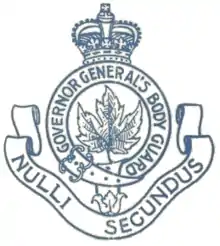 | |
| Active | 1822–1936 |
| Country | .svg.png.webp) Canada Canada |
| Branch | Canadian Militia |
| Type | Horse Guards |
| Role | Cavalry |
| Size | One Regiment |
| Garrison/HQ | Toronto Armories |
| Motto(s) | Latin: Nulli secundus ("second to none") |
| Engagements | Upper Canada Rebellion Fenian Raids North-West Rebellion Second Boer War First World War |
History
The regiment dates as far back as 1822 in York, Upper Canada (now Toronto). For the remainder of the 19th century this troop was recognized as the cavalry of the city of Toronto. It has links to the 1st York Light Dragoons formed in 1810 by Captain (later Major) John Button or Button's Troop (commanded until 1831). Also known as 'Denison's Troop', it began as the York Dragoons under the command of Captain George Taylor Denison I. Under the Militia Act of 1793, service in the militia was mandatory for all healthy male citizens aged 16 to 60 years. Like most militia in Canada during this period, the Dragoons were raised and financed by wealthy gentry, in this case the Denison family, as volunteers were not part of a regular army. The Dragoons began as a local mounted infantry company linked to the parent West York Regiment of Militia. This peculiar organization was a practice that started during the American Revolution with the Loyalist militia regiment the "Queen's York Rangers". Light cavalry was needed to provide dispatch duty, scouting, flank protection and picketing for the infantry battalion. Full militia cavalry regiments were too expensive to operate and large scale cavalry operations were of little use in the dense forests of eastern North America. The cavalry troop was sufficient to serve the purpose and militia infantry were allowed to raise cavalry troops under the Militia Act of 1808. This unit, like many local military units, was made up of volunteers and formed to supplement the presence of British Army units in Upper Canada. The company or troop broke from the parent infantry battalion and became an independent troop of cavalry in 1839.[2]
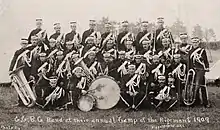
The troop was one of only two fully uniformed militia units to rally to the flag with the threat of unrest and rebellion within the colony, in 1837. The troop was given new uniforms, fully armed and redesignated the "Queens Light Dragoons" (QLD). Operating alongside the local Markham Troop, forming a squadron, the QLD participated in a number of actions during the rebellion to include Gallows Hill, Navy Island and Town of Scotland. The Toronto troop was on active service for several months during this crisis.[2]
In 1866, the troop was the only cavalry in Upper Canada to be placed on active duty, engaged and employed against the Fenian Irish Republican Army invasion from the United States. The troop lead Col Peacock's Column to meet the Fenian force along the Niagara Peninsula as scouts. The troop was the first unit to enter and relieve the town of Fort Erie - capturing several Fenians before they escaped across the Niagara River. The Fenian force was defeated and many of its members arrested by Canadian and American authorities.[2] [3]
By the mid-19th Century, Britain began to pull its army out of Canada for the Crimea War and the need to establish a Canadian army became clear. With the enactment of the Militia Act of 1855, the Canadian Militia Department was established. Under the act, the Canadian Militia unit establishment was drafted by the new department. Local militia units for the first time were recognized as standing units to become a more critical part of the defence of Canada. In 1847 the unit was gazetted and became known as the 1st Toronto Independent Troop of Cavalry. It was renamed again in 1855 as the 1st Troop of Volunteer Militia Cavalry of the County of York and placed on the Militia list 27 Sept 1855. In 1866 it was renamed 1st York Troop The Governor General's Body Guard for Upper Canada and in 1867 became The Governor General's Body Guard for Ontario. After British forces completely left Canada in 1870 the Canadian Government raised a small regular force and began to look at reorganizing the Militia cavalry into full regiments. Most of the independent troops across the country were amalgamated into numbered regiments of dragoons or hussars during the 1870s. The GGBG was the only non-numbered corps and was expanded to squadron strength in 1876. With a final rationalization of the Canadian Cavalry Corps in 1889, the GGBG was brought to full regimental strength with the amalgamation of the local Markham and Oak Ridges Troops. The name was changed a final time in 1895 to The Governor General's Body Guard of Canada.[2] [3]
The GGBG was mobilized as a full squadron and participated in the North-West Rebellion in 1885 as rear area security for General Middleton's force. The squadron's task was to protect the main supply route for the force in place with routine patrols from the rail line to Batoche and to secure the only supply depot and telegraph station at Humboldt. A fort was built, consisting of an earthen berm, around the telegraph station and named "Fort Denison". Middelton's force defeated the Metis at Batoche.[1] [2] [4]
The GGBG, as a regiment, supplied some 50 men to augment the small Canadian Regular Army for service in South Africa in 1900. Lt HZ Cockburn earned the Victoria Cross while serving as a volunteer with the Royal Canadian Dragoons during this conflict.[1] [2] [4] [5]
The GGBG, like all of the militia during the First World War, was not activated for duty, but rather assisted in raising numbered battalions for the Canadian Expeditionary Force and recruiting to fill the CEF ranks. Thousands of Toronto's citizens were recruited through the GGBG for service in the trenches. The GGBG supplied soldiers for the 3rd Bn, 2nd Bn, 4th CMR, 216th Bn, 124th Bn to name a few.[1] [2] [4]
In 1936 the regiment was amalgamated with The Mississauga Horse to become The Governor General's Horse Guards. [1] [2] [4]
Campaigns
- Rebellions of 1837–1838 / Upper Canada Rebellion
- Fenian Raids 1866
- North-West Rebellion 1885
- Boer War (1899)
- First World War 1914-1918
Uniform
Please note this is about the text of this Wikipedia article; it should not be taken to reflect on the subject of this article.
Do not restore or edit the blanked content on this page until the issue is resolved by an administrator, copyright clerk or OTRS agent.
If you have just labeled this page as a potential copyright issue, please follow the instructions for filing at the bottom of the box.

The previous content of this page or section has been identified as posing a potential copyright issue, as a copy or modification of the text from the source(s) below, and is now listed at Copyright problems :
Temporarily, the original posting is still accessible for viewing in the page history.
- You must permit the use of your material under the terms of the Creative Commons Attribution-Sharealike 3.0 Unported License (CC BY-SA 3.0) and the GNU Free Documentation License (GFDL) (unversioned, with no invariant sections, front-cover texts, or back-cover texts).
- Explain your intent to license the content on this article's discussion page.
- To confirm your permission, you can either display a notice to this effect at the site of original publication or send an e-mail from an address associated with the original publication to permissions-en
 wikimedia.org or a postal letter to the Wikimedia Foundation. These messages must explicitly permit use under CC BY-SA and the GFDL. See Wikipedia:Donating copyrighted materials.
 - Note that articles on Wikipedia must be written from a neutral point of view and must be verifiable in published third-party sources; consider whether, copyright issues aside, your text is appropriate for inclusion in Wikipedia.
Your rewrite should be placed on this page, where it will be available for an administrator or clerk to review it at the end of the listing period. Follow this link to create the temporary subpage.
- Simply modifying copyrighted text is not sufficient to avoid copyright infringement—if the original copyright violation cannot be cleanly removed or the article reverted to a prior version, it is best to write the article from scratch. (See Wikipedia:Close paraphrasing.)
- For license compliance, any content used from the original article must be properly attributed; if you use content from the original, please leave a note at the top of your rewrite saying as much. You may duplicate non-infringing text that you had contributed yourself.
- It is always a good idea, if rewriting, to identify the point where the copyrighted content was imported to Wikipedia and to check to make sure that the contributor did not add content imported from other sources. When closing investigations, clerks and administrators may find other copyright problems than the one identified. If this material is in the proposed rewrite and cannot be easily removed, the rewrite may not be usable.
- Posting copyrighted material without the express permission of the copyright holder is considered copyright infringement, which is both illegal and against Wikipedia policy.
- If you have express permission, this must be verified either by explicit release at the source or by e-mail or letter to the Wikimedia Foundation. See Wikipedia:Declaration of consent for all enquiries.
- Policy requires that we block those who repeatedly post copyrighted material without express permission.
If you have tagged the article for investigation, please complete the following steps:
- Add the following to the bottom of Wikipedia:Copyright problems/2021 December 9:
* {{subst:article-cv|The Governor General's Body Guard}} from https://www.militaryheritage.com/gghg.htm. ~~~~ - Place this notice on the talk page of the contributor of the copyrighted material:
{{subst:Nothanks-web|pg=The Governor General's Body Guard|url=https://www.militaryheritage.com/gghg.htm}} ~~~~ - To hide a section instead of an entire article, add the template to the beginning of the section and {{Copyvio/bottom}} at the end of the portion you intend to blank.