The Haunting (1999 film)
The Haunting is a 1999 American horror film directed by Jan de Bont, and starring Liam Neeson, Catherine Zeta-Jones, Owen Wilson, and Lili Taylor, with Marian Seldes, Bruce Dern, Todd Field, and Virginia Madsen appearing in supporting roles. Its plot follows a group of people who gather at a sprawling estate in western Massachusetts for an apparent volunteer study on insomnia, only to find themselves plagued by paranormal events connected to the home's grim history. Based on the 1959 novel The Haunting of Hill House by Shirley Jackson, it is the second feature film adaptation of the source material after Robert Wise's 1963 film adaptation of the same name.
| The Haunting | |
|---|---|
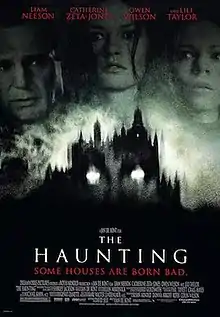 The Haunting film poster | |
| Directed by | Jan de Bont |
| Screenplay by | David Self |
| Based on | The Haunting of Hill House by Shirley Jackson |
| Produced by | Donna Roth Colin Wilson Susan Arnold |
| Starring | |
| Cinematography | Karl Walter Lindenlaub |
| Edited by | Michael Kahn |
| Music by | Jerry Goldsmith |
| Distributed by | DreamWorks Pictures |
Release date |
|
Running time | 114 minutes |
| Country | United States |
| Language | English |
| Budget | $80 million |
| Box office | $180.2 million |
Development for The Haunting originally began as a collaboration between filmmaker Steven Spielberg and writer Stephen King, who together began writing a new adaptation of Jackson's novel, largely inspired by Wise's 1963 film version. After creative differences, the project was aborted, with King retooling his screenplay to form the 2002 miniseries Rose Red. Spielberg meanwhile commissioned a new screenplay for the project, written by David Self, to be produced under Spielberg's own studio, DreamWorks Pictures. Filming of The Haunting began in the fall of 1998, with some location shoots occurring in England at Harlaxton Manor and Belvoir Castle, though the majority of the film was shot in specially-crafted sets in Los Angeles by esteemed Argentine production designer Eugenio Zanetti.
The Haunting premiered theatrically in North America in July 1999. Though met by largely negative reviews from film critics, it was a financial success, grossing $180 million worldwide.
Plot
Eleanor "Nell" Vance, an insomniac, has cared for her invalid mother for 11 years, sharing a Boston apartment with her. After her mother dies, Nell's sister Jane and her husband Lou inherit the residence. They eject Nell to prepare for a sale. As she faces homelessness, Nell accepts an invitation to participate in an insomnia study directed by Dr. David Marrow at Hill House, a secluded manor house in the Berkshires of western Massachusetts. At the house, she meets Mr. and Mrs. Dudley, an eccentric pair of caretakers. Two other participants arrive, Luke Sanderson and the glamorous Theodora ("Theo" for short), along with Dr. Marrow and his two research assistants. Unknown to the participants, Dr. Marrow's true purpose is to study the psychological response to fear, intending to expose his subjects to increasing amounts of terror. Each night, the caretakers chain the gate outside Hill House, preventing anyone from getting in or out until morning.
During their first night, Dr. Marrow relates the story of Hill House: Its original owner, Hugh Crain, a 19th-century textile tycoon, constructed the rambling home for his wife Renee, hoping to populate it with a large family. Unfortunately, all of Crain's children were stillborns, and Renee, devastated by the multiple losses, killed herself before the house was finished. After, Crain became a recluse. When Marrow's assistant declares that she feels there is more to the story, she is severely wounded in a freak accident and both research assistants leave for the hospital. As the four people stay in the house, supernatural events begin happening. A mysterious force tries to open the door to Theo and Nell's bedroom, there are banging noises against the walls, and the temperature drops in rooms and hallways. Nell begins seeing the ghosts of children in curtains and sheets and a large portrait of Hugh Crain morphs into a skeletal face, vandalized with the words "Welcome Home Eleanor" written in blood. During a heated argument, Theo and Luke deny any involvement in these events. They accuse Nell, claiming she is seeking attention, which she denies.
Nell becomes determined to prove that the house is haunted. She finds Crain's hidden office and learns that he used extensive child labor in his cotton mills. He took several orphans into his home, tortured and killed them, then burned their bodies in the fireplace. Nell surmises that these children's spirits are trapped in the house, providing Crain with an "eternal family". Nell also learns that Crain had a second wife named Carolyn, from whom she is descended. Dr. Marrow is skeptical of Nell's claims and soon reveals his true psychological fear study to the group. After a statue tries to drown him in a pool of water in a greenhouse, Marrow realizes Hill House is haunted and a danger to everyone. After several more terrifying events, Nell insists that she cannot leave the ghosts to suffer for eternity at Crain's hands. Theo offers to let Nell move in with her, but Nell reveals that she is related to Carolyn Crain and claims she must help the children to "move on" to the afterlife.
Dr. Marrow demands that everyone leave Hill House, but Hugh Crain's ghost seals it and traps them inside. Luke defaces a portrait of Crain, enraging his spirit to drag Luke to the fireplace where he is decapitated by a large chimney flue. When Crain himself manifests in massive spectral form, Dr. Marrow and Theo flee the house while Nell distracts Crain. Realizing that he thrived on the fear he created in children, Nell declares she is not afraid of Crain. Nell's declaration weakens the ghost and he is cast into a decorative bronze door, depicting various distressed children in a purgatory-like scene. Crain tries to drag Nell with him, but the children's spirits help her fend him off. As Nell dies, an image of her, posing as a motherly figure, is left in the bronze door, now surrounded by many happy children.
The Dudleys approach at dawn and ask Marrow if he "found what he was looking for". Dr. Marrow and Theo silently walk away from Hill House.
Cast
- Lili Taylor as Eleanor "Nell" Vance
- Liam Neeson as Dr. David Marrow
- Catherine Zeta-Jones as Theodora ("Theo")
- Owen Wilson as Luke Sanderson
- Marian Seldes as Mrs. Dudley
- Bruce Dern as Mr. Dudley
- Alix Koromzay as Mary Lambetta
- Todd Field as Todd Hackett
- Virginia Madsen as Jane Vance
- Tom Irwin as Lou
- Charles Gunning as Hugh Crain
Production
Development
Filmmaker Steven Spielberg approached horror author Stephen King in 1996 about making a haunted house film, and the two agreed that Robert Wise's 1963 film The Haunting was a benchmark of cinematic house horror. After collaborating on a screenplay partly-based on Wise's film (an adaptation of the Shirley Jackson novel The Haunting of Hill House), Spielberg and King ran into creative differences, and the project was ultimately aborted.[1] Spielberg pushed forward with the project, commissioning first-time screenwriter David Self to write a screenplay for the film. King went on to retool his rendition of the material into the 2002 miniseries Rose Red, which shares some elements of both Wise's 1963 film, as well as Jackson's source novel.[1]
Filming
.jpg.webp)
Principal photography began on November 30, 1998, and ended April 9, 1999. Harlaxton Manor, in England, was used as the exterior of Hill House while its Great Hall served as the games room scene where Marrow comfort Nell after seeing the bloodied "Welcome Home Eleanor" writing and where Nell reveals of Hugh Crain's crimes,[2] with the kitchen and pantry scenes done at Belvoir Castle.
The majority of the interior sets were built inside the dome-shaped hangar that once housed Hughes H-4 Hercules, near the permanently docked RMS Queen Mary steamship, in Long Beach, California.[3] The handcrafted interior sets cost an estimated $8–10 million to construct, and were designed by Argentine production designer Eugenio Zanetti.[4][5]
The film was burdened by reshoots, in part because cinematographer Caleb Deschanel left over creative differences one week into filming.[4] The studio also demanded a new ending be shot, which was completed in June 1999.[4]
Post-production
Following principal photography, the film's elaborate visual effects were completed by Phil Tippett, who had previously provided effects work on Jurassic Park (1993).[4]
Release
Box office
The Haunting opened theatrically in North America on July 23, 1999, screening in 2,808 theaters, and earning $33,435,140 during its opening weekend.[6] The film remained in theatrical release until November 1999.[6] It ultimately grossed $91,411,151 in North America, and $85,900,000 in international markets, making for a worldwide gross of $177,311,151.[6]
Critical response
The Haunting was largely met with unfavorable reviews from film critics, with many citing its weak screenplay, its heavy reliance on horror clichés, and its overdone CGI effects. Rotten Tomatoes gave the film a "Rotten" rating of 16% from 100 reviews, with the critical consensus stating "Sophisticated visual effects fail to offset awkward performances and an uneven script". Audiences polled by CinemaScore gave the film an average grade of "C+" on an A+ to F scale.[7] As a result of the negative reviews, it was nominated for five Razzie Awards but lost all five to Wild Wild West.[8]
Roger Ebert, however, gave the film a favorable review, praising the production design in particular: "To my surprise, I find myself recommending The Haunting on the basis of its locations, its sets, its art direction, its sound design, and the overall splendor of its visuals. The story is a mess, but for long periods of time that hardly matters. It's beside the point, as we enter one of the most striking spaces I've ever seen in a film."[5] Similar sentiments were echoed by The New York Times's Janet Maslin, who deemed the film "a lavish illustration of how to take a fairly modest black-and-white horror film from 1963 and amplify it so relentlessly that the sight of the flying cow in Twister would not be all that amiss... the film's spooky tricks are actually orchestrated by top-notch behind-the-scenes talent, who augment Mr. De Bont's tireless efforts to keep things moving."[9]
Awards and nominations
| Award | Category | Nominee(s) | Result |
|---|---|---|---|
| Golden Raspberry Awards | Worst Picture | Donna Roth, Colin Wilson and Susan Arthur | Nominated |
| Worst Director | Jan de Bont | Nominated | |
| Worst Actress | Catherine Zeta-Jones (also for Entrapment) | Nominated | |
| Worst Screenplay | David Self | Nominated | |
| Worst Screen Couple | Lili Taylor and Catherine Zeta-Jones | Nominated | |
| Stinkers Bad Movie Awards[10] | Worst Picture (Dishonourable Mentions) | The Haunting | Won |
| Worst Sense of Direction | Jan de Bont | Nominated | |
| Worst Screenplay for a Film Grossing Over $100M Worldwide Using Hollywood Math | David Self | Nominated | |
| Worst Remake | The Haunting | Won | |
| The Remake, Sequel, or Prequel Nobody Was Clamoring For | Nominated | ||
| Least "Special" Special Effects | Nominated |
Home media
The Haunting was released on VHS and DVD by DreamWorks Home Entertainment on November 23, 1999.[11] Following Paramount Pictures' acquisition of DreamWorks, Paramount reissued the film on DVD in October 2017.[12]
In October 2020, Paramount released the film on Blu-ray featuring a new 4K restoration under their "Paramount Presents" Blu-ray line.[13]
See also
References
- Kennedy, Michael (March 5, 2021). "Stephen King's Rose Red Was Originally A Remake Of The Haunting". ScreenRant. Archived from the original on August 27, 2021.
- The Haunting, filming & Production, Internet Movie Database
- Movie-Locations.com
- Jensen, Jeff (July 23, 1999). ""The Secrets of The Haunting"". Entertainment Weekly. Archived from the original on August 27, 2021.
- Ebert, Roger (July 1, 1999). "The Haunting". Chicago Sun-Times. Archived from the original on February 3, 2014.
- "The Haunting (1999)". Box Office Mojo. Retrieved August 27, 2021.
- "CinemaScore". cinemascore.com.
- Razzie Awards: 2000, Internet Movie Database
- Maslin, Janet (July 23, 1999). "'The Haunting': Things That Go Bump, and Worse, in the Night". The New York Times. Archived from the original on August 27, 2021.
- "Press Release - Stinkers 1999 Winners". February 17, 2002. Archived from the original on February 17, 2002.
- "Video Releases". The Baltimore Sun. November 25, 1999. p. 27 – via Newspapers.com.
- "The Haunting [DVD]". Amazon. Archived from the original on August 27, 2021.
- Squires, John (August 17, 2020). "Paramount Bringing 1999's 'The Haunting' to Blu-ray in October; Newly Remastered from 4K Transfer". Bloody Disgusting. Archived from the original on August 27, 2021.
External links
 |
Wikiquote has quotations related to: The Haunting (1999 film) |