The House in Fata Morgana
The House in Fata Morgana[lower-alpha 1] is a visual novel video game developed by Novectacle. It was released for Microsoft Windows and iOS by Novectacle in 2012 and 2014 in Japan, and for Microsoft Windows by MangaGamer in 2016 internationally. Additionally, a Nintendo 3DS version was released by FuRyu in 2016, and a PlayStation Vita version was released by Dramatic Create in 2017, both exclusive to Japan. Another PlayStation Vita version, as well as a PlayStation 4 version, were released in North America by Limited Run Games in 2019, who also released a Nintendo Switch version of the game in 2021.
| The House in Fata Morgana | |
|---|---|
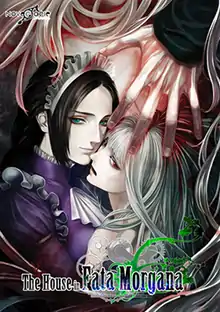 Cover art | |
| Developer(s) | Novectacle |
| Publisher(s) |
|
| Artist(s) | Moyataro |
| Writer(s) | Keika Hanada |
| Composer(s) | Mellok'n Gao Yusuke Tsutsumi Takaki Moriya Aikawa Razuna |
| Platform(s) | Microsoft Windows, iOS, Nintendo 3DS, PlayStation Vita, PlayStation 4, Nintendo Switch |
| Release | Microsoft Windows
|
| Genre(s) | Visual novel |
| Mode(s) | Single-player |
The House in Fata Morgana is a visual novel set in a mansion, where a spirit appears with amnesia. It meets a Maid in the mansion, and the two view the mansion's past in different time periods – 1603, 1707, 1869 and 1099 – to learn what has happened to its residents and to try to get the spirit to regain its lost memories.[1]
Plot
An amnesiac spirit awakens to find itself in a mansion. It is greeted by a Maid, who suggests exploring the mansion's past so the spirit may recover its memories. The Maid appears in all of the past events they visit, her appearance remaining unchanged. The mansion also appears in different locations throughout history.
She first takes them to 1603, where the mansion is inhabited by young aristocrat siblings Mell and Nellie Rhodes. Mell becomes smitten with a mysterious White-Haired Girl with pale skin and red eyes. She reveals to Mell that her father was a painter for the household but was kicked out and died in the streets. Mell apologizes for his family's actions, and the two begin a relationship. Nellie is driven mad with jealousy and discovers that the painter had slept with her and Mell's mother, resulting in the White-Haired Girl's birth and his expulsion. Nellie reveal this to Mell, as well as her own romantic feelings for him, leaving him distraught.
The Maid next takes the spirit to 1707, where the mansion is abandoned and destitute. The Maid, the mansion's only inhabitant, discovers Yukimasa, an amnesiac man, in the cellar. However, his amnesia, combined with abuse he received due to his race and inability to communicate, have caused him to visualize himself as a savage beast named "Bestia." The Maid tries to civilize him, but he murders villagers that come to the mansion in retaliation for his abuse. Some time later, a reincarnation of the White-Haired Girl appears at his doorstep, who retains hazy memories of her past life. Yukimasa attempts to kill her, but her lack of fear stupefies him, and the two become friends. Meanwhile, Pauline, Yukimasa's lover, searches for him. She gradually befriends Javi, a standoffish boy whose parents were killed by Yukimasa. The two travel to the mansion, but Yukimasa, who sees Pauline as another Bestia, kills her in his confusion. Later, Javi rallies the villagers to attack the mansion, resulting in the White-Haired Girl's death. Yukimasa succumbs to his bestial nature and slaughters all of the villagers.
The spirit is then lead by the Maid to 1869. The mansion is owned by young, greedy businessman Jacopo, and it has moved to America. He lives with his new wife, the White-Haired Girl, and as a multitude of servants, including the Maid and his childhood friend Maria. Jacopo, believing his wife to be wooing other men, locks her in a small exterior cottage. The White-Haired Girl writes love letters to him, but Maria alters the letters, secretly hoping to destroy the two's relationship. Jacopo eventually decides to release his wife, but he finds that she had given up hope and fled. Realizing the truth, Jacopo confronts Maria, who reveals her hatred towards him. The two exchange gunfire, and Maria dies. Jacopo spends the rest of his life unsuccessfully searching for the White-Haired Girl.
Briefly separated from the Maid, the spirit encounters a talking painting which shows him a memory of an unknown black-haired woman. Shortly after, the Maid takes them to 1099. In this era the White-Haired Girl flees to the mansion from a village that persecuted her for her appearance. She meets Michel, a mysterious hermit living in the mansion who has the power to drain life from anything he touches. The two fall in love, and the White-Haired Girl reveals that her name is Giselle. A bandit attacks the mansion, forcing Michel to drain some of his life. Having been cut, some of Michel's blood spills onto Giselle, and her health appears to deteriorate. The bandit tells the village of Michel and Giselle, so the villagers attack the manor, forcing the two to flee into the observation tower. With no chance of escape, the two embrace, causing Giselle to fall limp. Michel confronts the villagers and is skewered, but his blood kills all of the villagers. Giselle awakens, perfectly healthy. As she grieves for Michel, she is approached by the Maid, who says she's a witch named Morgana. Morgana offers her to be reincarnated so she may one day reunite with Michel's reincarnation, which Giselle accepts.
The spirit finally recalls its past identity as Michel, and the Maid explains that the White-Haired Girl had been Giselle's reincarnations. Michel, however, deduces that the last story was falsified and that the Maid is in fact Giselle. In reality, Giselle was not the White-Haired Girl, but instead a young black-haired woman in need of money for her family. She worked at an estate but was repeatedly raped by the patriarch, Antonin. When Antonin's wife discovered this, Giselle was to be executed, but instead Antonin had her banished to the mansion where Michel, their son, lived. Though Giselle is cheerful and cordial, Michel is cold and curt to her. When Giselle enters Michel's room one night, he discovers her and accuses her of thievery; Giselle flees in terror and passes out in the woods. She is brought to a nearby village where the villagers torture her to reveal the location of money they claim she stole. Out of desperation, Giselle leads them to the mansion so they may loot it. Michel steps outside, revealing his pale skin, white hair and red eyes. He scares the villagers away and accuses Giselle once more. Giselle, fed up, begs Michel to kill her, revealing his father's actions. Michel apologizes, and the two begin their relationship anew. Over a year, the two fall in love. After Michel hearing of his father's death, he sends a letter to his mother. Knights arrive and attack the manor. The two flee to the observation tower, but Michel leaves Giselle safely locked away while he confronts and is killed by the knights, his corpse being dragged away.
A disembodied voice speaks to Giselle, calling herself the Witch, Morgana. Morgana explains that she can reincarnate Michel, which Giselle agrees to. Morgana curses Giselle so that she no longer ages. Giselle waits for Michel's reincarnation to arrive for hundreds of years, eventually donning the Maid's garb per Morgana's recommendation. Eventually Mell and his family move into the house, and later the White-Haired Girl arrives. With her memories hazy, Giselle believes the White-Haired Girl, her actual name being Michelle, to be Michel's reincarnation, but Michelle doesn't remember her. Giselle becomes emotionally numb, watching the mansion's tragedies unfold with little reaction. Michelle's reincarnations only serve to torture Giselle further, until Morgana convinces her that she's always been the Maid and that her past memories with Michel aren't real.
The Maid, having regained her memories and personality as Giselle, is suddenly dragged away by Morgana into the observation tower. As Michel climbs the tower, Morgana reveals her past. As a child her blood was believed to have healing qualities, so her mother sold her to a local lord who mutilated her body to extract blood. She was freed in a slave uprising and cared for at a brothel, but bandits invaded and abducted Morgana. One of her fellow captives, a swordsman, broke free and, in his frenzy, killed their captors and fellow captives alike, sparing only Morgana. Morgana found a cottage and lived there for three years, until a boy came to her requesting she heal his sick sister. After Morgana gave his sister blood multiple times, the boy came to the cottage with the swordsman, who severed her arm. She was captured and brought to the lord, who kept her imprisoned in an observation tower to sell her blood through the church below. Though Morgana eventually died, her spirit lingered on, cursing the three men who made her suffer.
At the top of the tower, Michel finds an illusion of Giselle who, disgusted, claims that he is actually a woman. Michel, known as a child as "Michelle", was born intersex and was assumed female. Growing up he preferred the masculine activities of his brothers Didier, a knight, and Georges, an artist. After his voice deepened and his body became masculine, Michelle renamed himself "Michel" and claimed to have always been male. However, his mother, adoring him as her only daughter, considered him cursed and had him locked in his room until he could be "cured". He languished for two years until he was freed by Didier and Georges. With a fond farewell, they sent him to live in the mansion where he could be safe until they could welcome him back. Upon his father's death, Michel had written to his mother requesting her acceptance of him as a man. In her hysteria, she had sent the knights to claim his life, with Didier leading the procession.
Morgana taunts Michel by claiming that the White-Haired Girl was his reincarnation that Giselle had asked for, thus proving him to be female, while also mocking him for being unable to remember Giselle in his other lives. Giselle accepts Michel for everything he is and remains confident that the White-Haired Girl was not Michel. Michel, encouraged by Giselle, travels to the distant past when Morgana was alive to try to save Morgana from her fate. Michel convinces the "boy" and the "swordsman", past incarnations of Mell and Yukimasa, to free Morgana from the observation tower. He then travels into the memories of the "lord", the past Jacopo, learning that the "lord" who mutilated Morgana for blood was a different man. Instead, Jacopo was the slave who had saved and cared for Morgana, having eventually fallen in love with her before becoming the new lord. Overwhelmed with remorse, Jacopo agrees to free Morgana. When they climb the tower, they find Morgana on the verge of death and speaking to herself. Michel comforts her by her side as she dies; when he attempts to leave the mansion with her body, though, events play out as they originally had in the past, revealing that he was not changing the past but merely reliving it.
Back in the mansion, Michel meets the White-Haired Girl, who is the half of Morgana's soul embodying her self-sacrificing nature. Being formless until meeting Michel, the White-Haired Girl had modeled her appearance and name after him out of admiration. At her insistent request, Michel destroys her soul, allowing Morgana's soul to heal and become whole again. Now knowing the truth of the three men's actions, Morgana finally relinquishes her hatred. She goes with Michel to find their spirits, which are also trapped in the mansion, freeing them despite not forgiving them. Michel retrieves the talking painting, which contains Georges' soul. The three go to leave the mansion, but Didier's soul blocks their path. Georges blocks a fatal blow before Michel brings Didier to his senses and helps him pass on. Michel, Morgana and Giselle leave the dissipating mansion. In 2009 France, reincarnations of Mell, Nellie, Yukimasa, Pauline, Jacopo, Maria and Morgana are living ordinary lives. Giselle and Michel's reincarnations, having both retained their memories, reunite at the place where the mansion once stood.
Development
The game was developed by Novectacle and written by Keika Hanada,[2] with art by Moyataro.[3] The developers did not specifically target men or women with the game, and instead just intended to make a game for players who enjoy stories.[2] Hanada spent more than a year planning the story,[4] which was influenced by Tanith Lee's books, and the films Millennium Actress (2001) and The Best of Youth (2003).[5] To keep the text from distracting the player, it was mostly written in modern Japanese, with only little use of archaic speech.[6] To make the game feel unique, Moyataro made use of heavy coloring and shading, to portray a "more realistic kind of beauty" compared to the "cutesy" anime-like artstyle common in Japanese visual novels. Another important aspect in making the game feel unique was its music: more than half of the songs are vocal tracks, intended to make the game feel like visiting a theatre with someone singing in the background. Five composers worked on the music, and wrote 65 different tracks.[7]
In June 2013, the game distribution platform Playism announced that they were interested in localizing the game for English-speaking audiences, as they wanted to bring visual novels to their platform and felt The House in Fata Morgana might be a good place for them to start. They encouraged people to tell them if they were interested in the game, to gauge demand for it.[8] Two days later, they clarified that monetary issues were what caused them to not start localization work right away: Novectacle, being an indie developer, were unable to pay upfront for the localization work. Instead, Novectacle proposed that all revenue from Japanese The House in Fata Morgana sales would go to paying for the localization. As the Japanese sales on the Playism platform were much too low to finance the localization, Playism considered either waiting and seeing if Japanese sales would pick up pace, or launching a crowdfunding campaign.[9] Playism was still working towards a localization in late March 2014, when they released a localized demo.[10] During the Otakon convention in August 2014, the visual novel publisher MangaGamer announced that they had acquired the license to publish the game.[11]
Due to the large range of cultures and time periods appearing in the game, it was important to MangaGamer to decide on a localization strategy early on to avoid an inconsistent script; translator BlackDragonHunt said that making language in historical settings appear authentic was a difficult balancing act, with too modern dialogue breaking immersion, and older English being difficult for modern readers to understand. They decided to follow the same style as the Japanese original, mainly using modern language, with some use of words based on the various time periods and regions in the game to give it a "historical flavor": for instance, the word "bedroom" was replaced with "bedchamber", and "maid" with "abigail".[6]
Release and reception
| Aggregator | Score |
|---|---|
| Metacritic | (NS) 97/100[12] |
The game was originally released for Microsoft Windows on December 31, 2012 in Japan;[13] this version was also released through Playism on May 31, 2013 in Japan.[14] A Japanese iOS version followed on May 16, 2014.[15] MangaGamer released the Microsoft Windows version in English on May 13, 2016, both separately and in a bundle with the game's soundtrack.[1][16] A Nintendo 3DS version was released digitally in Japan on July 27, 2016 by FuRyu, as one of the first three games of their Catalyst line,[17] and a PlayStation Vita version was released both physically and digitally in Japan on March 16, 2017 by Dramatic Create.[18] This version includes new content; due to sickness, Moyataro was unable to create the new artwork needed for it, so another illustrator was given the task.[3]
Limited Run Games released the game in North America for PlayStation Vita on May 28, 2019, and released it for PlayStation 4 on June 11, under the title The House in Fata Morgana: Dream of the Revenants Edition; their PlayStation 4 version uses newer artwork as it was the first time the game was available in 4K resolution. They have also released physical versions for both platforms.[19] This version of the game was also released on the Nintendo Switch on April 9, 2021,[20] with a version for Japanese audiences released on March 25, 2021.[21]
The game was a runner-up for Hardcore Gamer's Best Story of 2016 award.[22]
The Steam release had an estimated total of 8,500 players by July 2018.[23]
Soundtrack
| The House in Fata Morgana Original Soundtrack | |
|---|---|
| Soundtrack album by Mellok'n, Takaki Moriya, Gao, Yusuke Tsutsumi and Aikawa Razuna | |
| Released | May 3, 2013 |
| Length | 272:49 |
The House in Fata Morgana Original Soundtrack is a soundtrack album which contains the original soundtrack from The House in Fata Morgana. It was released on May 3, 2013. The album is a compilation by five different artists: Mellok'n, Takaki Moriya, Gao, Yusuke Tsutsumi and Aikawa Razuna.
Track listing
| No. | Title | Artist | Length |
|---|---|---|---|
| 1. | "The House in Fata Morgana" | Mellok'n | 5:58 |
| 2. | "The Maid (Effected)" | Mellok'n | 1:40 |
| 3. | "The Maid (Piano)" | Mellok'n | 2:00 |
| 4. | "Ephemera" | Mellok'n | 2:49 |
| 5. | "Cetonilinae" | Mellok'n | 1:04 |
| 6. | "Petalouda" | Mellok'n | 2:33 |
| 7. | "Luciole" | Mellok'n | 2:12 |
| 8. | "Odonata (Unrest)" | Mellok'n | 2:06 |
| 9. | "Odonata" | Mellok'n | 2:13 |
| 10. | "Tarantula" | Mellok'n | 2:10 |
| 11. | "Muscomorpha" | Mellok'n | 3:55 |
| 12. | "Labirintia" | Mellok'n | 3:22 |
| 13. | "Acherontia Styx" | Mellok'n | 4:39 |
| 14. | "Vulpe" | Mellok'n | 1:23 |
| 15. | "Huaina" | Mellok'n | 2:39 |
| 16. | "Mephitis" | Mellok'n | 2:49 |
| 17. | "Mogera" | Mellok'n | 2:33 |
| 18. | "Comical" | Mellok'n | 1:02 |
| 19. | "Skia Oura" | Mellok'n | 3:35 |
| 20. | "Delphinas" | Mellok'n | 3:35 |
| 21. | "Fugitive Dust" | Mellok'n | 1:42 |
| 22. | "Fecha Me" | Gao | 6:37 |
| 23. | "Ciao Carina" | Takaki Moriya | 2:05 |
| 24. | "Dammi una Sigaretta" | Takaki Moriya | 3:46 |
| 25. | "La Meglio Gioventù" | Takaki Moriya | 3:09 |
| No. | Title | Artist | Length |
|---|---|---|---|
| 1. | "La Realtà Nella Nebbia" | Takaki Moriya | 4:10 |
| 2. | "The Past" | Takaki Moriya | 2:50 |
| 3. | "The Past (Harp Ver.)" | Takaki Moriya | 3:11 |
| 4. | "Bianco o Nero" | Takaki Moriya | 3:20 |
| 5. | "Dirà "Minchia!"" | Takaki Moriya | 4:23 |
| 6. | "Murk" | Takaki Moriya | 2:12 |
| 7. | "Morgana's Curse" | Takaki Moriya | 3:07 |
| 8. | "Cidade" | Gao | 3:51 |
| 9. | "Assento Dele" | Gao | 3:12 |
| 10. | "Olhos na Sala Esculo" | Gao | 2:46 |
| 11. | "Manita" | Gao | 5:01 |
| 12. | "Bad End" | Gao | 2:18 |
| 13. | "Necto Nédio" | Gao | 5:08 |
| 14. | "Planador" | Gao | 4:02 |
| 15. | "Sanctus" | Gao | 6:05 |
| 16. | "Fábula Escrita" | Gao | 5:40 |
| 17. | "Cicio" | Gao | 5:08 |
| 18. | "Giselle" | Gao | 5:01 |
| 19. | "Serie de Fragmento" | Gao | 4:55 |
| No. | Title | Artist | Length |
|---|---|---|---|
| 1. | "The Bollinger House" | Yusuke Tsutsumi | 1:01 |
| 2. | "Girlhood in Shambles" | Yusuke Tsutsumi | 2:14 |
| 3. | "Springtime Tears" | Yusuke Tsutsumi | 3:40 |
| 4. | "Venomous Angel" | Yusuke Tsutsumi | 4:16 |
| 5. | "Hex" | Yusuke Tsutsumi | 5:25 |
| 6. | "Hex (Youth Choir Ver.)" | Yusuke Tsutsumi | 5:29 |
| 7. | "Don't Say "Adieu"" | Yusuke Tsutsumi | 5:01 |
| 8. | "Desolation" | Yusuke Tsutsumi | 1:43 |
| 9. | "This Mutilated Body" | Yusuke Tsutsumi | 6:10 |
| 10. | "Portrait of White" | Yusuke Tsutsumi | 5:12 |
| 11. | "Everybody's Crying" | Yusuke Tsutsumi | 7:43 |
| 12. | "The March of Time" | Yusuke Tsutsumi | 4:36 |
| 13. | "A Noble Death" | Yusuke Tsutsumi | 5:17 |
| 14. | "Her Dying Voice" | Yusuke Tsutsumi | 6:00 |
| No. | Title | Artist | Length |
|---|---|---|---|
| 1. | "Never Hold Me" | Aikawa Razuna | 3:30 |
| 2. | "Drown in the Gutter" | Aikawa Razuna | 2:54 |
| 3. | "Stay Here, My Weary" | Aikawa Razuna | 2:40 |
| 4. | "Close My World" | Aikawa Razuna | 3:44 |
| 5. | "Crowd by the Riverside" | Aikawa Razuna | 2:20 |
| 6. | "Face Like a Mask" | Yusuke Tsutsumi | 4:00 |
| 7. | "Michel Bollinger (Intro)" | Yusuke Tsutsumi | 1:41 |
| 8. | "Michel Bollinger" | Yusuke Tsutsumi | 11:41 |
| 9. | "A Fleeting Fata Morgana" | Yusuke Tsutsumi | 11:25 |
| 10. | "The Symphonic House in Fata Morgana" | Takaki Moriya | 16:08 |
Other media
A manga adaptation of the game, The House in Fata Morgana: Anata no Hitomi o Tozasu Monogatari,[lower-alpha 2] was written by Hanada and drawn by Kanemune. It was published by Akita Shoten in four volumes from 2015 to 2017, of which the last three were released digitally. The manga has been licensed for release by Sekai Project, who released it digitally: the first volume was released November 2017, and the second February 2018.[24]
Notes
References
- Jenni (2016-03-31). "The House in Fata Morgana Opens Its Doors On May 13". Siliconera. Archived from the original on 2016-05-14. Retrieved 2016-05-14.
- Hanada, Keika (2016-05-13). "The House in Fata Morgana Now On Sale!". MangaGamer. Archived from the original on 2016-05-13. Retrieved 2016-05-14.
- "Is there a particular reason Moyataro isn't doing the artwork for the new content in the Vita version? And thank you for Fata Morgana! It was my favorite visual novel this year". Novectacle. 2016-12-25. Archived from the original on 2017-01-02. Retrieved 2017-01-02 – via ASKfm.
- "How log did you take to plan the plot?". Novectacle. 2016-12-30. Archived from the original on 2017-01-02. Retrieved 2017-01-02 – via ASKfm.
- "The plot and story behind House in Fata Morgana is noticeably rich and really deep in many aspects. What were your inspirations for the plot and character building behind House in Fata Morgana? Any book, series, songs perhaps?". Novectacle. 2016-12-24. Archived from the original on 2016-12-24. Retrieved 2016-12-24 – via ASKfm.
- BlackDragonHunt (2016-05-10). "The House in Fata Morgana: The Language of Fata Morgana". MangaGamer. Archived from the original on 2016-05-11. Retrieved 2016-05-10.
- "The House in Fata Morgana". MangaGamer. Archived from the original on 2016-05-14. Retrieved 2016-05-14.
- Ishaan (2013-06-02). "Here's The House in Fata Morgana, A Gothic Visual Novel You Might Get To Play". Siliconera. Archived from the original on 2014-10-11. Retrieved 2016-05-14.
- Ishaan (2013-06-04). "Financial Woes Strike Again; The House in Fata Morgana Localization Affected". Siliconera. Archived from the original on 2014-10-11. Retrieved 2016-05-14.
- Eugene (2014-03-30). "Gothic Visual Novel The House in Fata Morgana Has An English Demo". Siliconera. Archived from the original on 2015-01-11. Retrieved 2016-05-14.
- Estrada, Marcus (2014-08-08). "MangaGamer Announces Visual Novel Acquisitions at Otakon 2014". Hardcore Gamer. Archived from the original on 2015-09-10. Retrieved 2016-05-14.
- "The House in Fata Morgana - Dreams of the Revenants Edition -". Metacritic.
- "概要" (in Japanese). Novectacle. Archived from the original on 2016-05-14. Retrieved 2016-05-14.
- "ファタモルガーナの館 まとめ [PCゲーム]". Famitsu (in Japanese). Enterbrain. Archived from the original on 2016-05-14. Retrieved 2016-05-14.
- "ファタモルガーナの館[iPhone]". 4Gamer.net (in Japanese). Aetas Inc. Archived from the original on 2015-04-06. Retrieved 2016-05-14.
- Estrada, Marcus (2016-05-13). "The House in Fata Morgana Finally Available in English". Hardcore Gamer. Archived from the original on 2016-05-14. Retrieved 2016-05-14.
- Jenni (2016-07-20). "World End Economica And Other Visual Novels Are Coming To The 3DS In Japan". Siliconera. Archived from the original on 2016-07-21. Retrieved 2016-07-21.
- "ファタモルガーナの館 -COLLECTED EDITION-". Famitsu (in Japanese). Enterbrain. Archived from the original on 2016-12-24. Retrieved 2016-12-24.
- Romano, Sal (2019-05-22). "The House in Fata Morgana: Dream of the Revenants Edition launches May 28 for PS Vita, June 11 for PS4". Gematsu. Archived from the original on 2019-05-23. Retrieved 2019-05-24.
- Theriault, Donald (April 5, 2021). "Nintendo Downloads - April 8, 2021 - News". Nintendo World Report. Retrieved 2021-04-05.
- Hashimoto, Kazuma (2020-12-21). "The House in Fata Morgana Switch Will Open Its Doors in March 2021". Siliconera. Retrieved 2021-04-05.
- "Best of 2016 – Day One: Story, Soundtrack, Voice Acting". Hardcore Gamer. 2017-01-01. Archived from the original on 2017-01-02. Retrieved 2017-01-02.
- Orland, Kyle (2018-07-06). "Valve leaks Steam game player counts; we have the numbers". Ars Technica. Condé Nast. Archived from the original on 2018-07-10. Retrieved 2018-07-11. Complete list. Archived 2018-07-11 at the Wayback Machine
- "Sekai Project Licenses The House in Fata Morgana Manga". Anime News Network. 2017-08-12. Archived from the original on 2017-08-28. Retrieved 2017-08-12.
External links
 |
Wikiquote has quotations related to: The House in Fata Morgana |