The Pine Tree of Formentor
The Pine Tree of Formentor (Catalan: Lo Pi de Formentor, Spanish: El pino de Formentor) is one of the most well-known and celebrated poems by Miquel Costa i Llobera. Technically, it is considered as the culmination of the Romantic poetry in the Catalan language.[1]
.djvu.jpg.webp)
History
Miquel Costa i Llobera wrote the poem in Catalan language in 1875, during his first period of production.
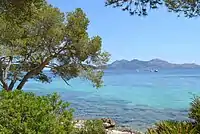
To compose it, he took inspiration from the majestic landscapes and visions of the pine trees rooted in the cliffs of the Formentor peninsula on Mallorca island. Costa i Llobera frequented those landscapes from an early age, which served as background for part of his work.
Years later, the poet published a version of the poem in Spanish.
Structure of the poem
The poem in Catalan is structured so that it contains 8 stanzas, totalling 40 alexandrine verses, with caesurae in the middle. Therefore, it is a 6+6 structure (12 metric syllables), with a rhyme.
Its beginning is famous:
Mon cor estima un arbre! Més vell que l'olivera, / més poderós que el roure, més verd que el taronger, / conserva de ses fulles l'eterna primavera, / i lluita amb les ventades que assalten la ribera, / com un gegant guerrer.
Whilst Costa i Llobera himself would publish a translation years later, in Spanish. The same first stanza reads:
Hay en mi tierra un árbol que el corazón venera: / de cedro es su ramaje, de césped su verdor; / anida entre sus hojas perenne primavera, / y arrostra los turbiones que azotan la ribera, / añoso luchador.
Legacy
The poem has been sung, among others, by Spanish singer Maria del Mar Bonet.
Artists such as Joan Miró[2] and Hermen Anglada Camarasa[3] used it as inspiration for their paintings.
References
- "Associació d'Escriptors en Llengua Catalana". AELC.
- Joan Miró. "Pine Tree of Formentor". Plazzart.com.
- "Pi de Formentor". Es Baluard Museum.