The Raising of the Cross
The Raising of the Cross is part of the Crucifixion of Jesus, and has been a distinct subject of Christian art.
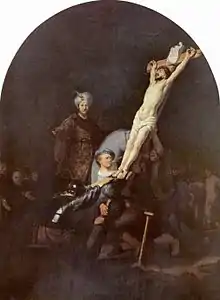
The Raising of the Cross by Rembrandt, 1633. Rembrandt painted himself into the depiction (in blue), partly to represent that he was (spiritually) present at the crucifixion.
Notable depictions include The Elevation of the Cross by Peter Paul Rubens and The Raising of the Cross by Rembrandt.
In John's gospel, Jesus predicted that he would be "lifted up from the earth" (John 12:32) in order to draw all men to himself. John notes that Jesus was referring to his death (John 12:33).
Rembrandt’s picture shows Christ as a king who is crucified. Nails driven through his arms and legs, naked and exposed as he takes his last breath. He is put to death at the hands of evil men. And yet, it is in this weakness that our salvation comes. There is much more happening at the cross than what our sinful eyes would have noticed. At the cross Christ redeemed sinners. At the cross Christ purchased a people for himself. At the cross Christ took our sin and stood in our place. At the cross Christ bore the wrath of God that we deserved. And meanwhile, like Rembrandt, we stand at the feet of Jesus. It was our sin that put him on that cross and it is our sin that he bore on that cross. In exchange, we receive the free gift of the righteousness of Christ. At the cross we receive an abundance of grace. While Adam’s sin led to our condemnation, the one act of righteousness by Christ led to our justification and life (Rom 5:18). By the one man, Adam, many were made sinners, but by the one man’s obedience “the many will be made righteous” (5:19). No longer do I see Rembrandt at the foot of the cross, but I see myself: a sinner in need of a Savior.[1]
This article is issued from Wikipedia. The text is licensed under Creative Commons - Attribution - Sharealike. Additional terms may apply for the media files.