The Social Dilemma
The Social Dilemma is a 2020 American docudrama film directed by Jeff Orlowski and written by Orlowski, Davis Coombe, and Vickie Curtis. The documentary provides a deep dive into how social media's design nurtures an addiction, manipulates people's views, emotions, and behavior, and spreads conspiracy theories and disinformation, to maximize profit. The film also examines the issue of social media's effect on mental health (including the mental health of adolescents and rising teen suicide rates).
| The Social Dilemma | |
|---|---|
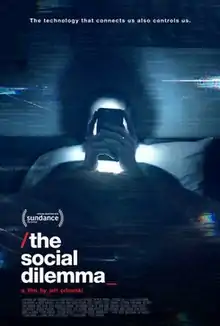 Promotional poster | |
| Directed by | Jeff Orlowski |
| Written by |
|
| Produced by | Larissa Rhodes |
| Starring | |
| Cinematography |
|
| Edited by | Davis Coombe |
| Music by | Mark A. Crawford |
Production companies |
|
| Distributed by | Netflix |
Release date |
|
Running time | 94 minutes |
| Country | United States |
| Language | English |
The film features interviews with many former employees, executives, and other professionals from top tech companies and social media platforms such as Facebook, Google, Twitter, and Mozilla. These interviewees draw on their primary experiences at their companies to discuss how such platforms have caused negative problematic social, political, and cultural consequences. Some of the interviewees qualify that social media platforms and big tech companies have provided some positive change for society as well. These interviews are presented alongside scripted dramatizations of a teenager's social media addiction.
The Social Dilemma premiered at the 2020 Sundance Film Festival on January 26, 2020, and was released on Netflix on September 9, 2020.[1] The documentary went on to be viewed in 38,000,000 homes within the first 28 days of release.[2] It received 7 nominations for the 73rd Annual Emmy Awards in 2021.[3]
Synopsis
The film dives into the psychological underpinings and the manipulation techniques by which, it claims, social media companies addict users. The interviewees state that this often leads to increased depression and increased suicide rates among teens and young adults.[4]
Orlowski uses a cast of actors to portray this in the dramatization. Ben, a teenager (played by Skyler Gisondo), slowly falls for these manipulation tactics and dives deeper into a social media addiction.
The dangers of artificial intelligence and fake news are touched on. Tristan Harris argues that this is a "disinformation-for-profit business model" and that companies make more money by allowing "unregulated messages to reach anyone for the best price". Wikipedia is mentioned as a neutral landscape that shows all users the exact same information without tailoring or monetizing it.
The interviewees restate their fear about artificial intelligence's role in social media and the influence these platforms have on society, arguing that "something needs to change."
Cast
Interviewees
- Tristan Harris, former Google design ethicist (2013–2016),[5] co-Founder and CEO of Apture (2007),[6], and co-founder of the Center for Humane Technology;[7] co-host of your undivided attention with Aza Raskin
- Tim Kendall, former Facebook executive (2006–2010), former President of Pinterest, and CEO of Moment (a mobile application that tracks screen time)[8]
- Jaron Lanier, American computer philosophy writer, computer scientist, visual artist, and composer of contemporary classical music; author of Ten Arguments for Deleting Your Social Media Accounts Right Now (2018)
- Roger McNamee, early investor at Facebook[9] and venture capitalist
- Aza Raskin, employee of Firefox and Mozilla Labs; co-founder of the Center for Humane Technology[7] and founder of Massive Health;[10] inventor of the infinite scroll
- Justin Rosenstein, Facebook engineer (2007–2008), Google engineer, and co-founder of Asana[11]
- Shoshana Zuboff, Professor Emeritus at Harvard Business School, author of The Age of Surveillance Capitalism (2019)[12]
- Jeff Seibert, former executive at Twitter, serial Tech Entrepreneur, and co-founder of Digits[13]
- Chamath Palihapitiya, former Vice President of Growth at Facebook (2007–2011)
- Sean Parker, former President at Facebook
- Anna Lembke, medical Director of addiction medicine at Stanford University
- Jonathan Haidt, social psychologist at the New York University Stern School of Business, author of The Righteous Mind: Why Good People are Divided by Politics and Religion (2012)
- Sandy Parakilas, former Operations Manager at Facebook (2011–2012) and ormer Product Manager at Uber
- Cathy O'Neil, data scientist and author of Weapons of Math Destruction (2016)[14]
- Randima Fernando, former product manager at Nvidia, former executive director at Mindful Schools, and co-Founder of Center For Humane Technology
- Joe Toscano, former experience design consultant at Google and author of Automating Humanity
- Bailey Richardson, early team member of Instagram (2012–2014)
- Rashida Richardson, adjunct professor at the New York University (NYU) School of Law and director of policy research at AI Now Institute
- Guillaume Chaslot, former engineer at YouTube (2012–2013), CEO of Intuitive AI, and founder of AlgoTransparency[15]
- Renée Diresta, research manager at the Stanford Internet Observatory and former Head of Policy at Data for Democracy
- Cynthia M. Wong, former senior Internet researcher at Human Rights Watch
Actors
- Skyler Gisondo as "Ben"
- Kara Hayward as "Cassandra"
- Sophia Hammons as "Isla"
- Chris Grundy as "Step-Dad"
- Barbara Gehring as "Mother"
- Vincent Kartheiser as "Artificial Intelligence"
- Catalina Garayoa as "Rebecca"
Scientific basis
The documentary explains how an extended amount of media consumption can subtly have a plethora of negative impacts on individuals.[16] Orlowski presents specific data to support this thesis, such as:
- A 62% increase in hospitalizations for American females aged 15–19 and a 189% increase in females aged 10–14 due to self harm, beginning in 2010–2011.[17]
- A 70% increase in suicide for females ages 15–19 and a 151% increase in females ages 10–14, beginning when social media was first introduced in 2009.[18]
However, it presents no proof of causation.
Reception
Critical response
On review aggregator website Rotten Tomatoes, the film holds an approval rating of 85% based on 66 reviews, with an average rating of 7.2/10. The website's critics consensus reads, "Clear-eyed and comprehensive, The Social Dilemma presents a sobering analysis of our data-mined present."[19] On Metacritic, the film has a weighted average score of 78 out of 100, based on nine critics, indicating "generally favorable reviews".[20]
The New York Times wrote that the documentary warns consumers about the hidden dangers of social media and the degree social networks collect personal data and use it to control and influence people's lives and decisions, and that the film features "conscientious defectors from companies such as Facebook, Twitter, and Instagram [who] explain that the perniciousness of social networking platforms is a feature, not a bug".[21] The film covers topics such as surveillance and polarization, addiction and the role capitalism plays in perpetuating a negative business model that has had "detrimental effects on everything from self-esteem to democracy" and uses an array of "personal anecdotes, emphatic pleas, and detailed data analyses" [22] to inform viewers of the risks of sharing information online and the perilous effects constantly being logged in has on our livelihoods.
ABC News's Mark Kennedy called the film "an eye-opening look into the way social media is designed to create addiction and manipulate our behavior, told by some of the very people who supervised the systems at places like Facebook, Google, and Twitter" and said it will "[make you] immediately want to toss your smartphone into the garbage can ... and then toss the garbage can through the window of a Facebook executive".[23] Variety's Dennis Harvey said the film does a good job of explaining how "what's at risk clearly isn't just profit, or even poorly socialized children, but the empathetic trust that binds societies, as well as the solidity of democratic institutions [which] we're learning can be all-too-effectively undermined by a steady diet of perspective-warping memes".[24] IndieWire's David Ehrlich stated that the film is the "single most lucid, succinct, and profoundly terrifying analysis of social media ever created".[1] A Financial Times review said the film "carefully details the skyrocketing levels of depression among children and teenagers; the flat-earthers and white supremacists; the genocide in Myanmar; the Covid misinformation; [and] the imperiling of objective truth and social disintegration".[25]
VentureBeat declared that the film is "a call to arms that strives to provoke a real response from lawmakers, companies, and the public at large before it's too late."[26] In a review article by Vanity Fair, they state "The Social Dilemma may finally convince you that we're being watched, manipulated, and misled by unscrupulous platforms and attention-harvesting algorithms."[27]
Nell Minow of RogerEbert.com offered a more mixed review, giving the film three stars out of four. She noted that the film "asks fundamental and existential questions" of humanity's potential self-destruction through its own use of computer technology, and praised its "exceptional" use of confessions from leaders and key players in the social media industry, but criticized the "poorly-conceived dramatic re-enactment of some of the perils of social media." She stated that "even the wonderfully talented Skyler Gisondo cannot make a sequence work where he plays a teenager seduced by extremist disinformation, and the scenes with Vincent Kartheiser embodying the formulas that fight our efforts to pay attention to anything outside of the online world are just silly."[28]
The film was also criticized for being simplistic, for its unhelpful or unnecessary dramatizations, and for failing to include many longstanding and diverse critics of social media.
Adi Robertson of The Verge noted the film offered a "familiar and simplistic assessment of how the internet has changed our lives." Robertson noted that "The film briefly mentions, for instance, that Facebook-owned WhatsApp has spread misinformation ... The film doesn't mention, however, that WhatsApp works almost nothing like Facebook. It's a highly private, encrypted messaging service with no algorithmic interference, and it's still fertile ground for false narratives."[29]
Casey Newton of The Verge also reviewed the film, arguing that it "is ridiculous[.] The dramatized segments include a fictional trio of sociopaths working inside an unnamed social network to design bespoke push notifications to distract their users. They show an anguished family struggling to get the children to put their phones away during dinner. And the ominous piano score that pervades every scene, rather than ratcheting up the tension, gives it all the feeling of camp."[30]
Pranav Malhotra of Slate stated that the film "plays up well-worn dystopian narratives surrounding technology," and "depend[s] on tired (and not helpful) tropes about technology as the sole cause of harm, especially to children." He also criticized the film for failing to acknowledge activists and commentators who have long-criticized social media, saying that "it could have also given space to critical internet and media scholars like Safiya Noble, Sarah T. Roberts, and Siva Vaidhyanathan, just to name a few, who continue to write about how broader structural inequalities are reflected in and often amplified by the practices of big technology companies."[31]
Elizabeth Pankova of The New Republic stated that "None of the information in the film is particularly new ... What's new is the purveyors of this information: the remorseful, self-aware warriors turned conscientious objectors of Silicon Valley. The film's interviewees take turns lamenting the way their utopian dream of connecting people "lost its way". She criticized the film for "lack[ing] any substantive political message other than a nod at 'regulation.'" and for suggesting that "the titular dilemma," then, isn't Facebook or Twitter or Instagram's to solve. It's ours. Turn off your notifications! Delete some apps! Follow people you disagree with on Twitter! These are the solutions hastily fired off as the credits roll."
Industry response
Author and digital media researcher Wendy Hui Kyong Chun argued that the film gives an inaccurate portrayal of how social media algorithms work and exaggerates how much control they have over their users.[32]
Facebook released a statement on its about page that the film “gives a distorted view of how social media platforms work to create a convenient scapegoat for what are difficult and complex societal problems".[33]
Mozilla employees Ashley Boyd and Audrey Hingle note that while the "making, release and popularity of The Social Dilemma represents a major milestone towards [the goal of] building a movement of internet users who understand social media’s impact and who demand better from platforms", the film would have benefited from featuring more diverse voices.[34]
Accolades
- 2020 Selectee, Documentary Premieres: Sundance Film Festival[35]
- 2020: Nominated for a Chicago Film Critics Association Award for Best Documentary Award [36]
- 2020 Winner: Impact Film Award, Boulder International Film Festival[37]
- 2021 Winner: Best Documentary Film, Music City Film Critics' Association Awards [37]
See also
- Algorithmic radicalization
- Communal reinforcement
- Digital media use and mental health
- Doomscrolling
- False consensus effect
- Filter bubble
- Group polarization
- Problematic social media use
- Selective exposure theory
- Search engine manipulation effect
- Social media and psychology
- Targeted advertising
- The Social Network
References
- Ehrlich, David (January 29, 2020). "'The Social Dilemma' Review: A Horrifyingly Good Doc About How Social Media Will Kill Us All". IndieWire. Archived from the original on April 17, 2020. Retrieved September 12, 2020.
- "Every Viewing Statistic Netflix Has Released So Far". What's on Netflix. February 28, 2021.
- "The Social Dilemma". Television Academy. Retrieved July 20, 2021.
- "Products - Data Briefs - Number 361 - March 2020". www.cdc.gov. April 7, 2020. Retrieved October 30, 2020.
- Orlowski, Jeff (September 9, 2020), The Social Dilemma (Documentary, Drama), Tristan Harris, Jeff Seibert, Bailey Richardson, Joe Toscano, Exposure Labs, Argent Pictures, The Space Program, retrieved October 28, 2020
- "Center for Humane Technology: Most Innovative Company". Fast Company. Retrieved October 28, 2020.
- "About". Tristan Harris. Retrieved October 28, 2020.
- "About us". inthemoment.io. Retrieved October 28, 2020.
- "Roger McNamee: "It's bigger than Facebook. This is a problem with the entire industry" - The Guardian".
- "30 Under 30: Aza Raskin, Massive HealthInc.com".
- "Facebook co-founder Dustin Moskovitz unveils new company, Asana". LA Times Blogs - Technology. November 2, 2011. Retrieved October 28, 2020.
- "Shoshana Zuboff - SHOSANA ZUBOFF".
- "Jeff Seibert - Medium".
- "Weapons of Math Destruction". weaponsofmathdestructionbook.com. Retrieved October 28, 2020.
- "YouTube: Candidates favored by the algorithm". algotransparency.org. Retrieved October 28, 2020.
- "Netflix documentary 'The Social Dilemma' unveils psychological manipulation used by social networks". TODAY.com. Retrieved October 28, 2020.
- "FastStats". www.cdc.gov. August 4, 2020. Retrieved October 28, 2020.
- "Products - Data Briefs - Number 361 - March 2020". www.cdc.gov. April 7, 2020. Retrieved October 28, 2020.
- "The Social Dilemma (2020)". Rotten Tomatoes. Fandango. Archived from the original on September 13, 2020. Retrieved October 10, 2021.
- "The Social Dilemma Reviews". Metacritic. Archived from the original on September 20, 2020. Retrieved September 14, 2020.
- Girish, Devika (September 9, 2020). "'The Social Dilemma' Review: Unplug and Run". The New York Times. ISSN 0362-4331. Retrieved October 12, 2021.
- Han, Angie (January 30, 2020). "'The Social Dilemma' and 'Coded Bias' docs sound the alarm on AI". Mashable. Retrieved October 12, 2021.
- Kennedy, Mark (September 8, 2020). "Review: Put down that phone, urges doc 'The Social Dilemma'". ABC News. Archived from the original on September 16, 2020. Retrieved September 9, 2020.
- Harvey, Dennis (January 31, 2020). "'The Social Dilemma': Film Review". Variety. Archived from the original on September 13, 2020. Retrieved September 9, 2020.
- Danny Leigh (September 9, 2020). "The Social Dilemma — this is how the world ends". www.ft.com. Archived from the original on September 14, 2020. Retrieved September 10, 2020.
- "The Social Dilemma: How digital platforms pose an existential threat to society". VentureBeat. September 2, 2020. Retrieved December 8, 2020.
- Breznican, Anthony. "This Documentary Will Make You Deactivate Your Social Media". Vanity Fair. Retrieved December 8, 2020.
- Robertson, Adi (September 4, 2020). "Telling people to delete Facebook won't fix the internet". The Verge. Retrieved October 13, 2020.
- Newton, Casey (September 16, 2020). "What 'The Social Dilemma' misunderstands about social networks". The Verge. Retrieved October 11, 2021.
- Malhotra, Pranav (December 8, 2020). "The Social Dilemma Fails to Tackle the Real Issues in Tech". Retrieved December 8, 2020.
- Weaver, Jackson (September 27, 2020). "What Netflix's The Social Dilemma gets wrong about Big Tech". CBC News. Retrieved October 13, 2020.
- "What 'The Social Dilemma' Gets Wrong" (PDF). fb.com. Retrieved December 7, 2020.
- Boyd, Ashley; Hingle, Audrey. "You watched 'The Social Dilemma.' Read these 11 books next". Fast Company. Retrieved December 8, 2020.
- "Documentary Premieres", Sundance Film Festival, retrieved February 28, 2021
- 'Nomadland' chosen as 2020's best movie by Chicago film critics - Chicago Sun-Times
