Thomas Crowther (ecologist)
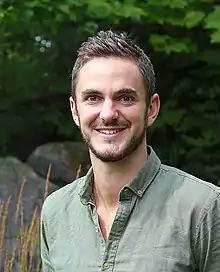
Thomas Ward Crowther (born 18 June 1986) is a Welsh ecologist and co-chair of the advisory board for the United Nations Decade on Ecosystem Restoration, specialising in ecosystem ecology.[1] He is a tenure-track assistant professor of Global Ecosystem Ecology at ETH Zurich where he formed the Crowther Lab.[2] His work aims to generate a holistic understanding of the global scale ecological systems which regulate the Earth's climate.[3][4][5][6]
Thomas Crowther | |
|---|---|
 | |
| Born | June 18, 1986 |
| Nationality | British |
| Known for | Global Ecology |
| Scientific career | |
| Institutions | ETH Zurich, Switzerland Yale University, USA Cardiff University, UK |
| Website | crowtherlab |
Along with broadcast journalist Lucy Mulenkei, Crowther co-chairs the advisory board of the UN Decade on Ecosystem Restoration.[7] In March 2021, Crowther was named a Young Global Leader by the World Economic Forum for his work on the protection and restoration of biodiversity and serves on the advisory council of WEF’s Trillion Trees initiative.[8]
In 2021, he founded Restor, an independent not-for-profit organization that provides transparency and connectivity to conservation and restoration efforts across the globe.[9][10][11]
Research career
Crowther’s research focuses on the biological feedbacks that influence climate change and points to the importance of conserving and protecting biodiversity in an effort to limit such feedbacks.[12][13] His early research demonstrated that 1 °C of warming can enhance carbon losses from high latitude soils, potentially accelerating carbon emissions by up to 17%.[14] In addition, his work suggests that the world loses around 10 billion trees each year, further limiting the carbon storage on land.[15] His research has also revealed that the Earth is home to just over 3 trillion trees,[16] and that there may be room for approximately 1 trillion more trees to naturally recover if degraded lands around the world can be restored and protected, which could draw down a portion of current anthropogenic carbon emissions.[17][18][19][20]
Crowther conducted his undergraduate and PhD studies at Cardiff University, under the supervision of Hefin Jones. After his PhD, Crowther received a postdoctoral fellowship from the Climate and Energy Institute at Yale University. In 2015, Crowther was awarded a Marie Curie fellowship to research the impact of carbon cycle feedbacks on climate change at the Netherlands Institute of Ecology (NIOO). In 2017, Crowther started a tenure track professorship at ETH Zürich.[21][22]
Soil biodiversity and ecosystem functioning
Crowther’s early research focused on how soil communities are connected. His PhD studied how grazing soil invertebrates can regulate the decomposition of wood by soil fungi. This work led him to Yale University, where he found that diverse communities of soil invertebrate grazers are important for regulating and limiting the increases in soil carbon loss that are expected under climate change.[23][24]
Since then, the scope of his research has expanded to the global scale, aiming to characterize the functional biogeography of global soil communities. His lab's research has explored the global biogeography of mycorrhizal fungi, earthworms, and nematodes across in soil, which are important for the health of ecosystems.[25][26]
Global ecosystem restoration
Crowther's post-doctoral research, which mapped the distribution and diversity of trees across the world,[27] estimated that there are approximately 3.04 trillion trees on Earth, 46% fewer than at the onset of agriculture about 12,000 years ago. Previous estimates had suggested there may have been only be 400 billion trees on Earth.[28][29][30][31]
As part of this research, Crowther compiled a large inventory of tree data based on a combination of satellite observations and on-the-ground ecological research.[32] In 2016 he co-founded the Global Forest Biodiversity Initiative (GFBI) – a foundation which manages the world's largest tree-level forest inventory database with 1.2 million plots from more than 70 countries.[33][34] The database was used to identify that across the global forest system, a greater number of tree species consistently leads to increases in the carbon storage of local forests, even with the same number of trees.[35]
In 2019, his group extended this work in a large-scale study exploring the global tree restoration potential.[36] Utilizing measurements of tree cover from over 78,000 locations around the globe, the study built machine learning models to characterize which environments are capable of supporting trees.[37] This revealed that outside of urban and agricultural areas there are 0.9 billion hectares of land that could naturally support just over 1 trillion trees, which could capture up to a third of the excess carbon that humans have emitted into the atmosphere to-date.[38] Crowther cautioned that it would take decades for forests to mature to this point and that phasing out fossil fuel use is vital for slowing climate change.[39]
Climate change ecology
A key goal of Crowther's global ecological research is to understand the biological feedbacks to climate change. In particular, this research has highlighted the presence of a strong positive feedback between atmospheric warming and soil carbon loss. In 2016, Crowther’s research showed that a 1 °C increase in temperatures could release an additional 55 billion tons of soil carbon into the atmosphere by 2050, driving a feedback loop that could accelerate climate warming by 12-17%.[40][41] Crowther's research suggested that warming generally stimulates decomposition more than photosynthesis.[42][43][44] Increased activity of microbes and soil animals, such as worms, would be the source of the additional carbon emissions, which could accelerate global warming by 17%.[45]
Ivan Janssens, seen as one of the godfathers in the global change ecology field commented "the research had provided essential data to climate change models". A subsequent scientific review of research on soil carbon feedback cited Crowther's work, saying the "new finding of a statistical dependence of decomposition on the initial carbon content of the soil may prove to be a useful benchmark for [Earth System Model] simulations".[46] The study's data was since incorporated into ongoing work by the UN's Intergovernmental Panel on Climate Change.[47][48] In a more recent scientific review of research on soil carbon feedback, Crowther's work was highly cited as the "new finding of a statistical dependence of decomposition on the initial carbon content of the soil may prove to be a useful benchmark for [Earth System Model] simulations".[49]
Geospatial mapping
Crowther's ongoing research employs location intelligence and mapping technologies to convey the status of Earth's terrestrial ecosystems. Through machine learning approaches they generate predictive models for a detailed understanding of the biosphere's spatial and temporal patterns.[50][51]
In October 2018 he delivered a keynote address at the 2018 conference for the Association for Forest Spatial Analysis Technologies (ForestSAT), hosted by the NASA Goddard Space Flight Center and the University of Maryland.[52] In February 2019, at the American Association for the Advancement of Science, Crowther announced that scientists had established there was room for an additional 1.2 trillion trees, noting that such a scale of reforestation could be one of the most powerful tools in the fight against climate change.[53][54]
Criticism
Following the publication of the 2019 paper on the global tree restoration potential, a number of scientists criticized the idea that planting trees across the globe is a simple solution to climate change. In particular, several articles suggested that it is dangerous and misleading to propose that tree planting can be a silver bullet to stop climate change.[55][56][57]
In 2020, Crowther's presentation at a TED Countdown event on climate change attracted more than a million views.[58] In the talk, Crowther stressed that he agreed with the criticisms, stating that ecosystem restoration [59] cannot be used as an excuse to ignore the very real challenges of cutting greenhouse gas emissions and protecting existing ecosystems.[60] He has also emphasized that ecosystem restoration is not simply about planting trees.[61] It is about protecting ecosystems (including grasslands, wetlands, forests, and other ecosystems) so that natural biodiversity can return and facilitating the recovery of nature to promote the ecological and economic sustainability of local communities around the world.[62]
Principles of responsible biodiversity restoration
Crowther cautions that there are inherent risks associated with ecosystem restoration, which must be considered in order to realize a positive impact for biodiversity, human well-being, and climate change. In a letter to The Guardian newspaper, he identified four basic principles which any organization pledging commitment to the trillion-tree campaign should uphold:[63]
- Cut emissions. Nature-Based Solutions are powerful tools to capture carbon from the atmosphere, but they are not a substitute for cutting greenhouse gas emissions. From a climate change perspective, we must rapidly cut fossil fuel emissions, decarbonize economies, and also maintain, sustainably manage, and restore ecosystems.
- Conserve & protect existing ecosystems. Intact soils, forests, grasslands, shrub-lands, wetlands, and aquatic ecosystems are vital repositories of carbon and biodiversity. Yet, we are losing them at an alarming rate. Protecting these last remaining strongholds of nature is critical.
- Be socially responsible. We must fully engage Indigenous peoples and local communities and respect and uphold their rights and leadership. We must also proactively contribute to fair and sustainable economic models that create new employment opportunities while avoiding competition with existing activities such as food production. Only when local communities benefit from the social, economic and ecological benefits that ecosystems provide can restoration be sustainable.
- Be ecologically responsible. Nature-Based Solutions must be founded on rigorous ecological principles. Biodiversity is vital for healthy ecosystems which are more productive, resilient and beneficial. Diverse mixtures of native species are most likely to provide desired benefits such as carbon storage, food production, and protection from floods, drought and disease. Monocultures of exotic species or low-diversity plantations are unlikely to provide these desired benefits.” [64]
References and selected publications
- "'I've never said we should plant a trillion trees': what ecopreneur Thomas Crowther did next". The Guardian. 2021-09-01. Retrieved 2021-09-14.
- "5 professors appointed". ethz.ch. Retrieved 2021-09-14.
- "Thomas Crowther - Nature-based solutions in the fight against climate change at TEDxLausanne". 2019-09-19. Retrieved 2019-12-12.
- "Tom Crowther". ForestSAT 2018. 2018-07-04. Retrieved 2018-10-21.
- "On the Business of Battling Climate Change". Esri. Retrieved 2018-10-31.
- stadt-mensch.ch (2018-06-29), Thomas Crowther - Atmosphärischer Wissenschafter, retrieved 2018-10-31
- "Thomas Crowther -Co-chair the advisory board of the UN Decade on Ecosystem Restoration".
- "Thomas Crowther -2021 WEF Young Global Leader".
- "Restor - Informing and connecting the global restoration movement".
- "How monitoring can spur investment in land restoration". World Economic Forum. Retrieved 2021-09-14.
- "'I've never said we should plant a trillion trees': what ecopreneur Thomas Crowther did next". The Guardian. 2021-09-01. Retrieved 2021-09-14.
- Crowther, Thomas, The global movement to restore nature's biodiversity, retrieved 2021-09-14
- Mulenkei, Thomas Crowther and Lucy. "This summer is a terrible reminder of why we must build back nature". CNN. Retrieved 2021-09-14.
- "Climate change escalating so fast it is 'beyond point of no return'". The Independent. 2016-12-01. Retrieved 2021-09-14.
- Crowther, T. W.; Glick, H. B.; Covey, K. R.; Bettigole, C.; Maynard, D. S.; Thomas, S. M.; Smith, J. R.; Hintler, G.; Duguid, M. C.; Amatulli, G.; Tuanmu, M.-N. (September 2015). "Mapping tree density at a global scale". Nature. 525 (7568): 201–205. Bibcode:2015Natur.525..201C. doi:10.1038/nature14967. ISSN 1476-4687. PMID 26331545. S2CID 4464317.
- Crowther, T. W.; Glick, H. B.; Covey, K. R.; Bettigole, C.; Maynard, D. S.; Thomas, S. M.; Smith, J. R.; Hintler, G.; Duguid, M. C.; Amatulli, G.; Tuanmu, M.-N. (September 2015). "Mapping tree density at a global scale". Nature. 525 (7568): 201–205. Bibcode:2015Natur.525..201C. doi:10.1038/nature14967. ISSN 1476-4687. PMID 26331545. S2CID 4464317.
- "The global tree restoration potential". EurekAlert!. Retrieved 2021-09-14.
- "Massive restoration of world's forests would cancel out a decade of CO2 emissions, analysis suggests". The Independent. 2019-02-18. Retrieved 2021-09-14.
- "Planting 1.2 Trillion Trees Could Cancel Out a Decade of CO2 Emissions, Scientists Find". Yale E360. Retrieved 2021-09-14.
- "Research: Planting trillions of trees could cancel out CO2 emissions". Futurism. Retrieved 2021-09-14.
- "5 professors appointed". www.ethz.ch. Retrieved 2018-10-21.
- "5 professors appointed". ethz.ch. Retrieved 2021-09-14.
- Crowther, Thomas W.; Thomas, Stephen M.; Maynard, Daniel S.; Baldrian, Petr; Covey, Kristofer; Frey, Serita D.; van Diepen, Linda T. A.; Bradford, Mark A. (2015-06-02). "Biotic interactions mediate soil microbial feedbacks to climate change". Proceedings of the National Academy of Sciences. 112 (22): 7033–7038. Bibcode:2015PNAS..112.7033C. doi:10.1073/pnas.1502956112. PMC 4460469. PMID 26038557.
- "The diet of worms: Soil dwellers emerge as climate change heroes in study". america.aljazeera.com. Retrieved 2021-09-14.
- Steidinger, B. S.; Crowther, T. W.; Liang, J.; Van Nuland, M. E.; Werner, G. D. A.; Reich, P. B.; Nabuurs, G. J.; de-Miguel, S.; Zhou, M.; Picard, N.; Herault, B. (May 2019). "Climatic controls of decomposition drive the global biogeography of forest-tree symbioses". Nature. 569 (7756): 404–408. Bibcode:2019Natur.569..404S. doi:10.1038/s41586-019-1128-0. ISSN 0028-0836. PMID 31092941. S2CID 155103602.
- van den Hoogen, Johan; Geisen, Stefan; Routh, Devin; Ferris, Howard; Traunspurger, Walter; Wardle, David A.; de Goede, Ron G. M.; Adams, Byron J.; Ahmad, Wasim; Andriuzzi, Walter S.; Bardgett, Richard D. (August 2019). "Soil nematode abundance and functional group composition at a global scale". Nature. 572 (7768): 194–198. Bibcode:2019Natur.572..194V. doi:10.1038/s41586-019-1418-6. ISSN 1476-4687. PMID 31341281. S2CID 198492891.
- Crowther, T. W.; Glick, H. B.; Covey, K. R.; Bettigole, C.; Maynard, D. S.; Thomas, S. M.; Smith, J. R.; Hintler, G.; Duguid, M. C.; Amatulli, G.; Tuanmu, M.-N.; Jetz, W.; Salas, C.; Stam, C.; Piotto, D.; Tavani, R.; Green, S.; Bruce, G.; Williams, S. J.; Wiser, S. K.; Huber, M. O.; Hengeveld, G. M.; Nabuurs, G.-J.; Tikhonova, E.; Borchardt, P.; Li, C.-F.; Powrie, L. W.; Fischer, M.; Hemp, A.; Homeier, J.; Cho, P.; Vibrans, A. C.; Umunay, P. M.; Piao, S. L.; Rowe, C. W.; Ashton, M. S.; Crane, P. R.; Bradford, M. A. (2 September 2015). "Mapping tree density at a global scale". Nature. 525 (7568): 201–5. Bibcode:2015Natur.525..201C. doi:10.1038/nature14967. PMID 26331545. S2CID 4464317.
- Ehrenberg, Rachel (2 September 2015). "Global count reaches 3 trillion trees". Nature. doi:10.1038/nature.2015.18287. S2CID 189415504.
- Skahill, Patrick. "The Tall Task of Counting Every Tree on Earth". Retrieved 2018-10-31.
- McMahon, Sean; Parnell, John (September 2018). "The deep history of Earth's biomass" (PDF). Journal of the Geological Society. 175 (5): 716–720. Bibcode:2018JGSoc.175..716M. doi:10.1144/jgs2018-061. hdl:2164/12379. S2CID 134552701.
- "Europe losing forest to harvesting at alarming rate, data suggests". The Guardian. 2020-07-01. Retrieved 2021-09-14.
- van Lammeren, André; Feijt, Arnoud; Konings, Joop; van Meijgaard, Erik; van Ulden, Aad (2000-07-14). "Combination of ground-based and satellite cloud observations on a routine basis". Meteorologische Zeitschrift. 9 (2): 125–134. Bibcode:2000MetZe...9..125V. doi:10.1127/metz/9/2000/125. ISSN 0941-2948.
- "Thomas Crowther". GFBI Home. Retrieved 2018-10-21.
- "GFBI Home". GFBI Home. Retrieved 2018-10-21.
- Crowther, Thomas (2016). "Positive biodiversity-productivity relationship predominant in global forests". Science. 354 (6309). doi:10.1126/science.aaf8957. PMID 27738143. S2CID 32049832.
- "The global tree restoration potential". EurekAlert!. Retrieved 2021-09-14.
- "The global tree restoration potential". EurekAlert!. Retrieved 2021-09-14.
- Dickinson, Tim (2020-03-13). "Can We Plant Enough Trees?". Rolling Stone. Retrieved 2021-09-14.
- Dickinson, Tim (2020-03-13). "Can We Plant Enough Trees?". Rolling Stone. Retrieved 2021-09-14.
- Crowther, T. W.; Todd-Brown, K. E. O.; Rowe, C. W.; Wieder, W. R.; Carey, J. C.; Machmuller, M. B.; Snoek, B. L.; Fang, S.; Zhou, G.; Allison, S. D.; Blair, J. M. (December 2016). "Quantifying global soil carbon losses in response to warming". Nature. 540 (7631): 104–108. Bibcode:2016Natur.540..104C. doi:10.1038/nature20150. ISSN 1476-4687. PMID 27905442. S2CID 205251843.
- "Climate change escalating so fast it is 'beyond point of no return'". The Independent. 2016-12-01. Retrieved 2021-09-14.
- Crowther, T. W.; Todd-Brown, K. E. O.; Rowe, C. W.; Wieder, W. R.; Carey, J. C.; Machmuller, M. B.; Snoek, B. L.; Fang, S.; Zhou, G.; Allison, S. D.; Blair, J. M.; Bridgham, S. D.; Burton, A. J.; Carrillo, Y.; Reich, P. B.; Clark, J. S.; Classen, A. T.; Dijkstra, F. A.; Elberling, B.; Emmett, B. A.; Estiarte, M.; Frey, S. D.; Guo, J.; Harte, J.; Jiang, L.; Johnson, B. R.; Kröel-Dulay, G.; Larsen, K. S.; Laudon, H.; Lavallee, J. M.; Luo, Y.; Lupascu, M.; Ma, L. N.; Marhan, S.; Michelsen, A.; Mohan, J.; Niu, S.; Pendall, E.; Peñuelas, J.; Pfeifer-Meister, L.; Poll, C.; Reinsch, S.; Reynolds, L. L.; Schmidt, I. K.; Sistla, S.; Sokol, N. W.; Templer, P. H.; Treseder, K. K.; Welker, J. M.; Bradford, M. A. (1 December 2016). "Quantifying global soil carbon losses in response to warming" (PDF). Nature. 540 (7631): 104–8. Bibcode:2016Natur.540..104C. doi:10.1038/nature20150. PMID 27905442. S2CID 205251843.
- Singh, Brajesh K., ed. (2018). Soil carbon storage: modulators, mechanisms and modeling. ISBN 978-0-12-812766-7.
- Wieder, William R.; Hartman, Melannie D.; Sulman, Benjamin N.; Wang, Ying-Ping; Koven, Charles D.; Bonan, Gordon B. (April 2018). "Carbon cycle confidence and uncertainty: Exploring variation among soil biogeochemical models". Global Change Biology. 24 (4): 1563–1579. Bibcode:2018GCBio..24.1563W. doi:10.1111/gcb.13979. PMID 29120516.
- "Climate change escalating so fast it is 'beyond point of no return'". The Independent. Retrieved 2018-10-21.
- Davidson, Eric A. (December 2016). "Projections of the soil-carbon deficit". Nature. 540 (7631): 47–48. doi:10.1038/540047a. ISSN 1476-4687. PMID 27905445.
- https://www.facebook.com/chriscmooney. "Scientists have long feared this 'feedback' to the climate system. Now they say it's happening". Washington Post. Retrieved 2018-10-21.
- "Climate change escalating so fast it is 'beyond point of no return'". The Independent. Retrieved 2018-10-21.
- Davidson, Eric A. (1 December 2016). "Projections of the soil-carbon deficit". Nature. 540 (7631): 47–48. doi:10.1038/540047a. PMID 27905445.
- Dangermond, Jack. "Shifting How We Deal With Change Using Location Intelligence". Forbes. Retrieved 2018-10-21.
- Esri Events (2018-07-10), The Crowther Lab at ETH Zürich: Ecosystem Science for Global Restoration, retrieved 2018-10-31
- "Tom Crowther". ForestSAT 2018. 2018-07-04. Retrieved 2018-10-21.
- "Massive restoration of world's forests would cancel out a decade of CO2 emissions, analysis suggests". The Independent. 2019-02-16. Retrieved 2019-03-21.
- "Planting 1.2 Trillion Trees Could Cancel Out a Decade of CO2 Emissions, Scientists Find". Yale E360. Retrieved 2019-03-21.
- Sengupta, Somini (2019-07-05). "Restoring Forests Could Help Put a Brake on Global Warming, Study Finds". The New York Times. ISSN 0362-4331. Retrieved 2021-09-14.
- "Trying to Plant a Trillion Trees Won't Solve Anything". Wired. ISSN 1059-1028. Retrieved 2021-09-14.
- Pearce, Fred. "Planting a trillion trees really can help us fight climate change". New Scientist. Retrieved 2021-09-14.
- Crowther, Thomas, The global movement to restore nature's biodiversity, retrieved 2021-09-14
- "What's the Potential of a Trillion Trees?". Crowther Lab. 2021-09-08. Retrieved 2021-10-18.
- "The global tree restoration potential". EurekAlert!. Retrieved 2021-09-14.
- "'I've never said we should plant a trillion trees': what ecopreneur Thomas Crowther did next". The Guardian. 2021-09-01. Retrieved 2021-09-14.
- Letters (2020-02-21). "Backing the trillion tree campaign to combat climate crisis | Letter". The Guardian. Retrieved 2021-09-14.
- Pearce, Fred. "Planting a trillion trees really can help us fight climate change". New Scientist. Retrieved 2021-09-14.
- Solutions, Nature Based (2020-06-30). ""And/also", not "Either/or" — The need to restore nature AND cut emissions". Medium. Retrieved 2021-09-14.
External links
 Media related to Thomas Crowther (ecologist) at Wikimedia Commons
- Thomas Crowther publications indexed by Google Scholar
- Crowtherlab
Authority control  |
|---|