3-torus
The three-dimensional torus, or three-torus, is defined as any topological space that is homeomorphic to the Cartesian product of three circles,

In contrast, the usual torus is the Cartesian product of two circles only.
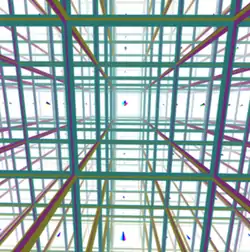
The three-torus is a three-dimensional compact manifold with no boundary. It can be obtained by "gluing" the three pairs of opposite faces of a cube, where being "glued" can be intuitively understood to mean that when a particle moving in the interior of the cube reaches a point on a face, it goes through it and appears to come forth from the corresponding point on the opposite face, producing periodic boundary conditions. Gluing only one pair of opposite faces produces a solid torus while gluing two of these pairs produces the solid space between two nested tori.
References
- Thurston, William P. (1997), Three-dimensional Geometry and Topology, Volume 1, Princeton University Press, p. 31, ISBN 9780691083049.
- Weeks, Jeffrey R. (2001), The Shape of Space (2nd ed.), CRC Press, p. 13, ISBN 9780824748371.