Thrust (particle physics)
In high energy physics, Thrust is an event shape observables used to characterize the collision of high energy particles in a collider.
When two high energy particles collide, they typically produce jets of secondary particles. This happens when one or several quark-antiquarks pairs are produced during the collision. Each colored quark/antiquark travels its separate way and subsequently hadronize. Many new particles are created by the hadronization process and travel in approximately the same direction. This set of particles constitutes a jet.
The Thrust[1][2] establishes the ″jettiness″ of the collision. It is defined as:[3]
,
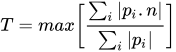
where is the momentum of particle , and is a unit vector that maximizes and defines the thrust axis. The sum is over all the final particles resulting of the collision. In practice, the sum may be carried over the detected particles only.


The thrust is stable under collinear splitting of particles, and therefore it is a robust observable, largely insensitive to hadronization details.
References
- S. Brandt, C. Peyrou, R. Sosnowski, and A. Wroblewski (1964), “The Principal axis of jets. An Attempt to analyze high-energy collisions as two-body processes“, Phys. Lett. 12 57–61.
- E. Farhi (1977), “A QCD Test for Jets“, Phys. Rev. Lett. 39 1587–1588.
- V. D. Barger, R. J. N. Phillips (1997) “Collider Physics” Frontier in Physics, Addison-Wesley Publishing Company, Inc.