Sino-Singapore Tianjin Eco-city
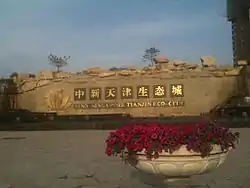
The Sino-Singapore Tianjin Eco-city (SSTEC, simplified Chinese: 中新天津生态城; traditional Chinese: 中新天津生態城; pinyin: Zhōng-Xīn Tiānjīn Shēngtài Chéng) is the result of a collaborative agreement between the governments of China and Singapore to jointly develop a socially harmonious, environmentally friendly and resource-conserving city in China.[1]
Sino-Singapore Tianjin Eco-city | |
|---|---|
 | |
| Country | People's Republic of China  China China |
| Direct-controlled municipality | Tianjin |
| Area | |
| • Total | 30 km2 (10 sq mi) |
| Population (2019) | |
| • Total | 100,000 |
| Time zone | UTC+8 (China Standard Time) |
| Website | www.tianjinecocity.gov.sg www.eco-city.gov.cn |
Overview
The Sino-Singapore Tianjin Eco-city agreement was signed on 18 November 2007 by the Singapore Prime Minister and Chinese Premier.[1] Designed to be practical, replicable and scalable, the Tianjin Eco-city will demonstrate the determination of both countries in tackling environmental protection, resource and energy conservation, and sustainable development, and serve as a model for sustainable development for other cities in China.
The Singaporean government formed a Ministerial Committee in 2011 in order to improve the coordination and support among its agencies for the project – reportedly a sign of the importance of the project to Singapore.[2]
Location
The Eco-city site is located 40 km from downtown Tianjin and 150 km from Beijing. The site is 10 km from the core district of the Tianjin Binhai New Area (TBNA), with the southern tip of the site only a 10-minute drive from the Tianjin Economic-Technological Development Area (TEDA).[3]
History and Master Plan
The groundbreaking ceremony of the Sino-Singapore Tianjin Eco-city was held on 28 September 2008. Singapore Senior Minister Goh Chok Tong and Chinese Premier Wen Jiabao officiated at the event, signifying the beginning of construction work on the Eco-city.[4] The plan was developed in 2008 through a collaborative council between public and private entities. A Joint Steering Council, Joint Working Committee, and the Sino-Singapore Tianjin Eco-City Investment and Development Co., Ltd have worked together to promote the three main initiatives of the project: environmental protection, social development, and economic development.[5]
Current estimates place the total population of Tianjin Eco-city at 100,000.[6] Through rapid development since residents first moved in in March 2012, the Eco-city tripled its population from 20,000 in 2014 to over 80,000 by 2018.[7] The city is expected to house 350,000 residents in over 100,000 homes once fully developed.[8] Initial construction began in 2008 with the 8km2 start-up area, consisting of "three Community Centres, the Eco-city Administrative Committee Service Centre, and several residential and industrial developments."[9] Completion of this phase were completed by 2013, but attention turned toward the creating a vibrant city center, which, as of 2021, is still under construction.[10] The Ministry of National Development addressed the importance of designing a space where work, leisure, and sustainability can intersect through a "Green Smart Hub" and Friendship Garden.[7]
Key Performance Indicators
There is a set of 26 Key Performance Indicators (KPIs) for the Sino-Singapore Tianjin Eco-city. In formulating these KPIs, reference is made to national standards in China and Singapore, as well as international standards.[11]
Some of the KPIs are listed below. The development of the start-up area and the entire Eco-city is targeted for completion by 2013 and 2020 respectively, and so reference is made to these years in the KPIs:
- Ambient Air Quality - The air quality in the Eco-city should meet at least China’s National Ambient Air Quality Grade II Standard for at least 310 days per year.
- Quality of Water from Taps - Water from all taps should be potable.
- Carbon Emission Per Unit GDP - The carbon emission per unit GDP in the Eco-city should not exceed 150 ton-C per US$1 million.
- Proportion of Green Buildings - All buildings in the Eco-city should meet green building standards.
- Green Transportation - At least 90% of trips within the Eco-city should be in the form of "green trips" by 2020. (Green trips refer to trips via nonmotorized transport, i.e. cycling and walking, as well as trips on public transport.)
- Barrier-Free Accessibility - The Eco-city should have 100% barrier-free access.
- Proportion of Affordable Public Housing - At least 20% of housing in the Eco-city will consist of subsidized public housing by 2013.
- Usage of Renewable Energy - Renewable energy should account for at least 15% of the energy utilized in the Eco-city by 2020. Possible sources of renewable energy for the Eco-city include geothermal energy, hydropower and solar power.
- Usage of Water from Nontraditional Sources - At least 50% of the Eco-city’s water supply will be from nontraditional sources such as desalination and recycled water by 2020.
- Jobs to be generated in the Eco-city - Sufficient jobs should be generated for at least 50% of the Eco-city’s residents within the Eco-city who are employable, to minimize the need for them to commute on a daily basis from their home to their workplace.
Urban Design
Often viewed as an experimental city of the future, the Tianjin Eco-city supports a wide array of social welfare and sustainability-focused initiatives. Through mixed-use, transit-oriented planning, the developers have attempted to create a user-friendly environment while simultaneously promoting environmental health.
The main layout of the Sino-Singapore Tianjin Eco-city is as follows: "1 Axis, 3 Centres, 4 Districts."[8] The axis references an "Eco-valley" that cuts through the city, "providing a scenic trail for pedestrians and cyclists."[8] Meanwhile, there is a city centre being currently built with two sub-centres planned for the future. Finally, the four Eco-districts cut the city into south, central, north, and north-east.[8] Each district is made up of a few neighborhoods, each containing four eco-cells, which consist of different housing types and businesses.[8] The Eco-cell model is intended to incentivize walking and alternative modes of transit by minimizing the distance to commercial amenities through localized mixed-use planning. Retaining views of the waterfront by reducing building heights was one way for improving aesthetic value.[7]
Sustainability
Sustainability is at the heart of design in the Sino-Singapore Tianjin Eco-city. The axis and Eco-cell designs facilitate walking and cycling instead of using vehicles. Although green spaces will be interspersed throughout the city in the form of "nodes", the main green space is the China-Singapore Friendship Garden, a 41-hectare park near the central district.[6] Renewable resources are utilized wherever possible and expected to produce at least 32% of energy for the city by 2035.[12]
Transportation
The Eco-valley is a walking and cycling pathway that spreads throughout the city enabling people to move without emitting greenhouse gases. To encourage drivers to use electric vehicles, charging stations have been placed across the city.[13] Public transportation is also a major emphasis of the Eco-city. A light-rail transit system, supplemented by a secondary network of trams and buses, will be the main mode of transportation in the Eco-city. This will help to reduce its carbon emissions.[14] Construction began on the new Z4 rail line to connect the Tianjin Eco-city with Beijing.[15]
Society and Economy
Social harmony will be a key feature of the Eco-city. A public housing complex based on Singapore's public housing policies, including a "'home ownership' scheme," is aimed at meeting the housing needs of lower and lower-middle income groups in society.[16]
The development of the Eco-city will respect local heritage. The profile of the Ji Canal, which is 1,000 years old, will be retained. Two existing villages within the Eco-city site will also be conserved through adaptive reuse or partial rebuilding.[17]
References
- "Tianjin | Who We Are". www.mnd.gov.sg. Retrieved 29 November 2021.
- "Singapore forms Ministerial Committee on Tianjin Eco-city project". ChannelNewsAsia. Retrieved 24 January 2011.
- "Location". Sino-Singapore Tianjin Eco-city. Retrieved 5 August 2008.
- Quek, T. (29 September 2008): "Top Leaders from Singapore and Beijing Break Ground for Eco-city", page A10, The Straits Times
- "Tianjin | Collaboration". www.mnd.gov.sg. Retrieved 29 November 2021.
- "Sino-Singapore Tianjin Eco-City". www.tianjineco-city.com. Retrieved 29 November 2021.
- "DEVELOPMENT OF THE SINO-SINGAPORE TIANJIN ECO-CITY MOVES TO THE CITY CENTRE" (PDF). Ministry of National Development. 1 July 2018.
- "Tianjin | Our Work". www.mnd.gov.sg. Retrieved 29 November 2021.
- "Tianjin | Progress". www.mnd.gov.sg. Retrieved 29 November 2021.
- "Tianjin | Progress". www.mnd.gov.sg. Retrieved 29 November 2021.
- "Key Performance Indicators". Sino-Singapore Tianjin Eco-city. Retrieved 5 August 2008.
- "Sino-Singapore Tianjin Eco-City". www.tianjineco-city.com. Retrieved 29 November 2021.
- "Sino-Singapore Tianjin Eco-City". www.tianjineco-city.com. Retrieved 29 November 2021.
- "Sino-Singapore Tianjin Eco-city" (PDF). Keppel Corporation. 25 August 2008.
- "Sino-Singapore Tianjin Eco-City breaks ground for Rail Line". www.mnd.gov.sg. Retrieved 29 November 2021.
- "Sino-Singapore Tianjin Eco-City". 720yun.com. Retrieved 29 November 2021.
- "Features". Sino-Singapore Tianjin Eco-city. Retrieved 5 August 2008.
External links
- The Sino-Singapore Tianjin Eco-city Website (Singapore)
- The Sino-Singapore Tianjin Eco-city Website (China)
- Bluepath Engineering Consultancy
- Tianjin Eco-City In China: The Future Of Urban Development? - slideshow at The Huffington Post
Authority control  | |
|---|---|
| General | |
| National libraries | |