Timoleague Friary
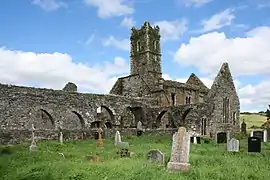
Timoleague Friary, also known as Timoleague Abbey, is a ruined medieval Franciscan friary located in Timoleague, County Cork, Ireland. It is the largest medieval ruin in West Cork.[1] It is located on the site of an early Christian church dedicated to St Molaga, whose feast day was celebrated down to the seventeenth-century.
 | |
  Location within Ireland | |
| Monastery information | |
|---|---|
| Order | Franciscans |
| Established | c.1240 |
| Disestablished | 1631 |
| Diocese | Cork and Ross |
| People | |
| Founder(s) | Domhnall Got MacCarthy or William de Barry |
| Architecture | |
| Status | Inactive |
| Style | Early English Gothic |
| Site | |
| Location | Timoleague, County Cork, Ireland |
| Coordinates | 51.64250°N 8.76306°W |
| Public access | Yes |
| Official name | Timoleague Friary |
| Reference no. | 21 |
The friary at Timoleague is one of the few early Franciscan friaries with substantial standing remains in Ireland. Located in a medieval village in County Cork, it stands on the banks of the Argideen River overlooking Courtmacsherry Bay.[2]
The friary is a National Monument in State Care (#21) and its RMP (Record of Monuments and Places) number is CO123-050002-.[3] It is listed as a discovery point on the Wild Atlantic Way.[4]
History
Early history
The friary sits on a 6th century monastic site dedicated to Saint Molaga.[4] According to legend, it was originally to be built a mile west of Timoleague, but all work done by day on that site would have fallen down by morning.[5] The town derives its Irish name, Teach Molaga or "Molaga's House" from the saint.[6]
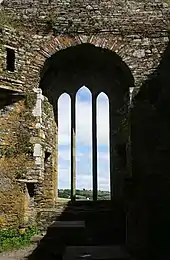
The date of foundation is disputed. According to the Annals of the Four Masters, the friary was founded in 1240 by the MacCarthy Reagh family.[2] This has been identified as possibly being too early.[7] Some sources ascribe this claimed foundation to Domhnall Got/Glas MacCarthy,[2] while others claim that Got MacCarthy merely expanded the friary anywhere between 1312 and 1366.[8][9] Samuel Lewis, in A Topographical Dictionary of Ireland... (1837) claims that the MacCarthy's founded the abbey in 1312.[10] The friary's foundation has also been attributed to the Anglo-Norman de Barry family in the early 14th century.[2] Though the friars were well established in Timoleague by 1320, the earliest parts of the ruined friary date from later in the 14th century. It is likely that they were based in Timoleague castle prior to the construction of the friary.[7] The friary is made from locally-sourced slate,[11] quarried in nearby Borleigh.[12] It is built in the Early English Gothic architectural style.[13] The south window of the transept was known as the "Leper's Hole", through which sufferers of leprosy could see and hear the service, and partake in the Blessed Sacrament.[14]
By the 15th century, the friary was a recognised as a centre of learning, and also as an important ecclesiastical centre.[15][16] Tadhg Mac Cárthaigh, also known as "Blessed Thaddeus", is said to have been educated by the friars.[17] An important patron of the church was Bishop John Edmond de Courcy, along with his nephew James, 8th Baron Kingsale. They funded the construction of the Gothic style bell tower, the infirmary, the library, and one of the dormitories.[18] John de Courcy had been a friar in Timoleague before being made a bishop. The tower was added in 1510.[19] They also contributed to the friary's collection of plate.[18] John de Courcy was buried in the transept of the friary, but in the Cromwellian period his grave was desecrated and his bones thrown into the estuary.[18]
Following the dissolution of the monasteries in 1540 by Henry VIII, the Franciscans remained resident in Timoleague until 1568, when the friary was seized by crown forces.[2] After the succession of James I, the Abbey was reclaimed by Catholics in 1603, and was repaired in its entirety by the end of 1604.[20][10]
Abandonment and destruction
In 1612, Bishop Lyons came to Timoleague to disperse the friars but was repelled by an Irish force led by Daniel O'Sullivan.[2][21] In 1629, four years after the death of King James, Richard Boyle was named Lord Justice and instigated the closure of religious buildings across Cork, putting increasing pressure on the friary.[22] It is assumed, however, that the friary was largely abandoned by the Franciscans by this point, as the guardian appointed to the friary, Eugenius Fildaeus, was appointed in Limerick, in Loco refugii.[23] The friary was eventually burnt down by crown forces in July 1642, when a force, led by Lord Kinelmeaky failed to capture Timoleague Castle and instead burnt the abbey and much of the town. The destruction of the friary led to a significant downturn in the financial development of the town.[22]
As ruins
Despite the burning of the friary, the Franciscan community of Timoleague survived for close to two centuries.[24] In 1696 four friars were reportedly living in the ruined monastery.[25] The last Franciscan friar working in the area was Fr Edmund Tobin (also known as Bonaventure Tobin),[26] who died circa 1822.[19] The Franciscans appointed titular guardians of the friary up until 1872.[26] The last guardian of Timoleague friary was Patrick Carey.[27] Interest in the friary was renewed due to the Romantic era of the early 19th century, and many paintings and sketches of the friary exist from this period. [28] On 15 January 1848, Fr Matt Horgan, writing under the pen-name "Viator", wrote the following which was released in the Cork Examiner:
"The walls [of the friary] are washed by the tide and some large breaches are already made in the burying ground, much to the disgrace of the lord of the soil, who must be either some heartless absentee, or a Gothic resident, having no feeling of fatherland; irrespective of its history or monuments, thinking only of bullocks, and knowing nothing, and caring less for the arts; blind to the beauties, with heart closed against the romance and poetry of the glorious past, and its mute but still eloquent memorials."
Soon after the publication of these remarks, Colonel Robert Travers, the so-called "lord of the soil", had the walls of the friary grounds replaced, and a road built between them and the sea, all at his own expense.[28] In 1891, mass was celebrated in the friary for the first time since it was burnt down 249 years prior.[14] One of the Timoleague chalices (the Dale-Browne Chalice) was used on the occasion.[29] In 1892, Denham Franklin wrote that
"The preservation of the abbey is mainly due to the care bestowed on it by the family of the present proprietor of Timoleague, Mr. Robert Travers, who did not allow the depredations unfortunately too common on our ancient buildings."
In 1920, in response to the murder of three police officers by Irish nationalists, British soldiers desecrated the abbey's burial ground. Burial vaults were opened, and the flags that had been draped over the coffins within were torn and cast aside. Coffins were opened, and in some cases, human remains were left visible.[30]
Historical artefacts
Book of Lismore
_frontispiece.pdf.jpg.webp)
Leabhar Leasa Móir, or the Book of Lismore, also known as Leabhar Mhic Cárthaigh Riabhaigh, is a 15th century manuscript with connections to the friary.[31] Though some sources claim that the manuscript was written or partly written in the friary,[4][15] Professor Pádraig Ó Macháin, an expert on Irish manuscripts, says that that is not the case.[32]
It was held in the friary at times, and material from the book was transcribed there by Mícheál Ó Cléirigh.[33]
Timoleague Chalices
Two golden 17th century chalices - both of which are referred to as the "Timoleague Chalice" - are associated with the friary.[34]
The first chalice, also known as the "Dale-Browne Chalice", or the "Dale Chalice",[35] was created circa. 1600 and is engraved with the words "Orate · Pro · Animabvs · Caroli · Dali · Et · Elizie · Browne · TimoLeagve." around the base.[36] The chalice is 8.5 inches tall, with the tulip-shaped bowl measuring 3.25 inches wide and 3 inches deep.[36] After the suppression of the monastery, one of the friars supposedly escaped with the chalice, disguised himself, and lived as a farmer.[37] His dying wish was that the chalice, along with his vestments, be buried beneath his house, and to remain buried until the abbey was restored and the friars had returned. Years later, the house was undergoing renovations and the box was discovered. The contents were given to Franciscans in Cork.[37] It is currently in the possession of the library of University College Dublin.[35]
The second chalice, also known as the "Timoleague Franciscan Chalice",[38] was deemed by experts to have been created in 1633.[39] When the friary was burnt down, three friars supposedly fled via rowboat.[40] The friars were found at sea by fishermen from Cape Clear Island, by which point two of them had died.[39] A box was left with the fishermen by the surviving friar, with instructions that they not open it, as the friar would one day return for it, though he never did.[39][40] The box was opened in 1860, and was found to contain a set of severely deteriorated vestments and a chalice that was "black with age". The chalice is engraved with the words "ffr’MinConv de Thimolaggi", which translates as "Friars Minor Convent of Timoleague”.[39][34] In 1892, 250 years after the chalice was removed from the town, it was returned to the parish priest of Timoleague.[38] It has remained in the safekeeping of his successors.[34]
In culture
Seán Ó Coileáin, an Irish language poet, wrote the poem Machtnadh an Duine Dhoilghiosaich about the ruins of the abbey in either 1813[41] or 1814.[42] Writing in 1831, James Hardiman describes it as one of the "finest modern poems in the Irish language".[43] It has been translated to English several times, including as The Mourner's Soliloquy in the Ruined Abbey of Timoleague and Lament over the Ruins of the Abbey of Teach Molaga.[43][44]
Gallery
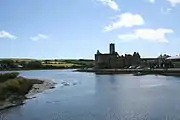 View of Timoleague Friary
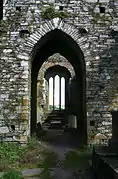 Interior of church
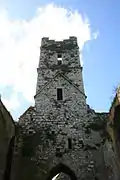 Bell tower
References
Notes
- Finola (26 October 2014). "Timoleague Friary". Roaringwater Journal. Retrieved 29 August 2021.
- "Timoleague Franciscan Friary | Monastic Ireland". www.monastic.ie. Retrieved 4 May 2017.
- "National Monuments in State Care: Ownership & Guardianship: Cork" (PDF). Archaeology. 4 March 2009. p. 5.
- "Timoleague Abbey". Wild Atlantic Way Ireland Map and Guide. Retrieved 29 August 2021.
- M, S (1 November 1834). "Timoleague Abbey". The Dublin Penny Journal. Retrieved 29 August 2021.
- Cochrane 1912, p. 14.
- Coombes 1969, p. 17.
- D'Imperio 2013.
- Franklin 1892, p. 174.
- Lewis 1837, p. 625.
- Wilkinson 1845, p. 146.
- Kinahan & 1885-1889, p. 244.
- Kinahan & 1885-1889, p. 354.
- O'Mahony 1892, p. 109.
- Whooley 2015, p. 104.
- Whooley 2015, p. 112.
- "Blessed Thaddeus McCarthy". Catholic Saints. Retrieved 1 September 2021.
- Coombes 1969, p. 18.
- "Timoleague (Co. Cork)". Franciscans. Retrieved 29 August 2021.
- Archdall 1873, p. 147.
- Franklin 1892, p. 175.
- Whooley 2015, p. 108.
- Franklin 1892, p. 176.
- Coombes 1969, p. 35.
- Franklin 1892, p. 178.
- Coombes 1969, p. 51.
- Mould 1991, p. 94.
- Coombes 1969, p. 52.
- O'Mahony 1892, p. 109-110.
- Donnelly Jr. 2012, p. 151.
- "Book of Lismore". UCC Library Guide. October 2020. Retrieved 29 August 2021.
- Leland 2011.
- "The Book of Lismore". celt.ucc.ie. Retrieved 7 September 2021.
- Coombes 1969, p. 53.
- Krasnodębska-D'Aughton 2009.
- Day 1897, p. 46.
- Dalton 1892, p. 228.
- Buckley 1943, p. 185.
- "Community Notes March 23". Argideen Rangers. 19 March 2019. Retrieved 1 September 2021.
- Kelly 2014.
- Kilfeather 2006, p. 92.
- Färber 2014.
- Hardiman 1831, p. 410.
- Färber 2011.
Sources
- Archdall, Mervyn (1873). Monasticon Hibernicum: Or, A History of the Abbeys, Priories, and Other Religious Houses in Ireland; Interspersed with Memoirs of Their Several Founders and Benefactors, and of Their Abbots and Other Superiors, to the Time of Their Final Suppression, Volume 1. Ireland. p. 147.
- Buckley, J.J. (31 March 1943). "Some Irish Altar Plate (The "Timoleague Franciscan" Chalice)". The Journal of the Royal Society of Antiquaries of Ireland. 7. Royal Society of Antiquaries of Ireland. 13 (1): 185–200. JSTOR 25510377 – via JSTOR.
- Cochrane, Dr. Robert (January–March 1912). "Notes on the Structures in the County of Cork vested in the Board of Works for Preservation as Ancient Monuments: Part I - Timoleague Friary, County Cork". Journal of the Cork Historical and Archaeological Society. 2. XVIII (93): 14–25.
- Coombes, James (July 1969). Timoleague and Barryroe. Timoleague. p. 52.CS1 maint: date and year (link)
- Dalton, John Paul (November 1892). "Notes and Queries: A Relic of Timoleague Abbey" (PDF). Cork Historical and Archaeological Society. 1: 228.
- Day, Robert (1897). "The altar plate of the Franciscan Church, Cork" (PDF). Journal of the Cork Historical and Archaeological Society. 2. 3 (26): 44–50.
- D'Imperio, Antonio (22 June 2013). "Timoleague Friary". Irish Stones. Retrieved 29 August 2021.
- Donnelly Jr., James S. (2012). "Big House Burnings in County Cork during the Irish Revolution, 1920–21*" (PDF). Éire-Ireland. 47 (3): 141–197. doi:10.1353/eir.2012.0021. S2CID 161570386.
- Franklin, Denham (September 1892). "Timoleague Abbey" (PDF). Journal of the Cork Historical and Archaeological Society. 1: 173–178.
- Färber, Beatrix (3 August 2011). "Lament over the Ruins of the Abbey of Teach Molaga". Corpus of Electronic Texts Edition: UCC. Retrieved 2 September 2021.
- Färber, Beatrix (4 February 2014). "Machtnadh an Duine Dhoilghiosaich". The Corpus of Electronic Texts: UCC. Retrieved 2 September 2021.
- Hardiman, James (1831). "The Mourner's Soliloquy in the Ruined Abbey of Timoleague". Irish Minstrelsy, or Bardic Remains of Ireland; with English Poetical Translations. 2. London. pp. 401–411.
- Harding, James D.; O'Callaghan Newenham, Robert (1830). Picturesque Views of the Antiquities of Ireland. 1. Strand: Thomas and William Boone. p. 7.
- Kelly, Pat (20 March 2014). "Timoleague Chalice". Irish Examiner. Retrieved 1 September 2021.
- Kilfeather, Siobhán (2006). "The Gothic novel". In Foster, John Wilson (ed.). The Cambridge Companion to the Irish Novel. Cambridge, United Kingdom: Cambridge University Press. p. 92. ISBN 978-0-521-67996-1.
- Kinahan, George Henry (1885–1889). "Arenaceous Rocks". Journal of the Royal Geological Society of Ireland: Economic Geology of Ireland. XVIII: 205–318.
- Kinahan, George Henry (1885–1889). "Slates and Clays. Part II.—Clays, Bricks, &c". Journal of the Royal Geological Society of Ireland: Economic Geology of Ireland. XVIII: 365–390.
- Krasnodębska-D'Aughton, Małgorzata (8 December 2009). "Dale-Browne Chalice". UCD Digital Library. doi:10.7925/drs1.ivrla_29952. Retrieved 1 September 2021.
- Leland, Mary (8 July 2011). "Lost and found: the leabhar of Lismore comes home". The Irish Times. Retrieved 1 September 2021.
- Lewis, Samuel (1837). A Topographical Dictionary of Ireland. 2. London: Lewis & Co. pp. 625–626.
- Mould, Daphne Desiree Charlotte Pochin (1991). "The Medieval Monasteries". Discovering Cork. Dingle, Ireland: Brandon Book Publishers. pp. 84–99. ISBN 0-86322-129-7.
- O'Donovan, Diarmaid (3 January 2021). "Welcome return of 'Book of Lismore'". The Southern Star. Retrieved 1 September 2021.
- O'Mahony, John (11 May 1892). "Proceedings of the Society" (PDF). Journal of the Cork Historical and Archaeological Society. 1: 109–110.
- Wilkinson, George (1845). "The Geology and Architecture of Ireland". The Civil Engineer & Architect's Journal: Scientific and Railway Gazette. VIII: 144–148.
- Whooley, Dónal (2015). "The Old Order Changeth:The development of Timoleague as a significant town and its subsequent decline in the medieval period" (PDF). Clonakilty Historical & Archaeological Journal. 1: 101–116.
Further reading
- Timoleague Abbey in 'The Dublin Penny Journal' (19th century)
- Andy Halpin; Conor Newman (26 October 2006). Ireland: An Oxford Archaeological Guide to Sites from Earliest Times to AD 1600. OUP Oxford. pp. 533–. ISBN 978-0-19-151317-6.
- Keohane, Frank (2020). Cork: City and County (Buildings of Ireland series). New Haven and London: Yale University Press. ISBN 978-0-300-22487-0.
External links
- Lament over the Ruins of the Abbey of Teach Molaga an English translation of Machtnadh an Duine Dhoilghiosaich, a poem written in 1814 by Seághan Ó Coileáin about the friary, translated by James Clarence Mangan.