Tokyo BRT
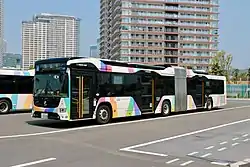
The Tokyo BRT (東京BRT株式会社, Tokyo BRT Kabushiki-gaisha)[3][4] is a bus company within the Keisei Bus (Keisei Group) established on 8 July 2019.[5]Tokyo BRT's vehicles are parking on a barn, which is the ownership of the Tokyo BRT and located Shinonome Kōtō. This company has two bases, one is Okuto Office, the other is Shinonome-Barn, both are used in step with Keisei Bus.
 | |
| Parent | Keisei Bus |
|---|---|
| Founded | 7 August 2019 |
| Headquarters | 3-3-1 Yawata, Ichikawa, Chiba, Japan[1] |
| Service area | Tokyo |
| Service type | Bus |
| Fleet | 9 buses[2] |
| Chief executive | Yoshiki Kinoshita (Keisei Bus’s managing director) |
| Website | Tokyo BRT (in English) |
Overview
The Tokyo BRT name was selected by inviting entries during August–September 2018.[6] The company also asked for public opinion regarding three plans for bus designs.[7]
The New Tokyo waterfront district is progressing with the development of the Olympics Village following 2020 Summer Olympics, but Kachidoki, Harumi area are inconveniently located since the railroad doesn't run. Improvement of public transportation is involved in the relocation of Tsukiji Market and the establishment of Toyosu Market.
Routes
| Tokyo BRT | |||||||||||||||||||||||||||||||||||||||||||||||||||||||||||||||||||||||||||||||||||||||||||||||||||||||||||||||||||||||||||||||||||||||||||||||||||||||||||||||||||||||||||
|---|---|---|---|---|---|---|---|---|---|---|---|---|---|---|---|---|---|---|---|---|---|---|---|---|---|---|---|---|---|---|---|---|---|---|---|---|---|---|---|---|---|---|---|---|---|---|---|---|---|---|---|---|---|---|---|---|---|---|---|---|---|---|---|---|---|---|---|---|---|---|---|---|---|---|---|---|---|---|---|---|---|---|---|---|---|---|---|---|---|---|---|---|---|---|---|---|---|---|---|---|---|---|---|---|---|---|---|---|---|---|---|---|---|---|---|---|---|---|---|---|---|---|---|---|---|---|---|---|---|---|---|---|---|---|---|---|---|---|---|---|---|---|---|---|---|---|---|---|---|---|---|---|---|---|---|---|---|---|---|---|---|---|---|---|---|---|---|---|---|---|---|
| |||||||||||||||||||||||||||||||||||||||||||||||||||||||||||||||||||||||||||||||||||||||||||||||||||||||||||||||||||||||||||||||||||||||||||||||||||||||||||||||||||||||||||


In 2020, the route was partially opened to traffic (at the section between Toranomon Hills and Harumi BRT Terminal before the 2020 Olympics was held) for passengers who live in the New Tokyo waterfront district and go on business.[8] An extension of the Tokyo BRT to Ginza Station and Tokyo Station (from the side of Shimbashi) and Tokyo International Cruise Terminal Station (from the side of Harumi) is under consideration.[9]
Demonstration service
The Tokyo BRT is to be rolled out in three phases: demonstration service (preliminary), demonstration service (secondary), and complete service. For demonstration service, there will be six buses during peak hours to service 450 people per hour and four buses during regular hours to service 300 people per hour.
During the preliminary stage of demonstration service, the buses will run 1 line:
- Toranomon Hills Station (B11) – Shimbashi Station (B01) – Kachidoki BRT (B02) – Harumi BRT Terminal (B22)
During the secondary stage of demonstration service, the buses will run 3 lines:
- Main Road Line: Toranomon Hills Station (B11) – Shimbashi Station (B01) – Kachidoki BRT (B02) – Shijo-mae Station (B03) – Ariake-Tennis-no-mori Station (B04) – Kokusai-Tenjijo Station (B05) – Tokyo Teleport Station (B06)
- Harumi・Toyosu Line: Toranomon Hills Station (B11) – Shimbashi Station (B01) – Kachidoki BRT (B02) – Harumi Chūō (B21) – Harumi BRT Terminal (B22)
- Kachidoki Line: Shimbashi (B01) – Kachidoki BRT (B02)
Complete service
For complete service, there will be 20 buses during peak hours to service 2000 people per hour and 12 buses during regular hours to service 1200 people per hour.
During complete service, the buses will run 4 lines:
- Main Road Line: Toranomon Hills Station (B11) – Shimbashi Station (B01) – Kachidoki BRT (B02) – Shijo-mae Station (B03) – Ariake-Tennis-no-mori Station (B04) – Kokusai-Tenjijo Station (B05) – Tokyo Teleport Station (B06)
- Harumi・Toyosu Line: Toranomon Hills Station (B11) – Shimbashi Station (B01) – Kachidoki BRT (B02) – Harumi Chūō (B21) – Harumi BRT Terminal (B22)
- Kachidoki Line: Shimbashi (B01) – Kachidoki BRT (B02)
- Olympics Village Line: Shimbashi Station (B01) – Kachidoki BRT (B02) – 〈Harumi Gochōme〉(B31, B32, B33: stops, facilities and new route are in consideration)
List of bus stops
- ●:STOP|:Non stop
| Depot Number |
Depot Name | Demonstrational operation (First) |
Demonstrational operation(Second) Complete operation |
Complete operation | Location | ||
|---|---|---|---|---|---|---|---|
| Main Route | Harumi・Toyosu Route | Kachidoki Route | Senshumura Route | ||||
| B11 | Toranomon Hills | ● | ● | ● | ● | Minato | |
| B01 | Shimbashi | ● | ● | ● | ● | ● | |
| B02 | Kachidoki BRT[10] | ● | ● | ● | ● | ● | Chuo |
| B31 | Harumi 5chome (tentative name) |
| | | | | | ● | ||
| B32 | | | | | | | ● | |||
| B33 | | | | | | | ● | |||
| B21 | Harumi Chuo | | | | | ● | |||
| B22 | Harumi BRT Bus Terminal | ● | | | ● | |||
| B23 | Toyosu Station | | | ● | Koto | |||
| B03 | Toyosu Shijo mae | ● | ● | ||||
| B04 | Ariake Tennis no Mori | ● | |||||
| B05 | Kokusai-Tenjijō | ● | |||||
| B06 | Tokyo Teleport | ● | |||||
Fare
Normal fare:
IC1 diary bike-race ticket:
IC commuter pass:
- Commuting: 9000 yen/1 month, 26000 yen/3 months, 50000 yen/6 months[11]
- Attending school: 6300 yen/1 month, 18200 yen/3 months, 35000 yen/6 months[11]
- Children: 3150 yen/1 month, 9100 yen/3 months, 17500 yen/6 months[11]
Payment options
Vehicles
The Tokyo BRT uses three types of buses. These include:
- SORA (fuel cell vehicle): 5 cars[12]
- Isuzu Erga Duo (articulated bus): 1 car[12]
- Isuzu Erga (diesel vehicle): 3 cars[12]
Timeline
- 2014
- 2015
- April – announcement of「都心と臨海副都心とを結ぶBRT基本計画」
- September – selected Keisei Bus
- 2016
- April – announcement of「都心と臨海副都心とを結ぶBRT事業計画」
- 23 June – decided on「東京臨海部地域公共交通網形成計画」
- 2019
- 8 July – establishment of Tokyo BRT kabushiki-gaisha
- 2020
- 2021 – plan for starting demonstration service (secondary)
- 2022 – plan for starting complete service
See also
- Bus rapid transit
- Keisei Group
- Keisei Bus (Parent company)
- Keisei Transit Bus
- Tokyo Bay City Bus
- Kantō Railway
- Kantetsu Green Bus (The bus company operates the similar BRT service)
References
- registration (in Japanese)
- TokyoBRT (in Japanese) – toyokeizai.net (as of September 2020)
- 都心と臨海地域を結ぶBRTに関する事業計画 – Bureau of Urban Development Tokyo Metropolitan Government, Revision Aug 2018 (in Japanese)
- establishment of TokyoBRT (2019) – Kesei Bus Co.,Ltd. and Tokyo BRT (in Japanese)
- Tokyo BRT. Tokyo BRT Company profile. Japan. Retrieved 7 October 2020.
- news (in Japanese)
- opinion for BRT of design – Bureau of Urban Development Tokyo Metropolitan Government 、2018年11月08日
- https://mainichi.jp/english/articles/20201002/p2a/00m/0na/014000c – Tokyo BRT Mainichi news.
- 5 minute's walk will bring to Kachidoki Station from this bus terminal
- "Guidance of Fare". Tokyo BRT. Retrieved 30 September 2021.
- Design – Bureau of Urban Development Tokyo Metropolitan Government. Retrieved September 2020.
- establishment of transportation for the New Tokyo waterfront district
- "postponement of starting demonstration service" (PDF) (Press release). Tokyo BRT. 12 May 2020. Retrieved 13 May 2020.
- "about demonstration service" (PDF) (Press release) (in Japanese). Kesei Bus. 7 September 2020. Archived from the original (PDF) on 7 September 2020. Retrieved 9 October 2020.
- "issue that the required time is the same existing transportation". Yomiuri News online. 1 October 2020. Retrieved 9 October 2020.
External links
 |
Wikimedia Commons has media related to Tokyo BRT. |
.svg.png.webp) JR East lines JR East linespassing through Central Tokyo | |
|---|---|
 Tokyo Metro lines Tokyo Metro lines | |
 Toei subway lines Toei subway lines | |
 Yokohama Municipal Yokohama Municipal | |
| JR East lines in satellite cities or suburbs | |
 Keikyu Keikyu | |
 Keio Keio | |
 Keisei Keisei | |
 Odakyu Odakyu | |
 Seibu Seibu | |
 Sotetsu Sotetsu | |
 Tobu Tobu | |
 Tokyu Tokyu | |
| Other commuter rail lines | |
| Trams | |
| Monorails | |
| People movers | |
| Hinterland | |
| Funiculars and aerial lifts | |
 Bus services and hubs Bus services and hubs | |
| Public ferries | |
| Major terminals | |
| Miscellaneous | |
| Construction projects | |
| |


.svg.png.webp)


_symbol.svg.png.webp)
_symbol.svg.png.webp)
_symbol.svg.png.webp)
_symbol.svg.png.webp)
_symbol.svg.png.webp)








| Configuration | _Arriva_London_New_Routemaster_(19522859218).jpg.webp) | |
|---|---|---|
| Special uses | ||
| Technologies | ||
| Manufacturing | ||
| ||
| Vehicles | |
|---|---|
| Systems (List) | |
| See also | |
| Buses portal | |
| Keisei lines |
| |
|---|---|---|
| Related lines | ||
| Major stations | ||
| Related companies | ||