Tomás Bilbao Hospitalet
Tomás Bilbao Hospitalet (1890–1954) was a Basque-origin Spanish architect and politician. He was among the founders of Basque Nationalist Action. After serving as a minister of justice he exiled first to France and then, to Mexico.
Tomás Bilbao Hospitalet | |
|---|---|
| Minister of Justice | |
| In office 1937–1938 | |
| Personal details | |
| Born | 18 September 1890 Bilbao |
| Died | 16 March 1954 (aged 63) New Mexico |
| Nationality | Spanish |
| Spouse(s) | Julia Durán |
| Children | 7 |
| Alma mater | Madrid School of Architecture |
Early life and education
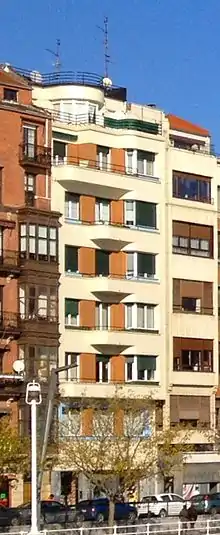
Bilbao was born in Bilbao on 18 September 1890 and his father was a building contractor.[1] He received a degree in architecture in 1918 from the School of Architecture of Madrid.[2]
Career
After working as an architecture Bilbao designed Altos Hornos de Vizcaya in 1929.[2] Later he involved in politics and became a cofounder of the Basque Nationalist Action party in 1930 and the president of the Bilbao Municipal Housing Board in 1931.[1] He was also councillor and deputy mayor of the Bilbao City Council during the Second Republic.[1] In the period 1937–1938 he was minister of justice.[1]
Exile, personal life and death
Bilbao first exiled to France.[2] Then he fled to Mexico in May 1942 when France was invaded by Nazi forces.[2] There he worked for the Compañía Mexicana de Comercio Exterior.[2]
Bilbao was married to Julia Durán with whom he had seven children.[2] Their oldest son was arrested and executed following the exile of his father.[1][3] Tomás Bilbao died in Mexico City on 16 March 1954.[2]
One of his grandchildren, Tatiana Bilbao, is a well-known architecture in Mexico.[2]
References
- "Tomás Bilbao Hospitalet" (in Spanish). Real Academia de la Historia. 2018. Retrieved 12 December 2021.
- Juan Ignacio del Cueto Ruiz-Funes. "Contributions of the Basque Exile to Mexican Architecture". Mas Context. Archived from the original on 23 April 2021. Retrieved 12 December 2021.
- "Bilbao Hospitalet, Tomás". Eusko Ikaskuntza. Archived from the original on 12 December 2021. Retrieved 12 December 2021.
External links
 Media related to Tomás Bilbao Hospitalet at Wikimedia Commons
