Tom Eastick
Brigadier Sir Thomas Charles Eastick, CMG, DSO, ED, JP (3 May 1900 – 16 December 1988) was a senior Australian Army artillery officer during World War II and a post-war leader of the principal ex-service organisation in South Australia. He commanded the 2/7th Field Regiment during the First and Second Battles of El Alamein in the Western Desert campaign in North Africa in 1942, for which he was appointed as a Companion of the Distinguished Service Order. Upon return from the Middle East he commanded the artillery of the 7th Division during the final stage of the Salamaua–Lae campaign and then during the Markham, Ramu and Finisterre campaigns in New Guinea between August 1943 and April 1944, and then held the same role for the 9th Division during the Borneo campaign in 1945. Eastick was military governor of the Raj of Sarawak after taking the Japanese surrender at Kuching, and led the army's peacetime Central Command headquartered in South Australia from 1950 to 1953. He was the state president of the Returned Sailors', Soldiers' and Airmen's Imperial League of Australia (the Returned & Services League from 1965) between 1950 and 1954 and again from 1961 to 1972. He was made a Companion of the Order of St Michael and St George in 1953, and knighted by Queen Elizabeth II in 1970, in both cases for his services to ex-servicemen.
Brigadier Sir Tom Eastick CMG, DSO, ED, JP | |
|---|---|
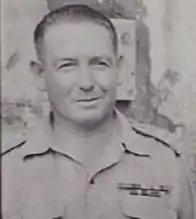 Brigadier Tom Eastick in Sarawak in late 1945 | |
| Born | 3 May 1900 Hyde Park, South Australia |
| Died | 16 December 1988 (aged 88) Somerton Park, South Australia |
| Allegiance | Australia |
| Service/ | Australian Army |
| Years of service | 1918–1946 1950–1953 |
| Rank | Brigadier |
| Commands held | Kuching Force (1945) Royal Australian Artillery, 9th Division (1944–1945) Royal Australian Artillery, 7th Division (1943–1944) 2/7th Field Regiment (1940–1943) 13th Field Brigade, Royal Australian Artillery (1939–1940) |
| Battles/wars | World War II |
| Awards | Knight Bachelor Companion of the Order of St Michael and St George Distinguished Service Order Efficiency Decoration Mentioned in Despatches Companion of the Order of the Star of Sarawak |
| Relations | Bruce Eastick (son) |
| Other work | State President of the Returned Sailors’, Soldiers’ and Airmen’s Imperial League of Australia (the Returned & Services League from 1965) 1950–1954 and 1961–1972 |
Early life and career
Thomas Charles Eastick was born on 3 May 1900 at Hyde Park, South Australia the eldest of six children of Charles William Lone Eastick, who was a plumber, and his wife Agnes Ann née Scutt. Known as Tom, Eastick attended Goodwood Public School, but his formal education ended at the age of 12 when he left school in order to care for his ill mother and his five younger siblings. His father was at that time struggling to support the family. Tom worked for a hardware company, Colton, Palmer & Preston Ltd, as a purchasing officer. It was during this time that he acquired managerial skills that he employed effectively in his later career.[1]
Having served for four years in the compulsory senior cadets, in 1918 Eastick enlisted as a part-time soldier in the Australian Field Artillery of the Citizen Forces. He was commissioned as a lieutenant in 1922, and was posted to the 13th Field Brigade where he soon earned a reputation as an effective trainer of artillerymen. He was appointed as the commander of the 50th Battery of the brigade in 1924.[1] On 31 October of following year, Eastick married Ruby Sybil Bruce, a saleswoman and youngest daughter of Mrs A. H. Bruce, at the Baptist church at Richmond, and after a honeymoon at Port Noarlunga,[2] they lived in the northern part of Colonel Light Gardens known as Reade Park. The couple had five sons: Bruce, who was later the Leader of the Opposition from 1972 to 1975 and Speaker of the South Australian House of Assembly from 1979 to 1982;[1] Keith, David, Geoff and Barry.[3] Tom was promoted to captain in 1926. His proficiency as an artillery officer was demonstrated by his involvement in two innovations: in 1926 he was the first Australian artillery officer to use survey procedures to accurately predict gun data to engage targets without ranging, and the following year a Royal Australian Air Force pilot adjusted the fire of Eastick's battery during field firing. Also in 1927, he took over the management of an engineering company in Adelaide, and this led to him co-founding a small engineering business, Angas Engineering Co. (Pty Ltd) at premises in Moore Street, Adelaide,[1][3] with a mechanic friend. The business venture went well until the Great Depression began around 1929, after which difficulties mounted.[1] The Citizen Forces were renamed the Militia in 1929.[4] In 1930, Eastick was promoted to major, and in 1938 his battery won the Mount Schank Trophy as the most efficient Militia field battery in the country. The following year Eastick was temporarily promoted to lieutenant colonel and appointed as the commanding officer of the 13th Field Brigade.[1]
World War II
In early 1940, shortly after the outbreak of World War II, Eastick put the 13th Field Brigade through a training program over a three-month period. In April his promotion to lieutenant colonel in the Militia was made substantive, and he was appointed at the same rank to raise and command the 2/7th Field Regiment, part of the Second Australian Imperial Force which was being raised for overseas service.[1] Initially consisting of the 13th Battery raised in South Australia, and the 14th Battery raised in Western Australia, its original members were mainly Militia artillerymen. In October the regiment was allocated to the 9th Division and the following month the regimental headquarters and 13th Battery embarked on the troopship SS Stratheden at Port Adelaide, and picked up the 14th Battery at Fremantle en route to the Middle East.[5][6]
Eastick's regiment arrived in the Middle East in December 1940, and was garrisoned at Qastina in Palestine where it conducted training with World War I-vintage QF 18-pounder guns and QF 4.5-inch howitzers. In March 1941 the 9th Division was moved to Egypt, but due to lack of vehicles, the 2/7th Field Regiment did not join them until the following month. Initially deployed to a staging area at Ikingi Maryut, in May it moved forward into defensive positions at Mersa Matruh.[5][1] By the end of July, the regiment had received most of its entitlement of 24 Ordnance QF 25-pounder guns.[7] At the beginning of September, it moved forward to a position between the Axis controlled Halfaya Pass and the Allied-held fortress of Sidi Barrani. It remained there, harassing the enemy, until October, by which time the majority of the 9th Division had been withdrawn from Tobruk and was rebuilding in Palestine. Instead of rejoining the division immediately, the 2/7th was transferred to become the depot regiment at the Royal Artillery-run Middle East School of Artillery near Cairo in Egypt for three months.[5][1] This was an honour granted in recognition of the level of efficiency reached by the regiment under Eastick's command.[1] From February to June 1942, the regiment was deployed in defensive positions at Bsarma near Tripoli in Allied-occupied French Syria.[5]
In June, the 9th Division was deployed back to Egypt to bolster Allied defences at El Alamein. The division was allocated to the northern sector and the 2/7th Field Regiment was placed under the command of the division's 26th Brigade, taking up a position at Kilo 91, east of El Alamein, on 8 July. Two days later the 26th Brigade attacked German positions on the high ground of the Tel el Eisa, supported by the whole of the divisional artillery, part of the First Battle of El Alamein. The Germans subsequently counter-attacked, and over a five day period, the 2/7th Field Regiment fired 20,129 rounds. In September, the regiment supported Operation Bulimba, a diversionary attack launched by the 20th Brigade.[5]
The 2/7th Field Regiment again supported the 20th Brigade during the Second Battle of El Alamein in October and November 1942, firing 65,594 rounds across the 13 days of fighting. The regiment also participated in the pursuit of the enemy as they withdrew, reaching El Dabaa. Following this vital success, the 9th Division, including the 2/7th Field Regiment, began returning to Australia to prepare for operations against the Japanese closer to home.[5] On 15 December, Eastick was mentioned in despatches for "gallant and distinguished services in the Middle East during the period November 1941 to April 1942",[8] and recognised the high level of efficiency reached by the 2/7th Field Regiment under Eastick's command during that period.[1] The regiment arrived in Fremantle on 18 February 1943.[5] On the same day, Eastick was made a Companion of the Distinguished Service Order in recognition of "gallant and distinguished services in the Middle East during the period May 1942 to October 1942", covering the period of both battles of El Alamein.[9] The citation stated:[10]
Lieutenant Colonel Eastick commanded his regiment with exceptional ability during difficult operations. The successful performance of tasks given to his regiment was largely due to his forcefulness and determination. He was an inspiration to his observation post officers who were always willing to act most boldly to ensure the effectiveness of the firing of the regiment. Throughout operations Colonel Eastick used his regiment aggressively and the effectiveness of its work was due largely to his leadership and personal example.
The regiment disembarked in Melbourne a week after its visit to Fremantle.[5] In March, Eastick was awarded the Efficiency Decoration (ED) for twenty years' service in the Citizen Forces and Militia.[3] The members of the regiment were given leave, and the regiment moved to Queensland in April for further training.[5]
In June 1943, Eastick was appointed commander of the 7th Division artillery with the temporary rank of brigadier.[5] He deployed to New Guinea with the division in August, and commanded the artillery assets of the division during the landing at Nadzab and advance to Lae in September as part of the closing phase of the Salamaua–Lae campaign, and then during the Markham, Ramu and Finisterre campaigns until April 1944 when the division returned to Australia.[11][12] Two months later Eastick was appointed as commander of the 9th Division artillery. The 9th Division was at that time reforming and training on the Atherton Tablelands in North Queensland.[13]
Due to rapid developments in the war and strategic uncertainty over the role of Australian forces in the Pacific, the 9th Division remained in Australia for over a year before seeing action once more. While the Australian I Corps (of which the 9th Division was part) had originally been intended to participate in the liberation of the Philippines, these plans were dropped, and the Corps was instead tasked with the liberation of Borneo between 1 May and 15 August 1945.[14] This was the division's final involvement in the war and its participation in the campaign was broken up into two primary operations: the Battle of Tarakan, a landing on Tarakan Island also known as Operation Oboe One; and Operation Oboe Six, which consisted of a landing at Brunei on the north Borneo coast, and a landing and subsequent battle on the island of Labuan.[15]
In September 1945 Eastick was appointed commander of Kuching Force, a detachment of the 9th Division which supervised the Japanese surrender in the southern Raj of Sarawak, on the island of Borneo.[1] Eastick oversaw the liberation and repatriation of Allied prisoners of war and internees in Sarawak, including the large Batu Lintang camp. He was military governor of Sarawak until December 1945, when the territory returned to civilian rule.[16] He then administered command of the 9th Division until February 1946, and on 28 February he transferred to the Reserve of Officers with the honorary rank of brigadier. He was subsequently made a Companion of the Order of the Star of Sarawak.[1]
Post-war career
Eastick returned to civilian life and his business and became involved in ex-service organisations. He became a member of the Colonel Light Gardens sub-branch of the Returned Sailors’, Soldiers’ and Airmen’s Imperial League of Australia (RSSAILA) the Returned & Services League (RSL) from 1965), the principal Australian veterans' organisation. He was recalled to service in January 1950 with the rank of brigadier, and was posted as the commander of the Headquarters Group, Central Command, in Adelaide. During this posting he was also an honorary aide-de-camp to the Governor-General of Australia, Sir William McKell. Eastwick had a leading role in the development of A Call to the People of Australia,[1] an exhortation to Australian citizens to "Fear God, Honour the King", which was launched on Remembrance Day 1951 and signed by church leaders and the chief justices of the states.[17] Eastick returned to the Reserve of Officers on 1 October 1953. From 1950 to 1954 he was the state president of RSSAILA,[1] and in Queen Elizabeth II's 1953 Coronation Honours he was appointed a Companion of the Order of St Michael and St George (CMG) for his work with the organisation.[18] From 1955 to 1960, Eastick was the colonel commandant of the Royal Regiment of Australian Artillery. He was again the state president of RSSAILA and then the RSL between 1961 and 1972.[1] Early in his second stint as president, Eastick urged the state premier, Sir Thomas Playford, to investigate RSSAILA allegations about communists working within state government departments.[19] Eastick was a Freemason, a justice of the peace (JP), and the federal president of the Australia Day Council from 1963 to 1965. He served about 25 organisations, many of which were ex-service-related, in honorary roles.[1]
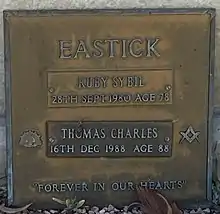
A knighthood in recognition of his work for the interests of ex-servicemen was announced in the 1970 New Year Honours.[20] It was conferred on him in person by Queen Elizabeth II on 24 April 1970 at Government House, Canberra.[21] In September 1972, following the discovery of a National Socialist Party of Australia training camp at Gawler, South Australia, Eastick said that there was "no room in Australia for anybody with subversive thoughts like the Nazi Party".[22] Eastick continued to work at Angas Engineering until 1977, and was again federal president of the Australia Day Council from 1976 to 1980. His wife, now-Lady Ruby Eastick, died suddenly in 1980, and after a few years he moved to the Masonic Nursing Home in Somerton Park. He died there on 16 December 1988 and was cremated.[1]
Eastick's entry in the Australian Dictionary of Biography by David N. Brook states that:[1]
Integrity, professional competence, steadfastness, self-discipline and self-reliance had been instilled in Eastick at an early age. He inspired the officers and men he commanded with his proficiency and resolution. He was a valued and trusted businessman and servant of the many organisations with which he was involved. Despite the hardships of his early life and war service, he remained a kindly and charitable man who was tough and forceful when those attributes were required. He was not flamboyant, but a consistent performer who lived by the dictum with which he had been brought up—'near enough is never good enough'.
Footnotes
- Brook 2007.
- The Mail 5 December 1925.
- The Advertiser 16 March 1943, p. 2.
- Palazzo 2001, p. 110.
- AWM 2021.
- Rungie 1986, pp. 92–93.
- Rungie 1986, p. 94.
- The London Gazette 11 December 1942.
- The London Gazette 16 February 1943.
- The News 6 May 1944, p. 3.
- Johnston 2005, pp. 172–208.
- Keogh 1965, pp. 345–359.
- Johnston 2002, p. 186.
- Keogh 1965, pp. 395–396.
- Keogh 1965, pp. 431–433.
- Keat Gin 2013, pp. 57–61.
- A Call to the People of Australia 1951.
- The London Gazette 26 May 1953.
- The Canberra Times 6 December 1962.
- The London Gazette 30 December 1969.
- The London Gazette 12 May 1970.
- The Australian Jewish News 8 September 1972.
References
Books
- Johnston, Mark (2002). That Magnificent 9th: An Illustrated History of the 9th Australian Division 1940–46. Sydney, New South Wales: Allen & Unwin. ISBN 978-1-86508-654-5.
- Johnston, Mark (2005). The Silent 7th: An Illustrated History of the 7th Australian Division 1940–46. Crows Nest, New South Wales: Allen & Unwin. ISBN 1-74114-191-5.
- Keogh, Eustace (1965). South West Pacific 1941–45. Melbourne, Victoria: Grayflower Publications. OCLC 7185705.
- Keat Gin, Ooi (2013). Post-War Borneo, 1945–1950: Nationalism, Empire and State-Building. London: Routledge. ISBN 978-1134058105.
- Palazzo, Albert (2001). The Australian Army: A History of its Organisation 1901–2001. Melbourne, Victoria: Oxford University Press. ISBN 978-0-19-551506-0.
- Rungie, R.H (1986). "2/7th Australian Field Regiment AIF". In Brook, David (ed.). Roundshot to Rapier: Artillery in South Australia 1840–1984. Hawthorndene, South Australia: Investigator Press. pp. 93–111. ISBN 0-85864-098-8.
News and documents
- A Call to the People of Australia, Australia, 1951, nla.obj-2545178137, retrieved 21 November 2021 – via Trove
- "Ban Nazis Call in S.A." The Australian Jewish News. XXXIX (1). Victoria, Australia. 8 September 1972. p. 15. Retrieved 22 November 2021 – via National Library of Australia.
- "Boy Scouts". The Daily Herald. 6 (1576). South Australia. 10 April 1915. p. 12. Retrieved 21 November 2021 – via National Library of Australia.
- "EASTICK—BRUCE". The Mail. 14 (706). South Australia. 5 December 1925. p. 21. Retrieved 21 November 2021 – via National Library of Australia.
- "Globe Derby". The Coromandel Times. 29 (36). South Australia. 25 April 1974. p. 4. Retrieved 21 November 2021 – via National Library of Australia.
- "Inquiry into Reds Promised". The Canberra Times. 37 (10, 401). Australian Capital Territory, Australia. 6 December 1962. p. 25. Retrieved 21 November 2021 – via National Library of Australia.
- "Lieut.-Col. Eastick Awarded D.S.O." The News. 42 (6, 480). South Australia. 6 May 1944. p. 3. Retrieved 21 November 2021 – via National Library of Australia.
- Miles, John (6 June 1953). "The Good Soldier". The News. 60 (9, 305). South Australia. p. 4. Retrieved 21 November 2021 – via National Library of Australia.
- "S.A. Officers Decorated". The Advertiser. LXXXV (26347). South Australia. 16 March 1943. p. 2. Retrieved 21 November 2021 – via National Library of Australia.
- "Witch-hunters' S.A. contest". Tribune (1293). New South Wales, Australia. 20 February 1963. p. 8. Retrieved 21 November 2021 – via National Library of Australia.
Gazettes
- "Government Gazette Appointments and Employment". Commonwealth Of Australia Gazette (136). Australia. 31 July 1947. p. 2203. Retrieved 21 November 2021 – via National Library of Australia.
- "No. 35821". The London Gazette (Supplement). 11 December 1942. pp. 5437–5446.
- "No. 35908". The London Gazette (Supplement). 16 February 1943. p. 863.
- "No. 39863". The London Gazette (Supplement). 26 May 1953. p. 2944.
- "No. 44999". The London Gazette (Supplement). 30 December 1969. p. 2.
- "No. 45098". The London Gazette. 12 May 1970. p. 5343.
Websites
- "2/7th Field Regiment". Australian War Memorial. Retrieved 21 November 2021.
- Brook, David N. (2007). "Eastick, Sir Thomas Charles (Tom) (1900–1988)". Australian Dictionary of Biography. 17. Melbourne University Press. ISSN 1833-7538. Retrieved 20 November 2021 – via National Centre of Biography, Australian National University.
Authority control  | |
|---|---|
| Biographical dictionaries | |
| Other | |