Thomas Menino
Thomas Michael Menino (December 27, 1942 – October 30, 2014) was an American politician who served as the 53rd mayor of Boston, Massachusetts from 1993 to 2014. He was the city's longest-serving mayor. He was elected mayor in 1993, after first serving three months in the position of "acting mayor" following the resignation of his predecessor Raymond Flynn (who had been appointed United States ambassador to the Holy See). Before serving as mayor, Menino was a member of Boston City Council and had been elected president of the City Council in 1993.
Thomas Menino | |
|---|---|
.jpg.webp) | |
| 53rd Mayor of Boston | |
| In office November 16, 1993 – January 6, 2014 Acting: July 12, 1993 – November 16, 1993[1] | |
| Preceded by | Raymond Flynn |
| Succeeded by | Marty Walsh |
| President of the Boston City Council | |
| In office January 1993 – March 1993 | |
| Preceded by | Dapper O'Neil |
| Succeeded by | James Kelly |
| Member of the Boston City Council for the 5th district | |
| In office 1984–1993 | |
| Preceded by | Constituency established |
| Succeeded by | Daniel F. Conley |
| Personal details | |
| Born | Thomas Michael Menino December 27, 1942 Boston, Massachusetts, U.S. |
| Died | October 30, 2014 (aged 71) Boston, Massachusetts, U.S. |
| Resting place | Fairview Cemetery |
| Political party | Democratic |
| Spouse(s) | Angela Faletra (m. 1966) |
| Children | 2 |
| Education | Boston College Mount Ida College (AA) University of Massachusetts Boston (BA) |
Dubbed an “urban mechanic”, Menino had a reputation for focusing on “nuts and bolts” issues, Menino enjoyed very high public approval ratings as mayor. During Menino’s tenure as mayor, Boston saw a significant amount of new development. This included the Seaport District, the redevelopment of Dudley Square (today known as “Nubian Square”), and the redevelopment of the area surrounding Fenway Park stadium. Alongside the positives of this development, there were negatives, such as gentrification (which priced some longtime residents out of neighborhoods) and allegations of favoritism by Menino towards certain developers. During his tenure as mayor, Crime in Boston fell to unprecedented lows, and the city came to rank among the safest large cities in the United States. Menino also undertook a number of environmentally-focused actions. In the last year of Menino’s tenure, the city faced the Boston Marathon bombing, an incident of domestic terrorism.
Menino was a liberal member of the Democratic Party. Menino led a powerful political machine in Boston, and also played roles in national politics, such as serving as president of the United States Conference of Mayors from 2002 to 2003, bringing the 2004 Democratic National Convention to Boston, and co-founding the group Mayors Against Illegal Guns with New York City Mayor Michael Bloomberg.
After the end of his mayoralty, he was appointed professor of the practice of political science at Boston University. He also served as co-founder and co-director of the Initiative on Cities, an urban leadership research center based at Boston University.
Early life and education
Menino was born on December 27, 1942, in Readville, a part of Boston's Hyde Park neighborhood. He was the son of Susan and Carl Menino, both of Italian descent. Menino's father was a factory foreman at Westinghouse Electric,[2] and his grandparents lived on the first floor of his parents' Hyde Park home.[3]
After graduating from St. Thomas Aquinas High School in Jamaica Plain in 1960.[4][5] Menino enrolled in three night classes at Boston College, before abandoning his college education.[5][4] Much to his father's dismay, Menino had decided that college was not for him.[6] Carl Menino once recalled his son's reasons for opting out of higher education: "Truman didn't go to college," the younger Menino would tell his father (President Harry S. Truman was Menino's favorite president and was his personal hero).[6] Menino eventually went on to receive an Associate degree in Business Management in 1963 at the now-defunct Mount Ida College. In 1984, during his tenure as a Boston city councilor, Menino enrolled as an undergrad at the University of Massachusetts Boston. He graduated with a Bachelor of Arts in Community Planning in January 1988.[5]
Early career
Prior to running for office, Menino worked as a housing relocation specialist for the Boston Redevelopment Authority, was a research assistant for the state legislative committee on housing and urban development, and served as an aide to state senator Joseph F. Timilty.[7][8]
In 1961, at the age of nineteen, Menino met Joseph F. Timilty, who would become a political mentor to him.[5]
Menino began working in sales at Metropolitan Life Insurance in 1963.[5][4] He left the insurance industry in 1968, after Timilty got him an entry-level position at the Boston Redevelopment Authority.[5]
Menino worked on Timilty's 1971 and 1975 mayoral campaigns.[5] In retribution for Menino working on Timilty's effort to unseat him, Mayor Kevin White fired Menino from the Boston Redevelopment Authority.[5] Menino again worked on Timilty's campaign in the 1979 Boston mayoral election.[5]
City Council career
.jpg.webp)
Menino was elected Boston city councilor for the newly created District 5 in November 1983, capturing 75 percent of the vote against Richard E. Kenney.[9] Timilty would later claim that District 5's boundaries had been effectively designed with the goal of designing a district that would be guaranteed to elect his protégé Menino to the Boston City Council.[5] In the 1983 Boston mayoral election, which coincided with the City Council election, Menino endorsed Raymond Flynn over Mel King.[5] Menino represented District 5 for nine years. In 1984, he was named chairman of the council's Planning and Development Committee. Menino ran unopposed for re-election in November 1985.[10]
In 1986, then-mayor Raymond Flynn offered Menino the position of Parks and Recreation Commissioner. In response to Flynn's proposal, Menino said it "surprised" him, but that he does "think about all opportunities that come before [him]."[11] Ultimately, Menino did not assume the position. He was re-elected in November 1987, with 87 percent of the vote.[12] Also in 1986, Menino announced a candidacy for Suffolk County sheriff, but soon after abandoned his candidacy.[5]
.jpg.webp)
In 1988, Menino became chairman of the City Council's Finance Committee. This committee was renamed the City Council Ways and Means Committee in 1990, a name that it continues to hold today. Menino remained chairman of the Ways and Means Committee for the entirety of his tenure as City Councilor. Menino was known to be a "vigilant watchdog of the city budget," as hailed by The Boston Globe.[13] He was again re-elected in November 1989 (running unopposed) and November 1991 (capturing 82 percent of the vote).[14] He was a founding member of the City Council's Tourists and Tourism Committee, which was created in 1991.[15]
_(1).jpg.webp)
In 1992, Menino planned to run for the United States Congress seat that Rep. Brian J. Donnelly (D-Dorchester) was vacating.[16] This 11th Congressional seat served a district that stretched from the Boston neighborhood of Dorchester through communities on the South Shore and into Plymouth County. After federal courts decided to allot Massachusetts only 10 congressional seats, Donnelly's district disappeared, and Menino chose to not challenge Representatives from the other districts.[17]
In 1993, Menino was elected president of the Boston City Council over Maura Hennigan.[5] This had been somewhat an upset victory.[18]
During his time on the City Council, Menino received praise for what The Boston Globe's Adrian Walker called, "aptitude for details of city government", and some criticism for his closeness to Mayor Flynn.[18] Walker also wrote that Menino had received a reputation as a councilor, "for dilligence and attention to detail."[18]
During his tenure as a city councilor, Menino opposed several domestic ordinances that would have expanded rights to same-sex couples in domestic partnerships, including the 1991 Family Protection Act (which would have extended benefits to any household registering itself as a family).[19] During his 1993 mayoral campaign, his spokesperson credited this opposition to Menino believing that these ordinances too broadly defined "family", and not outright opposition to similar legislation that would more narrowly define domestic partnerships.[19]
As a city councilor, Menino supported proposals for clean needle distribution and condom distribution, both of which were aimed at preventing the transmission of AIDS.[20][21] Menino's support for condom distribution included supporting distribution in schools.[19] In his role as Ways and Means Committee chairman, Menino advocated for increasing the funding of AIDS programs.[19] In 1988, Menino authored a 5-point plan outlining steps to stop the spread of AIDS among users of intravenous drugs, including use of needle exchanges, community health vans, street outreach workers, and increased drug rehabilitation facilities.[19]
Menino sponsored a studyt by municipal government of homelessness.[18] Menino also advocated as a city councilor for the Boston City Hospital to be reorganized.[18]
Acting mayoralty
_(1).jpg.webp)
In March 1993, President Clinton nominated Mayor Flynn to be the United States Ambassador to the Holy See. Mayor Flynn accepted the nomination, effectively making Menino, who was President of the Boston City Council at the time, the presumptive future acting mayor.[22]
Menino had had a longtime friendship with outgoing mayor Flynn. However, their relationship was noted to have become somewhat terser during the period in which Flynn was preparing to hand over the office to Menino.[23] One cause for their rift was that, after Menino had promised he would appoint 100 new police officers when he took office, Flynn beat him to the chase and did so himself, which angered Menino.[20]
Upon Flynn's resignation on July 12, 1993, Menino became acting Mayor of Boston until the upcoming November 1993 election.[5][1] He was the first Italian American to lead the city.[24]
Some initially saw Menino as likely to be a sort of “caretaker” of the office, with Brian McGrory of The Boston Globe writing at the start of Menino’s acting mayoralty, that to some, “Menino is believed to be a caretaker, a known quantity, a moderate compromise builder who is unlikely to bring great change or wreak serious harm on the city.” McGregory also reported that some of Menino’s City Council colleagues believed Menino had an undistinguished legislative record as a city councilor.[20]
During his acting mayoralty, Menino temporarily appointed Alfreda Harristo to fill a vacancy on the Boston School Committee. After Harristo cast the decisive vote in the Boston School Committee's rejecting of a teacher contract proposal, the Boston Teachers Union sued, questioning Menino's powers as acting mayor to make such an appointment. A judge dismissed the lawsuit for lack of standing.[25]
In early August 1993, Menino signed a grant agreement with the state which advanced $3.7 million in state funds to be allotted for the construction of a materials recycling facility in the city.[26]
Menino put in place a freeze on water utility rates in the city, which were at rising due to the need to pay off the expenses of a court-ordered cleanup of Boston Harbor. Menino's freeze was popular with the city's residents, though there were questions as to whether an acting mayor actually held the authority to take such action.[27]
1993 mayoral campaign
Menino would win the 1993 Boston mayoral election, becoming mayor.[25] This made him the city's first non-Irish American mayor since the Great Depression.[5]
Having informally indicated his intentions ahead of taking office as acting mayor, for months, Menino initially ran a low-profile campaign.[20] After taking office as acting mayor, Menino ran a sort of "Rose Garden campaign" that played up his acting incumbency and used the perks of the office.[28] He formally declared himself a candidate for mayor on August 16, 1993, after many other candidates had already formally entered the race.[29] A number of actions he took immediately after taking office were characterized by analysts as shoring up his image for a mayoral run.[18]
When running for mayor, Menino pledged to serve "only two terms, and that's it for me."[30] However, his tenure ultimately exceeded this in length. In 2001, when Menino ran for a third term, he clarified, "I promised I'd serve two terms – in every century."[31] Menino was ultimately elected to a fifth term in 2009.
Mayoralty
Menino served an unprecedented[32] five terms as mayor of Boston. On March 28, 2013, Menino announced that he would not seek a sixth term.[33]
After Menino's death, Katherine Q. Seelye of The New York Times wrote that, as mayor, Menino, "presided over one of the most successful urban renaissances in modern American history".[34]
Politics
.jpg.webp)
Menino was a liberal and a Democrat.[34]
Menino led a powerful political machine in Boston.[34] In 2009, the Boston Globe wrote, "Menino has assembled the most extensive political operation in modern Boston history over his 16 years in office, rivaling that of legendary mayor James Michael Curley. He’s done it the old-fashioned way, by blurring the lines between politics and policy, between city work and campaign work, delivering services to everyday residents and warnings to his rare foes — many of them intended to strengthen his electoral standing."[34]
.jpg.webp)
Reelection campaigns
In 1997, Menino was reelection, running formally unopposed after no challenger managed to collect enough valid signatures to qualify for the ballot.[35][36]
In the 2001 mayoral general election, Menino faced Peggy Davis-Mullen, with a third opponent, Althea Garrison, having been eliminated in the nonpartisan primary.[37] Menino, with an approval rating near 85%, was heavily favored to win. Davis-Mullen lacked in name recognition, and, additionally, faced a slew of stories in The Boston Globe and The Boston Herald during her campaign with negative allegations that hurt her public image.[38] Menino won 73.37% of the vote in the primary election, and 76.06% of the vote in the general election.[37]
In 2005, Menino won 67.52% of the vote against Maura Hennigan.[39] Menino faced a negative campaign from Henigan, who blamed Menino for the city's high cost of living and a recent rise in its crime rate. However, Menino had stayed above the fray, largely not responding to her attacks.[40]
_(1).jpg.webp)
In the 2009 general election, Menino faced Michael F. Flaherty, after Sam Yoon and Kevin McCrea were eliminated in the nonpartisan primary.[41] Menino won 50.52% of the vote in the primary, and 57.27% of the vote in the general election.[41] In the general election, Flaherty teamed up with eliminated candidate Sam Yoon, making Yoon his unofficial running mate by promising to appoint Yoon to a recreated "deputy mayor" position if elected.[42][43] During the 2009 campaign, The Boston Globe printed an article alleging dirty tricks against political opponents and their supporters in Menino's mayoral campaign that year.[44] The article reported several instances of questionable behavior, including more than one case of Menino's associates monitoring mayoral opponent Michael F. Flaherty's Facebook affiliations. According to the article, the Menino campaign sent out a campaign memo containing the name of at least one small-business owner who supported Flaherty.[44] In 2011, Flaherty would allege that his former running mate Sam Yoon had to leave Boston after running against Menino because the mayor's allies made it difficult for Yoon to find a job locally.[45]
National politics
In May 2002, Menino was elected president of the United States Conference of Mayors. He held this role for thirteen months.[5]
In 2003, Menino served on the selection committee for the Rudy Bruner Award for Urban Excellence.[46]
_(cropped).jpg.webp)
Menino brought the Democratic National Convention to Boston in 2004. Although the convention was controversial due to fundraising difficulties, security concerns, protests by unions, and inconvenience to residents, Menino estimated that the convention generated $150 million in business for the city; meanwhile, other estimates suggest that the convention generated $14.8 million for the city.[47]
On April 25, 2006, Menino and New York City Mayor Michael Bloomberg hosted a summit at Gracie Mansion in New York City, during which the Mayors Against Illegal Guns Coalition was formed. The coalition, of which Menino remained co-chair until he left office, stated its goal of "making the public safer by getting illegal guns off the streets." The initial group consisted of 15 mayors; the 15 drafted and signed a statement of principles[48] and set a goal to expand their membership to 50 mayors by the end of 2006. That goal was met six months ahead of schedule, and led to its current membership of more than 900 mayors, with members from both major political parties and 40 states.[49]
Menino supported the 2008 presidential campaign of Hillary Clinton, even sending his own campaign workers to New Hampshire to work for her candidacy ahead of the 2008 New Hampshire Democratic presidential primary.[34]
.jpg.webp)
Menino spoke at the 2012 Democratic National Convention.[50] In September 2012, he endorsed Democratic nominee Elizabeth Warren in the 2012 United States Senate election in Massachusetts.[51]
Fiscal matters
Throughout Menino's tenure, the city of Boston had an operating surplus.[52] This led Moody's Investors Service and Standard & Poor's to boost the city's bond rating a combined nine times over the course of Menino's mayoralty.[52]
Social issues
Menino was a cofounder of Mayors Against Illegal Guns.[5]
Gay rights
By the time he was elected mayor in 1993, Menino had already taken the public position of supporting that gay and lesbian couples be allowed to act as foster parents.[19]
At the time of his 1993 mayoral campaign, Menino took a position supporting an existing municipal executive order which allowed city employees sick leave or bereavement time in instances in which a domestic partner or other household member has taken ill or died.[19]
In 1998, Menino signed an executive order allowing domestic partners and dependents of gay, lesbian, and unmarried municipal employees to receive health benefits from the city.[54] He was among the first mayors in the United States to extend such benefits to same-sex partners of municipal employees.[34]
Menino came out in support of same-sex marriage in 2003.[55]
At one point, Menino refused to partake in the South Boston St. Patrick's Day parade due to their exclusion of gays.[34]
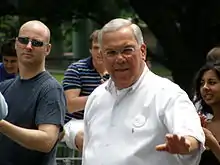
On July 19, 2012, Mayor Menino stated that he would work to prevent Chick-fil-A from opening restaurants within Boston, especially near the Freedom Trail, citing their opposition to same-sex marriage and what he called Boston's status as "a leader when it comes to social justice and opportunities for all."[56] The next day, Menino sent a letter to Chick-fil-A president Dan Cathy. Menino urged the company to "back out of your plans to locate in Boston" because of his stance on gay marriage. Gay rights supporters applauded the mayor's support of gay marriage rights, while First Amendment advocates decried the potential for abuse of office to infringe on free speech rights.[56] Menino later stated that he knew there was little he could do as mayor to prevent them from opening restaurants and that he was stating his personal opinion. He maintained, however, that they were not welcome in the city.[57] Boston Herald columnist Michael Graham called Menino's stance nonsensical, in light of Menino's previous friendly relations with the Islamic Society of Boston, which at one point listed among its "spiritual guides" Yusuf al-Qaradawi, who has called for homosexuals to be put to death.[58]
Urban development
During Menino's tenure, the city's total square footage of office and residential space increased by 11%, and 80 million square feet of development was constructed.[59]
In the 1990s, Menino made an effort to redevelop Boston City Hall Plaza, which was shelved after it failed to receive federal support.[60]
Menino was highly supportive of a project by the Islamic Society of Boston to build a mosque in Roxbury, including selling city land to the mosque at a significantly below-market rate and participating in a groundbreaking ceremony for the mosque in 2002.[61] The project became increasingly controversial due to the ISB's alleged ties to various individual terrorists and terrorist organizations; and by 2008, when the initial building was completed, the Boston Phoenix reported that "Menino and other city representatives have vanished from public association with the project."[61]
_(1).jpg.webp)
In 2006, Menino proposed two major construction projects that would have significantly impact the city, but ultimately failed to materialize. Trans National Place is a proposed 1,000-foot (300 m) tower to be built on the site of a city-owned parking garage in Boston's Financial District. The second proposal calls for the city to sell Boston City Hall,[5] a 1960s example of Brutalist architecture. Menino would then have the city use the proceeds from the sale to fund construction of a new seat of government on the South Boston waterfront,[5] on the site of the current Bank of America Pavilion (Drydock 4). Menino abandoned the idea of moving the city's city hall in January 2009.[62]
Menino supported the proposed redevelopment of Filene's site in Downtown Crossing into a 39-floor tower. This was fast-tracked by the Boston Redevelopment Authority in 2007, but halted during the Great Recession.[52] This site would long sit vacant as a result of the failure of this faltered project.[52] It would later become home to the Millennium Tower.[63]
In 2008, the Friends of Mary Cummings Park delivered a complaint to the Massachusetts Attorney General alleging breach of charitable trust by the Menino administration, which had sought to sell more than 200 acres (81 ha) of public parkland for development. The Menino administration had used hundreds of thousands of dollars from the Mary P.C. Cummings care and maintenance trust fund, substantially depleting the fund, to pay for legal services working toward breaking the trust and to hire a real estate agent to prepare an extensive plan on how to develop the public parkland as either commercial or residential real estate.[64]
Menino, in 2012, made an effort to get a casino developed at Suffolk Downs in East Boston, and opposed a proposed casino development in Everett, Massachusetts (which would have used a small portion of land located in Boston's city limits).[65][66][67]
At the end of Menino's tenure, the city was undergoing a construction boom, with Moody's Investor Service having credited the city in 2012 with having, "the strongest commercial real estate market in the country since the 2008 recession".[59]
Accusations of favoritism towards developers
Menino often faced criticism accusing him of playing "favorites" with developers.[52]
In 2001, Menino intervened to help stop a chain drugstore from opening a few blocks from a pharmacy owned by a close friend and political supporter. The case raised the question of favoritism and cronyism in the city's zoning and licensing practices.[68]
Downtown Boston Business Improvement District
Since the mid-1990s, Menino had pushed for the idea of the downtown business improvement district.[63] However, legislation for such a plan repeatedly was defeated in the state legislature, before legislation giving state approval finally succeeded in 2010.[63][69]
Dudley Square (Nubian Square)
Menino gave priority to the redevelopment of Dudley Square (today known as "Nubian Square"). Over his tenure, there had been roughly $330 million of private development there.[60] In March 2011, Menino proposed renovating the abandoned Ferdinand's Furniture building in the area and relocating 400 Boston Public School employees from the School Department's headquarters at 26 Court Street, a block from Boston's City Hall. The "Ferdinand" building is a circa-1895, Baroque Revival structure located in the Dudley Square area of Roxbury. The renovation was estimated to cost $100–115 million, an amount raised by issuing municipal bonds that would be paid back by selling or leasing five of the city's municipal buildings.[70]
Housing
Between 2000 and 2010, Boston saw 20,500 new units of housing constructed, including 5,500 units of affordable housing.[71] The influx of millions of dollars of new high-priced housing during Menino's tenure contributed to gentrification, which had the negative impact of pricing longtime residents out of neighborhoods.[34]
More than 12,000 new college dormitory rooms were constructed in Boston during Menino's tenure.[59]
Neighborhood development
Menino was also known for focusing on neighborhood development in Boston, organizing services by neighborhood, and appointing neighborhood coordinators who serve as ambassadors from the city in their areas, believing that development should happen in every neighborhood. In 2001, Governing magazine named Mayor Menino Public "Official of the Year" for effective neighborhood development in Boston. This model has spread to other cities as a result of its effectiveness.[72]
Seaport District
Menino oversaw the development of the Seaport District,[52] also known as the "Innovation District".
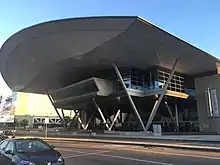
In June 2004, the city completed construction on the Boston Convention & Exhibition Center, a project which Menino had strongly supported for years.[5] When Menino had taken office, the city had only 293,000 square feet of convention space. By the time he left office, it had 1,3099,000 square feet of convention space.[73] The construction of the Boston Convention & Exhibition Center marked the start of the Seaport District of the city.[5]
In January 2010, Mayor Menino launched an initiative to create an urban environment fostering innovation, collaboration, and entrepreneurship on 1,000 acres (400 ha) of the South Boston waterfront.[74][75] The so-called Innovation District includes the Fort Point neighborhood, Seaport Square, Fan Pier, and Marine Industrial Park.[74] Of the initiative, Mayor Menino said: "A new approach is called for on the waterfront—one that is both more deliberate and more experimental. The massive expanse of the South Boston waterfront—with its existing knowledge base, opportunity for growth, and world-class infrastructure—is ripe to produce world-class products and services."[76]
Sports venues
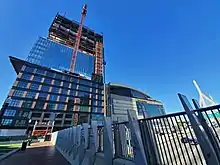
In the mid 1990s, Menino opposed two plans proposed by Robert Kraft for new venues that would have housed the New England Patriots in the city.[60] One of these plans was the proposed Boston Sports Megaplex in Roxbury.[77][78][79] The other of these plans was for a stand-alone waterfront football stadium in South Boston (where the Seaport District is today).[60][78] Menino instead favored constructing a stand-alone convention center in South Boston, and urged instead for a location in the South Bay to be considered for the stadium for the New England Patriots.[80]
Menino was involved with negotiating with Boston Red Sox ownership and the state of Massachusetts a deal to provide public funds to build a new baseball stadium near the existing Fenway Park. However, the Boston City Council rejected the deal, and the existing Fenway Park was instead renovated.[52] After new ownership abandoned the idea of replacing Fenway Park, Menino supported their efforts to renovate the stadium, and also launched a review of the potential new development in the surrounding neighborhood. Following a 2004 rezoning effort of the neighborhood surrounding Fenway Park, the area began to see major new developments.[60]
Menino was involved in providing millions of dollars in tax breaks for the development of a complex of high-rise towers surrounding the TD Garden arena.[63]
Education
.jpg.webp)
Student performance in Boston Public Schools made improvements during Menino's tenure in regards to test scores.[52][34] However, Menino was resistant to school reforms,[52] despite having promised to overhaul the schools.[34] Menino failed in his effort to lengthen school days, meeting resistance from the Boston Teachers Union.[52]
Public safety and law enforcement
During Menino's tenure, crime in Boston fell to record lows, and the city came to rank among the nation's safest large cities.[81] Boston's violent crime rate fell from 1,957.7 in 1993, to 845.2 in 2011.[73]
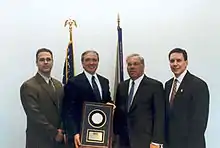
Menino took office amid the "Boston Miracle", a successful joint effort by police, churches, and neighborhood groups which worked to decrease youth-on-youth violence.[62] At the start of his tenure, Boston was experiencing a 29-month long period in which no teenagers were murdered in the city. This ended on December 11, 1997, when a sixteen year old was murdered in Dorcester.[5] Menino supported Operation Ceasefire,[82] which is credited with decreasing homicide rate in the city.[62] In 2003, the Operation Ceasefire program received the United States Department of Justice's "Outstanding Comprehensive Strategic Plan Award".[83]
.jpg.webp)
In November 2003, Menino appointed James M. Hussey as acting police commissioner, following the departure of Commissioner Paul F. Evans.[84][85] In 2004, Menino appointed Kathleen O'Toole as the first-ever woman to serve as commissioner of the Boston Police Department.[86] In May 2006, Menino appointed Albert Goslin to serve as interim police commissioenr following O'Toole's departure.[87] In December 2006, Menino appointed Ed Davis to serve as police commissioner.[88] In November 2013, Menino appointed William B. Evans to serve as interim police commissioner following Davis' departure.[89]
In October 2011, controversy arose surrounding Menino's decision to evict members of the Occupy Boston protest on the Rose Kennedy Greenway. Menino later commented that "I sympathize with their issues, some of those issues we really have to look at in America, but when it comes to civil disobedience I will not tolerate civil disobedience in the city of Boston."[90][91] On December 10, 2011, Menino oversaw a peaceful removal of Occupy Boston's tent city from Dewey Square. The encampment had been running for seventy days before this. The removal of it occurred peacefully.[62]
_(1).jpg.webp)
In his last year in office, the Boston Marathon bombing took place. Menino, who had been recovering in the hospital from a leg fracture at the time of the attacks (confining him to a wheelchair), checked out of the hospital in order to be present in the aftermath of the attacks.[81]
Public health
.jpg.webp)
Menino oversaw negotiations that led to the January 1996 merger of the Boston City Hospital (which had been declining, and was in financial trouble) with the BU Medical Center. This merger had been arranged with the aim of improving healthcare for the city's more impoverished residents. This merger resulted in the establishment of the privatized Boston Medical Center.[5][21] Menino had, as a city councilor, previously given support to the idea of reorganizing the Boston City Hospital.[18] The Menino Pavilion at the Boston Medical Center would later be named for him, crediting his efforts on public health.[21]
In the early 2000s, Menino was an early supporter of efforts to pass a statewide ban in Massachusetts on smoking in indoor workplaces.[21] In 2012, Boston became Massachusetts' first large city, as well as the largest city in the United States, to ban smoking in public housing.[21]
In 2005, Menino created an $1 million effort to track ethnic and racial disparities in healthcare, and to collaborate with hospitals and other health providers to address these.[21]
In 2008 Menino publicly criticized drugstore chains for failing to open clinics in the city of Boston. The state of Massachusetts had moved to permit drugstores to open clinics, and while many had opened in the suburbs, none had opened in the city of Boston.[21]
In April 2011, in an effort to fight obesity, Menino banned advertisements and sales of sugar-heavy drinks in municipal buildings and at city-sponsored events.[62]
Environmental issues
In 2008, Boston was ranked as the third-greenest city in the United States by Popular Science.[92] In the previous decade, there had been new initiatives around planting more trees in the city, single-stream recycling, increasing the solar power capacity of the city, investing in alternative energy, and biking. One of the most innovative ideas has been green building zoning, which requires large-scale private construction to be "green" by LEED standards. Boston is the first city to revise its building code to ensure green construction.[93] The documentary The Greening of Southie by Ian Cheney and Curt Ellis tells the story of the first green residential building in Boston.[94]
Menino was a founding members of the US Mayors' Alliance for Green Schools.[95]
Under Menino, Boston became the first major city in the United States to incorporate green building standards in its zoning codes. Boston changed its zoning codes to require private construction larger than 50,000 square feet to adhere to the U.S. Green Building Council's LEED standards.[95]
Under Menino, Boston partnered with other government agencies and local businesses to accomplish its goals of reducing greenhouse gas emissions by 7% below 1990 levels by 2012, and to 80% below 1990 levels by 2050.
Menino released an updated Climate Action Plan for the City of Boston on Earth Day 2011. The major goals of the climate plan included reducing community greenhouse emissions 25% by 2020 and 80% by 2050, including projected climate change into all formal planning and project review processes, encouraging community climate action and leadership, and creating green jobs.[96]
In may 2013, Menino launched Greenovate Boston, a community-driven movement aiming to achieve Menino's goal of an 80% reduction in greenhouse-gas emissions by 2050, as outlined in his 2011 climate action plan.[97]
Bicycling
Three times between the years 1999 and 2006, Boston was ranked by Bicycling magazine as one of the worst cities in the United States for bicycling.[52] In, September 2007, Menino started a bicycle program called Boston Bikes with a goal of improving bicycling conditions by adding bike lanes and racks and offering bikeshare programs.[98][99] By hosting events and creating a bike-friendly landscape throughout the city, the initiative encourages residents and tourists to explore the city by bicycle. Olympic cyclist Nicole Freedman headed the program for several years.[100] By the end of Menino's tenure, the city had 120 miles of bicycling paths, and had roughly 1,000 Hubway bike sharing cycles.[52]
Arts and culture
.jpg.webp)
Menino was an important supporter of efforts to renovate the Boston Opera House, Modern Theatre, and Paramount Theatre.[101][102] Menino had, in 1995, started a challenging effort to save the three physically deteriorating venues, all locavted in what was regarded to be a disreputable area at the time.[102] Menino successfully lobbied the National Trust for Historic Preservation to list the three venues among the nation's eleven most endangered landmarks in 1995.[102][103] Menino championed the renovation of these theatres as a means to revitalize Washington Street.[103] In 1996, David Anderson, head of Pace Theatrical expressed his interest in renovating the Boston Opera House.[102] In Clear Channel Entertainment Theatrical, which Anderson became the head of, ultimately acquired the Boston Opera House.[102] The effort was complicated by opposition from some neighbors, who sued the city in 2000 to block the revitalization of the venue. This litigation lasted two years.[102] Menino worked to keep the developers from backing out of the project while litigation ensued.[102] The city fast tracked zoning, permitting, and other approval.[102] In November 2002, Clear Channel received a building permit to begin restoration on the Boston Opera House.[103] Clear Channel undertook a $54 million renovation of the historic venue, which reopened in July 2004.[102] In 2002, the city successfully convinced the developers of the Ritz Carlton being constructed a block away to pay for restoration to the venues façade and marquee.[102] The city later signed an agreement with Emerson College to redevelop it into the Paramount Center, which opened in 2010.[102] In 2011, the Modern Theatre was reopened by Suffolk University.[102]
.jpg.webp)
In the late 1990s, after the operator of the Harborlights Pavilion was evicted from the venue's original location at Fan Pier, Menino and Boston Redevelopment Authority head Thomas N. O'Brien worked to find a new location on the city's waterfront for the venue.[104]
Menino was an important supporter of the revitalization of Dorcester's Strand Theatre.[102] Menino's administration began working to revitalize the venue in 2005, in hopes of making it a local cultural attraction to draw crowds to the area. The city failed to find development partners, and instead spent $6.2 million of its own money on capital improvements to the venue, transforming it into a youth arts and performance center managed by Boston's cultural affairs office.[102]
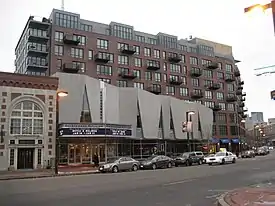
Menino was an important supporter of the construction of the Calderwood Pavilion. Menino negotiated the deal between the Boston Center for the Arts and the Druker Company in which the Druker Company agreed to build the "shell and core" of a performing arts venue as part of its Atelier/505 luxury mixed-use condo development. Support from the city and its Boston Redevelopment Authority were critical to the construction of the venue.[102]
Menino gave some financial assistance and in kind services to support the Commonwealth Shakespeare Company's free performances of the works of William Shakespeare on the Boston Common.[102][105]
In 2003, Menino relaunched the Boston Arts Festival.[106]\
Menino supported the construction of a new home for the Institute of Contemporary Art at Fan Pier.[105]
Menino created a position of city poet laureate, installing Samuel James Cornish as the first holder of this position in 2008.[102][107]
In 2010, Menino's administration launched the Payments in Lieu of Taxes (PILOT) program, which asked the city's largest nonprofits to may voluntary payments equal to roughly 25% what, they would have to pay if they lacked non-profit status in taxable property on properties word $15 million or more.[102][108] The program aimed to assist the city in offsetting the rising cost of municipal services and the loss of state financial aid due to cuts. Among the nonprofits that were asked to participate were ten cultural groups. The Boston Symphony Orchestra and the public radio station WGBH agreed to participate in the program. The Boston Museum of Fine Arts complained about the program, and instead contributed only one-fifth the amount that the city had asked it to contribute. The remaining seven cultural groups disregarded the city's request. This program was ultimately seen as straining Menino's relations with many of the city's major cultural relationship.[102]
At the end of his tenure, Menino supported the creation of the Boston Calling Music Festival.[105]
During Menino's tenure, the city had regularly ranked towards the bottom five among the United States' 30 largest cities in regards to the total amount of funds its spent annually on arts, per data collected by Americans for the Arts.[102] The budget of the Mayor's Office of Arts, Tourism, and Special Events was roughly $1.1 million in 2013.[102] Maureen Dezell of WBUR attributed the city's relatively low arts budget to Massachusetts state laws restricting the revenue sources of the state's cities and towns, leaving the city with less sources of revenue than other United States cities.[102]
Other
Started in 1994,[109] the Mayor's Youth Council met with Menino twice a month to discuss youth issues in the city of Boston.
In 2002, the FBI opened a corruption probe into Menino, which it ultimately closed without any charges. The probe was in response to a Boston Herald article which questioned the appropriateness of comments Menino was shown making during a segment on the television series Boston 24/7. The comments showed Menino appearing to threaten a Sprint Corporation attorney that he would award a Boston Housing Authority contract to their competitor AT&T because AT&T had sponsored a summer youth program for the city, while Sprint had failed to take similar initiative. Menino defended these comments as a "joke". The Boston Globe found there was no actual telecommunications contracts that were up for bid when Menino made these comments.[110]
Public image
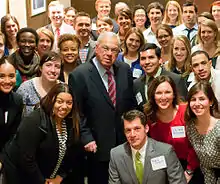
Menino enjoyed strong popularity. Menino's perennial popularity garnered him the tongue-in-cheek epithet "Mayor for Life."[111][112][113][114][115][116] In July 2012, it was reported that Menino had an 82% approval rating.[117]
Menino made appearances at community events, such as parades and community meetings.[81] Surveys, such ones conducted in April 2008, in May 2009, and March 2013 for The Boston Globe by the University of New Hampshire Survey Center, showed that, at one point, more than half of the city's residents had reported having at one point personally met Menino, an immense share of residents for a big city mayor.[81][118][119][120]
Menino, who famously was dubbed, and even styled himself, as an "urban mechanic", had a reputation for focusing strongly on "nuts and bolts" issues.[60][81] The "urban mechanic" nickname had both positive and negative connotations to it.[60] He had been given this nickname in late 1994.[62]
Approval polling
Menino enjoyed high approval ratings among Boston residents.
In March 2013, a Boston Globe poll not only showed Menino with a strong approval rating, but also found that nearly three-fourths of respondents believed that the city was heading in the "right direction".[121][122]
| Segment polled | Polling group | Date | Approve | Disapprove | Sample size | Margin-of-error | Polling method | Source |
|---|---|---|---|---|---|---|---|---|
| Adults | University of Massachusetts Amherst/The Boston Globe | August 2013 | 82% α | 8% | ± 6.2% | [123][124] | ||
| Likely voters | Suffolk University/Boston Herald | July 10–15, 2013 | 82% | 12% | 600 | [125][126] | ||
| Adults | University of New Hampshire/The Boston Globe | March 20–26, 2013 | 74.1% [β] | 15.9% | 440 | ± 4.7% | Telephone (landline and cell phones) | [120][122] |
| Adults | University of New Hampshire/The Boston Globe | April 30–May 6, 2009 | 73% | 19% | 508 | ± 4.4% | [119] | |
| Adults | University of New Hampshire/The Boston Globe | April 12–17, 2008 | 72% | 20% | 519 | ± 4.4% | [118][127] | |
| Likely voters | The Boston Globe/WBZ-TV | October 15–20, 2005 | 66% | 513 | ± 4.4% | [128] | ||
| 2001 | 85% | [129][130] | ||||||
| Residents | KRC Communications Research/The Boston Globe | July 5–6, 2000 | 77% | 7% | ± 5% | [131][132] | ||
| Mass Insight Corp. | 2000 | 79% | [133] | |||||
| The Boston Globe | 1998 | 71% | [132] | |||||
| 1997 | 74% | [134] | ||||||
| Likely voters | Marttila & Kiley | September 25–28 1995 | 80% | 16% | 500 | [135] | ||
| Likely voters | KRC Communications Research/The Boston Globe/WBZ-TV | October 19–20, 1993 | 70% | 12 | 400 | ± 5% | Telephone | [136][137] |
Post-mayoralty
After leaving office as mayor in January 2014, Mayor Menino was appointed as Professor of the Practice in the Department of Political Science at Boston University;[138] and he co-founded the Initiative on Cities (IOC),[139] an urban leadership research center based at the University, alongside Professor of Political Science Graham Wilson. As a co-founder and co-director of the IOC, Mayor Menino helped develop the office's mission to bridge the gap between the academic study of cities and the real-world practice of urban governance. This was accomplished by hosting conferences,[140][141][142] seminars, and a speaker series; by providing research funding to BU faculty and students; and by providing fellowship opportunities for students interested in local government.
Under Mayor Menino, the IOC also created its flagship research project, the recently rededicated Menino Survey of Mayors,[143] the only nationally representative survey of American mayors. The Survey stands as an annual examination of the most pressing challenges and opportunities facing America's urban leaders.[144]
Speech errors
Mayor Menino was known for his distinctive voice, thick Boston accent, and speech errors, some of which are malapropisms. The examples here also include substitution; deletion; and addition, or epenthesis—which mean that, respectively, whole words are used in place of the intended word; portions of a word are eliminated; and portions of a word are added into the intended word. As a result of these various errors, some commentators (such as conservative radio show host and author Howie Carr) refer to the mayor as "Mumbles Menino"[145][146] or "Mayor Mumbles." A typical example of one of his speech errors involves a reference to Boston's parking shortage as "an Alcatraz around my neck" (meaning, instead, an albatross around his neck), which is a substitution error.
An example of Menino causing controversy with his choice of words occurred in a interview for the August 28, 2013, issue of the New York Times Magazine, Menino was quoted as saying that he would blow up Detroit and start all over, in reference to the inaction of the city's leaders.[147] In response, Detroit mayor (and one-time member of the Boston Celtics) Dave Bing questioned his choice of words: "I would think the mayor of a city that recently experienced a deadly bombing attack would be more sensitive and not use the phrase 'blow up.'" The comments came just over four months after the Boston Marathon bombing.[148] Menino apologized on September 4.[149]
Personal life
Menino met Angela Faletra in 1963 when the two were playing tennis in Roslindale on adjacent courts.[150] The two were married three years later and moved to Hyde Park, where they resided until his death. They had two children, Susan and Thomas Jr., and six grandchildren.[151]
Menino was hospitalized several times while mayor. He was admitted for abdominal pain and intestinal inflammation and was treated for kidney stones in 1995 and 1997. In 2003, Menino underwent surgery at Brigham and Women's Hospital to remove a rare sarcoma (DFSP) on his back. The tumor had not spread, and the mayor was able to return to work several days later. In 2004, he was diagnosed with Crohn's disease, helping to explain his recurring intestinal problems. The condition required lifelong treatment with anti-inflammatory medication and careful monitoring of his diet.[152]
Illness and death
.jpg.webp)
In March 2014, Menino announced that he had been diagnosed with an advanced form of cancer of unknown primary origin that had spread to his liver and lymph nodes and that he was beginning intensive chemotherapy treatment at Dana-Farber Cancer Institute in Boston.[153] On October 23, 2014, he made the announcement that he would be halting cancer treatments, as well as his book tour, to spend more time with family.[154] However, only seven days later, on October 30, 2014, Menino died just after 9:00 a.m. He was 71 years old.[155]
His body lay in state at Faneuil Hall in Boston on November 2, and his funeral was held at the Most Precious Blood Parish in Hyde Park the following day.[156] The funeral services were pre-planned by Menino himself, including the list of invitees for the private funeral mass.[157] His funeral services were presided over by Cardinal Seán Patrick O'Malley, the Archbishop of Boston; attendees included Menino's successor, Marty Walsh; Governor Deval Patrick; former Governor William Weld; Vice President (and later President) Joe Biden; former President Bill Clinton; Secretary of State and former U.S. Senator from Massachusetts John Kerry; House Minority Leader Nancy Pelosi; Boston Celtics legend Bill Russell; and David Ortiz and Pedro Martínez of the Boston Red Sox.[158][159] He was buried at Fairview Cemetery in Hyde Park, around the corner from his home.[157]
Legacy
Various facilities in the Boston area have been named after Menino, including:
- Mayor Thomas M. Menino Park, in Charlestown[160]
- Menino Arts Center, in Hyde Park[161][162]
- Menino Pavilion, at the Boston Medical Center[163][164]
- Thomas M. Menino Community Center, in Roslindale[165]
Electoral history
City Council
| 1983 Boston City Council district 5 election | ||||
|---|---|---|---|---|
| Candidates[166] | Preliminary election[167] | General election[168] | ||
| Votes | % | Votes | % | |
| Thomas Menino | 11,375 | 57.8% | 17,554 | 74.7% |
| Richard E. Kenney | 3,126 | 15.9% | 5945 | 25.3% |
| William G. Broderick | 3123 | 15.9% | ||
| Robert MacGregor | 1124 | 5.7% | ||
| Constance L. Brown | 467 | 2.4% | ||
| George L. Richmond | 461 | 2.3% | ||
| 1985 Boston City Council district 5 election | ||||
|---|---|---|---|---|
| Candidates[169] | General election[170] | |||
| Votes | % | |||
| Thomas Menino (incumbent) | 5,745 | 100 | ||
| 1987 Boston City Council district 5 election | ||||
|---|---|---|---|---|
| Candidates[171] | General election[172] | |||
| Votes | % | |||
| Thomas Menino (incumbent) | 10,437 | 87.0% | ||
| Gerald Bagley | 1,556 | 13.0% | ||
| 1989 Boston City Council district 5 election | ||||
|---|---|---|---|---|
| Candidates | General election | |||
| Votes | % | |||
| Thomas Menino (incumbent) | 100 | |||
| 1991 Boston City Council district 5 election | ||||
|---|---|---|---|---|
| Candidates[173] | Preliminary election[174] | General election[175] | ||
| Votes | % | Votes | % | |
| Thomas Menino (incumbent) | 6,784 | 79.5% | 9,678 | 81.6% |
| Peter D. Stone | 913 | 10.7% | 2181 | 18.4% |
| Edmund T. Burke | 632 | 7.4% | ||
| Gerald Bagley | 203 | 2.4% | ||
Mayor
| 1993 Boston mayoral election | ||||
|---|---|---|---|---|
| Candidates | Preliminary election[37] | General election[37] | ||
| Votes | % | Votes | % | |
| Thomas Menino (acting incumbent) | 30,060 | 26.89 | 74,448 | 64.45 |
| James T. Brett | 25,052 | 22.41 | 41,052 | 35.54 |
| Robert Rufo | 22,517 | 20.14 | ||
| Rosaria Salerno | 19,605 | 17.54 | ||
| Bruce Bolling | 6,564 | 5.87 | ||
| Christopher Lydon | 3,630 | 3.25 | ||
| Francis Roache | 3,362 | 3.01 | ||
| Diane Moriarty | 991 | 0.89 | ||
| 1997 Boston mayoral election[176] | ||||
|---|---|---|---|---|
| Candidates | General election | |||
| Votes | % | |||
| Thomas Menino (incumbent) | 71 | |||
| all others | 29 | |||
| 2001 Boston mayoral election | ||||
|---|---|---|---|---|
| Candidates | Preliminary election[37] | General election[37] | ||
| Votes | % | Votes | % | |
| Thomas Menino (incumbent) | 31,715 | 73.37 | 68,011 | 76.06 |
| Peggy Davis-Mullen | 9,958 | 23.04 | 21,393 | 23.93 |
| Althea Garrison | 1,552 | 3.59 | ||
| 2005 Boston mayoral election | ||||
|---|---|---|---|---|
| Candidates | General election[177] | |||
| Votes | % | |||
| Thomas Menino (incumbent) | 64,001 | 67.52 | ||
| Maura Hennigan | 30,468 | 32.14 | ||
| 2009 Boston mayoral election | ||||
|---|---|---|---|---|
| Candidates | Preliminary election[41] | General election[41] | ||
| Votes | % | Votes | % | |
| Tom Menino (incumbent) | 41,026 | 50.52 | 63,123 | 57.27 |
| Michael Flaherty | 19,459 | 23.96 | 46,768 | 42.43 |
| Sam Yoon | 17,179 | 21.16 | ||
| Kevin McCrea | 3,340 | 4.11 | ||
See also
- Timeline of Boston, 1990s–2010s
Published works
- Menino, Thomas; Beatty, Jack (2014). Mayor for a New America. Houghton Mifflin Harcourt. ISBN 978-0544302495.
References
- McGrory, Brian (July 13, 1993). "Menino, 'a neighborhood guy,' now at center stage". The Boston Globe. p. 12. Retrieved June 11, 2021 – via newspapers.com.
- Ryan, Andrew (May 30, 2013). "Harvard to Give Menino Honorary Degree". The Boston Globe. Retrieved October 31, 2014.
- Wesley Lowery (July 15, 2013). "Menino Ready to Write the Book on His Mayoralty". The Boston Globe. Retrieved October 31, 2014.
- Ryan, Andrew (May 30, 2013). "Harvard to Give Menino Honorary Degree". The Boston Globe. Retrieved October 31, 2014.
- Baker, Matthew Reed (September 24, 2013). "Boston Mayor Thomas M. Menino: A Timeline". Boston Magazine. Retrieved November 29, 2021.
- Ryan, Andrew (May 30, 2013). "Harvard to Give Menino Honorary Degree". The Boston Globe. Retrieved October 31, 2014.
- Rogers, David (July 19, 1979). "Meet 'The Mission Hill Gang'". The Boston Globe.
- "A Look at the Boston City Council, Thomas M. Menino". The Boston Globe. November 17, 1983.
- "BOSTON ELECTION RESULTS". The Boston Globe. November 16, 1983. Retrieved February 21, 2018 – via pqarchiver.com.
- Frisby, Michael K. (September 5, 1985). "As Elections Draw Near, Boston Districts Unexpectedly Quiet". The Boston Globe. Retrieved October 31, 2014.
- "Menino Considers Being Parks Chief". The Boston Globe. May 29, 1986. Retrieved October 31, 2014.
- "The Boston Vote". The Boston Globe. November 4, 1987. Retrieved February 23, 2018 – via pqarchiver.com.
- "The Choices before Boston Voters Flynn Deserves Reelection". The Boston Globe. October 29, 1991. Retrieved October 31, 2014.
- "City Council district members". The Boston Globe. November 6, 1991. Retrieved February 24, 2018 – via pqarchiver.com.
- "Councilors Learn of Committee Jobs". The Boston Globe. January 23, 1992. Retrieved October 31, 2014.
- Walker, Adrian (January 5, 1993). "For Menino, a Key Career Step an Ally Says He Needed, Earned". The Boston Globe. Retrieved October 31, 2014.
- Phillips, Frank (May 5, 1993). "Campaign Phone Calls for Menino a Violation". The Boston Globe. Retrieved October 31, 2014.
- Walker, Adrian (August 17, 1993). "Menino declares, citing record as acting mayor". Newspapers.com. The Boston Globe. Retrieved December 16, 2021.
- Tong, Betsy Q.M. (October 3, 1993). "Gay community cautious of backing Brett or Menino". Newspapers.com. The Boston Globe. Retrieved December 16, 2021.
- McGrory, Brian (July 13, 1993). "Menino, 'a neighborhood guy,' now at center stage". Newspapers.com. The Boston Globe. Retrieved December 2, 2021.
- Lazar, Kay (March 29, 2013). "Menino long championed public health - The Boston Globe". Boston Globe. Retrieved December 13, 2021.
- Nolan, Martin F. (March 27, 1993). "Menino hints he would drop Roache, most on school panel". newspapers.com. The Boston Globe. Retrieved December 1, 2021.
- "Emotional Flynn parades out of his city on road to Rome". Newspapers.com. The Boston Globe. July 13, 1993. Retrieved December 2, 2021.
- Crouch, Ian (March 28, 2013). "Thomas Menino's Greatest Feat". The New Yorker. Retrieved November 29, 2021.
- Iglar, Brooke (April 14, 2021). "Profile: Acting Mayor Kim M. Janey". Boston Political Review. Retrieved September 28, 2021.
- "Menino signs grant, moves city toward recycling". Newspapers.com. The Boston Globe. August 3, 1993. Retrieved December 1, 2021.
- Jonas, Michael (July 28, 2021). "Janey hands out the goodies". CommonWealth Magazine. Retrieved December 7, 2021.
- Vennochi, Joan (September 16, 2021). "It was Kim Janey's race to lose and she lost it". The Boston Globe. Retrieved September 17, 2021.
- Walker, Adrian (August 17, 1993). "Menino declares, citing record as acting mayor". Newspapers.com. The Boston Globe. Retrieved December 16, 2021.
- Lisa Wangsness (October 27, 2005). "Menino says this may not be his final campaign". Boston Globe.
- Seth Gitell (March 23, 2000). "Talking Politics". Boston Phoenix. Archived from the original on September 5, 2008.
- "Choice between more than two men". Retrieved on July 29, 2013
- Ryan, Andrew (March 29, 2013). "Menino makes 5th term his last". The Boston Globe. p. A.1. Retrieved February 26, 2018 – via pqarchiver.com.
- Seelye, Katharine Q. (October 30, 2014). "Thomas M. Menino, Mayor Who Led Boston's Renaissance, Is Dead at 71". The New York Times. Retrieved November 29, 2021.
- Goldberg, Carey (September 21, 1997). "For the First Time in Memory, Boston Has No Mayoral Contest". The New York Times. Retrieved December 14, 2021.
- Berke, Richard L. (November 5, 1997). "THE 1997 ELECTIONS: MAYORAL RACES; For Incumbents in Cities, Celebrations Came Easily". The New York Times. Retrieved February 14, 2018.
- "Election Results". The City of Boston. Archived from the original on September 7, 2011. Retrieved June 5, 2011.
- Dorgan, Lauren R. (May 2, 2001). "Davis-Mullen Chances Slim in Boston Mayoral Race | News | The Harvard Crimson". www.thecrimson.com. The Harvard Crimson. Retrieved December 14, 2021.
- "City of Boston Municipal Election - November 8, 2005: Mayor" (PDF). City of Boston. Retrieved June 5, 2011.
- Estes, Thomas Menino (November 9, 2005). "A fourth term for Menino - The Boston Globe". Boston.com. The Boston Globe. Retrieved December 14, 2021.
- "Unofficial Election Results - City of Boston". Cityofboston.gov. Retrieved October 30, 2014.
- http://www.bostonherald.com/news/politics/view.bg?articleid=1201854%5B%5D
- Levenson, Michael (September 29, 2009). "Yoon is joining Flaherty as deputy". The Boston Globe.
- Stephanie Ebbert; Michael Levenson & Donovan Slack (September 13, 2009). "A well-tuned political machine, powered by zeal". Boston Globe.
- Michael Flaherty incident Archived May 16, 2011, at the Wayback Machine, digboston.com, May 2011; accessed October 30, 2014.
- "Rudy Bruner Award for Urban Excellence". Committee Members. Bruner Foundation. Archived from the original on January 7, 2014. Retrieved January 7, 2014.
- "The Economic Impact of the Democratic National Convention on the Boston Economy: The Final Tally" (PDF). The Beacon Hill Institute. Retrieved October 31, 2014.
- "Mayors Against Illegal Guns: Coalition Principles". Archived from the original on July 2, 2007. Retrieved on June 18, 2007
- "Mayors Against Illegal Guns: Coalition Members". Archived from the original on October 7, 2007. Retrieved on June 18, 2007
- "2012 DNC speeches". www.ontheissues.org. Retrieved November 29, 2021.
- "Mayor Menino Endorses Warren For Senate". WBUR. September 21, 2012. Retrieved December 8, 2021.
- Schwartz, Jason (September 24, 2013). "Mayor Menino's Greatest Hits and Misses: The Best/Worst of Tom Menino". Boston Magazine. Retrieved November 29, 2021.
- "Archbishop won't attend dinner honoring Menino". Newspapers.com. North Adams Transcript. The Associated Press. November 25, 2005. Retrieved December 16, 2021.
- "Unwed partners of Boston city workers get benefits". Deseret News. August 5, 1998. Retrieved November 30, 2021.
- "How Mayor Tom Menino Tackled Racial Diversity and Gay Rights in Boston". Boston Magazine. September 24, 2013. Retrieved November 30, 2021.
- "Mayor Menino on Chick-fil-A: Stuff it". Boston Herald. July 20, 2012. Retrieved April 15, 2013.
- "Boston mayor clarifies position on Chick-fil-A". The Kennebec Journal. Augusta, ME. July 27, 2012. Retrieved April 15, 2013.
- Graham, Michael (July 27, 2012). "Radical imam OK but not Chick-fil-A". Boston Herald.
- Seelye, Katharine Q. (September 20, 2013). "In Boston, Mayor Builds a Legacy With Construction Cranes". The New York Times. Retrieved December 7, 2021.
- Fitzgerald, Jay (August 30, 2013). "He built this city (sort of)". www.bizjournals.com. Boston Business Journal.
- Bernstein, David S. (November 24, 2008). "Menino's mosque". Boston Phoenix.
- "Timeline: Boston Mayor Thomas M. Menino through the years". Boston Herald. October 30, 2014. Retrieved December 8, 2021.
- Acitelli, Tom (October 30, 2014). "Boston Mayor Tom Menino's Greatest Real Estate Hits". Curbed Boston. Retrieved December 7, 2021.
- "Friends of Mary Cummings Park delivers complaint to the Mass. Attorney General Martha Coakley seeking an investigation of misallocation of care and maintenance trust funds, breach of charitable trust". Cumminspark.org. July 23, 2008. Archived from the original on July 9, 2012. Retrieved October 31, 2014.
- "Thomas Menino, council in casino faceoff". Boston Herald. January 19, 2012. Retrieved December 7, 2021.
- "Menino's Threat on Wynn's Casino". charlestownbridge.com. Charlestown Patriot-Bridge. July 25, 2013.
- Salesberg, Bob (April 13, 2012). "Boston Mayor Thomas Menino touts proposed Suffolk Downs casino, names panel". masslive. Retrieved December 7, 2021.
- Brian C. Mooney & Stephanie Ebbert (July 20, 2001). "Mayor's role in blocking pharmacy eyed". Boston Globe. Archived from the original on September 27, 2002. Retrieved February 28, 2017.
- Mohl, Bruce (October 19, 2010). "A business improvement district in Boston-finally". CommonWealth Magazine.
- Levenson, Michael (March 4, 2011). "Mayor plans partnership to revive Dudley Square". The Boston Globe.
- Alonso, Rachel (June 2012). "Analyzing the Flexibility of Inclusionary Zoning: Should Affordable Units Be Build On-Site or Off-Site" (PDF). core.ac.uk. Massachusetts Institute of Technology.
- "Mayor Menino Named Public Official of the Year by Governing Magazine". U.S. Mayor. November 12, 2001. Archived from the original on April 13, 2009. Retrieved April 15, 2013.
- "Then and Now: Photos of Boston Before and After the Big Dig". Boston Magazine. September 24, 2013. Retrieved November 30, 2021.
- "FAQ — Innovation District". Innovationdistrict.org. Retrieved October 30, 2014.
- "Case Study: The Boston Waterfront Innovation District | Smart Cities Dive". www.smartcitiesdive.com. Smart Cities Dive. Retrieved December 8, 2021.
- "About — Innovation District". Innovationdistrict.org. Retrieved October 30, 2014.
- Aucoin, Don; Lehigh, Scot (January 14, 1997). "Stadium dispute puts Menino in the hot seat". Newspapers.com. The Boston Globe. Retrieved December 7, 2021.
- Kessler, Martin (October 30, 2014). "Remembering Boston Mayor Tom Menino's Sports Legacy". www.wbur.org. WBUR. Retrieved December 7, 2021.
- Roberts, Randy (April 30, 2005). The Rock, the Curse, and the Hub: A Random History of Boston Sports. Cambridge, Massachusetts: Harvard University Press. pp. 191–192. ISBN 978-0-674-01504-3.
- Aucoin, Don; Lehigh, Scot (January 14, 1997). "Stadium dispute puts Menino in the hot seat". Newspapers.com. The Boston Globe. Retrieved December 7, 2021.
- Quinn, Garrett (October 30, 2014). "Former Boston Mayor Tom Menino was city's urban mechanic". masslive. Retrieved November 29, 2021.
- "Taming inner-city youth gangs". The Denver Post. February 5, 2009. Retrieved December 8, 2021.
- "#054: 01-31-03 JUSTICE DEPARTMENT ANNOUNCES RECIPIENTS OF FIRST ANNUAL PROJECT SAFE NEIGHBORHOODS ACHIEVEMENT AWARDS". www.justice.gov. United States Department of Justice. January 31, 2003. Retrieved December 14, 2021.
- Belkin, Douglas (November 12, 2003). "Hussey likely choice as acting police head". Newspapers.com. The Boston Globe. Retrieved December 9, 2021.
- Estes, Andrea (December 25, 2003). "Top officer residecy questioned". Newspapers.com. The Boston Globe. Retrieved December 9, 2021.
- Paul, Noel C. (March 16, 2004). "The woman chosen to lead Boston's police". Christian Science Monitor. Retrieved December 9, 2021.
- "Too Safe Police Pick". Newspapers.com. The Boston Globe. May 13, 2006.
- "Boston police Commissioner Ed Davis is stepping down". USA Today. Associated Press. September 22, 2013. Retrieved December 9, 2021.
- "Menino Appoints Interim Top Cop On Davis' Last Day". WBUR. November 1, 2013. Retrieved December 9, 2021.
- "Mayor Menino on Occupy Boston arrests". Necn.com. October 11, 2011. Retrieved April 15, 2013.
- Andrew Ryan (October 11, 2011). "Boston mayor says protesters can't tie up the city". Boston Globe. Archived from the original on October 11, 2011.
- Svoboda, Elizabeth (February 8, 2008). "America's 50 Greenest Cities". Popular Science. Retrieved April 15, 2013.
- Zezima, Katie (December 20, 2006). "Boston Plans to Go 'Green' on Large Building Projects". The New York Times.
- "The Greening of Southie". The Greening of Southie. Retrieved April 15, 2013.
- "Tom Menino on Environment". www.ontheissues.org. Retrieved December 12, 2021.
- "Climate Action - City of Boston". Cityofboston.gov. Retrieved October 30, 2014.
- Carlock, Happy (July 19, 2013). "Making Boston Green". U.S. News. Retrieved December 12, 2021.
- Katie Zezima (August 9, 2009). "Boston Tries to Shed Longtime Reputation as Cyclists' Minefield". The New York Times. Retrieved August 16, 2009.
- "A Future Best City: Boston". Rodale Inc. Archived from the original on February 11, 2010. Retrieved August 16, 2009.
- Staff, Nicole Dungca Globe; March 20; 2015; Comments, 7:24 p m Email to a Friend Share on Facebook Share on TwitterPrint this Article View. "Boston's top biking official leaving for Seattle - The Boston Globe". BostonGlobe.com. Retrieved September 11, 2021.CS1 maint: numeric names: authors list (link)
- Johnson, Mrgan (May 15, 2017). "These Three Historic Theaters Are Honored For Their Remarkable Makeovers". Architectural Digest. Retrieved December 9, 2021.
- Dezell, Maureen (May 29, 2013). "Mayor Menino Leaves A Lasting Legacy In The Arts". WBUR. Retrieved December 9, 2021.
- "Opera House restoration permit issued". www.bizjournals.com. Boston Business Jorunal. November 13, 2002. Retrieved December 9, 2021.
- Flint, Anthony (January 17, 1999). "Promoter readies final Harborlights push". Newspapers.com. The Boston Globe.
- Shea, Andrea (July 11, 2013). "A 'Supporter,' But No 'Champion'?: Considering Menino's Arts Legacy". WBUR. Retrieved December 9, 2021.
- "The Boston Art Festival is Back for 2016 – The Boston Sun". The Boston Sun. August 22, 2016. Retrieved December 9, 2021.
- Clark, Jonathan (April 18, 2008). "JP to host poet laureate twice in early May | Jamaica Plain Gazette". Jamaica Plain Gazette.
- "Boston Task Force Asks Nonprofits To Pay Up". boston.cbslocal.com. CBS Boston. December 22, 2010. Retrieved December 9, 2021.
- "Mayor's Youth Council | City of Boston". Bostonyouthzone.com. Retrieved April 15, 2013.
- "FBI investigated Menino, but closed probe without charges". WCVB. April 30, 2015. Retrieved December 7, 2021.
- Bailey, Steve (November 30, 2007). "Boston Globe: Menino's A-game (November 30, 2007)". Boston Globe. Retrieved April 15, 2013.
- Is "Mr. Smooth" Menino Mayor for Life? (April 22, 2008). "Is "Mr. Smooth" Menino Mayor for Life?". Bostonist.com. Archived from the original on February 24, 2012. Retrieved April 15, 2013.
- Vennochi, Joan (November 1, 2007). "Boston Globe: Menino and the accountability gap (November 1, 2007)". The Boston Globe. Retrieved April 15, 2013.
- "Don't underestimate Mr. Pothole (Continued)". Boston Phoenix. Archived from the original on September 23, 2015. Retrieved October 31, 2014.
- "Dorchester Reporter: Potentials give '09 citywide run a look (July 31, 2008)". Dotnews.com. July 31, 2008. Archived from the original on February 23, 2012. Retrieved April 15, 2013.
- "61 New Best Things about Boston". Boston Magazine. March 20, 2008. Retrieved April 15, 2013.
- Stout, Matt (July 21, 2013). "Menino's Going out with a Smile". Boston Herald. Retrieved October 31, 2014.
- Drake, John C. (April 20, 2008). "Smitten with Menino". Boston Globe. Retrieved April 15, 2013.
- "Menino maintains high approval rating in Globe poll". Newspapers.com. The Boston Globe. May 10, 2009. Retrieved December 15, 2021.
- Ryan, Andrew (March 27, 2013). "Mayor widely backed, but run isn't". Newspapers.com. The Boston Globe. Retrieved December 15, 2021.
- Seelye, Katharine Q.; Bidgood, Jess (March 29, 2013). "Beloved but Ill, Boston Mayor Won't Run Again". The New York Times. Retrieved December 15, 2021.
- Ryan, Andrew (March 27, 2013). "Menino widelty popular, but some think he shouldn't run again". Newspapers.com. The Boston Globe. Retrieved December 15, 2021.
- Ryan, Andrew (September 1, 2013). "Boston on upswing, poll shows". Newspapers.com. The Boston Globe. Retrieved December 15, 2021.
- Ryan, Andrew (September 1, 2013). "Turns out, Boston really is the hub, new survey finds". Newspapers.com. The Boston Globe. Retrieved December 15, 2021.
- "Suffolk University/Boston Herald Likely Boston Voters July 2013" (PDF). www.suffolk.edu. Suffolk University. July 2013. Archived from the original (PDF) on April 20, 2015.
- User, Migration (July 17, 2013). "Voters still love Menino, but they're ready for a change". Boston Herald. Retrieved December 17, 2021.
- "Poll shows strong support for mayor". Newspapers.com. The Boston Globe. April 20, 2008. Retrieved December 15, 2021.
- Estes, Andrea (October 23, 2005). "Poll suggests a solid lead for Menino". Newspapers.com. The Boston Globe. Retrieved December 16, 2021.
- Ebbert, Stephanie (March 20, 2001). "An edgy outlook on mayors". Newspapers.com. The Boston Globe. Retrieved December 15, 2021.
- Meheren, Elizabeth (November 3, 2001). "Boston's Mayor, a Bland Favorite". Newspapers.com. The Los Angeles Times. Retrieved December 15, 2021.
- Ebbert, Stephanie (July 10, 2000). "Menino approval rating continues to climb, poll says". Newspapers.com. The Boston Globe.
- Ebbert, Stephanie (July 10, 2000). "Menino gains, Red Sox plan loses in city poll". Newspapers.com. The Boston Globe. Retrieved December 15, 2021.
- Flint, Anthony (January 11, 2000). "Proven Formula". Newspapers.com. The Boston Globe. Retrieved December 16, 2021.
- Anand, Geeta (April 11, 1997). "Unchallenged? Unheard-of". Newspapers.com. The Boston Globe. Retrieved December 17, 2021.
- Mooney, Brian C. (November 25, 1995). "Nuts and bolts add up in poll". Newspapers.com. The Boston Globe. Retrieved December 15, 2021.
- McGrory, Brian (October 24, 1993). "Poll shows Menino enjoys sizable lead". Newspapers.com. The Boston Globe. Retrieved December 15, 2021.
- McGrory, Brian (October 24, 1993). "Poll shows Menino enjoys sizable lead". Newspapers.com. The Boston Globe. Retrieved December 15, 2021.
- "Mayor Menino a Welcome Addition to BU". BU Today. Retrieved July 28, 2015.
- "Tom Menino's Initiative On Cities". wbur.org. Retrieved February 28, 2017.
- "Governor praises cooperation after marathon bombs". salon.com. Associated Press. Retrieved July 28, 2015.
- Phillip Martin. "Lessons Learned From The Boston Marathon Bombing". wgbhnews.org. Retrieved July 28, 2015.
- "Patrick, Menino, Other Leaders Reflect on Lessons Learned From Boston Marathon Bombing". NECN. Retrieved July 28, 2015.
- "What Keeps U.S. Mayors Awake at Night?". nextcity.org. Retrieved July 28, 2015.
- "Initiative on Cities Releases First National Survey of Mayoral Priorities". bu.edu. Retrieved July 28, 2015.
- Archived January 30, 2009, at the Wayback Machine
- Archived February 10, 2009, at the Wayback Machine
- Leibovich, Mark (August 30, 2013). "Thomas Menino Is a Cranberry-Juice-Drinking Workhorse". Retrieved February 28, 2017 – via NYTimes.com.
- "Boston Mayor Thomas Menino Says He'd 'Blow Up' Detroit And Start Over". The Huffington Post. September 4, 2013. Retrieved October 30, 2014.
- "Say what?! Boston mayor apologizes for saying he'd 'blow up' Detroit". Yahoo News. September 4, 2013. Retrieved October 30, 2014.
- "Boston's Reluctant First Lady". The Boston Globe. November 14, 2004.
- "Boston Mayor Thomas M. Menino observes Thanksgiving from his bed at Brigham and Women's Hospital". The Boston Globe. Retrieved October 30, 2014.
- Slack, Donovan (August 20, 2004). "Menino battles Crohn's disease". The Boston Globe.
- "Former mayor Thomas M. Menino diagnosed with advanced cancer". Boston Globe. Retrieved October 30, 2014.
- "Former Boston mayor Thomas Menino suspending cancer treatments, book tour". Boston Globe. Retrieved October 30, 2014.
- "Thomas M. Menino, Boston's Longest-Serving Mayor, Has Died". Boston Globe. Retrieved October 30, 2014.
- "Menino to Lie In State at Faneuil Hall Sunday". Boston Globe. Retrieved October 30, 2014.
- "Menino to Be Laid to Rest in Hyde Park". NECN. Retrieved November 8, 2014.
- "Bill Clinton, Joe Biden Attending Mayor Thomas Menino Funeral". Boston Globe. Retrieved November 8, 2014.
- "Mayor Thomas Menino's Funeral in Boston". Boston Globe. Retrieved November 8, 2014.
- "Mayor Thomas M. Menino Park". playlsi.com. Retrieved December 14, 2018.
- "About Us". hpaa-mac.org. Retrieved December 14, 2018.
- "Menino Arts Center". cityvoter.com. Retrieved December 14, 2018.
- "Information Desk - Menino Pavilion". bmc.org. Retrieved December 14, 2018.
- "Integrated project delivery team collaborates on Boston Medical Center's Menino addition and renovations project". healthcarefacilitiestoday.com. March 19, 2015. Retrieved December 14, 2018.
- Robare, Matt (July 31, 2013). "Roslindale's Archale Community Center renamed after Mayor Menino". wickedlocal.com. Retrieved December 14, 2018.
- "CANDIDATES AS THEY APPEAR ON THE BALLOT". The Boston Globe. October 10, 1983. Retrieved February 22, 2018 – via pqarchiver.com.
- "FINAL ELECTION RESULTS OF BOSTON PRELIMINARY ELECTIONS: DISTRICT 5". The Boston Globe. October 12, 1983. Retrieved February 22, 2018 – via pqarchiver.com.
- "BOSTON ELECTION RESULTS". The Boston Globe. November 16, 1983. Retrieved February 21, 2018 – via pqarchiver.com.
- "O'NEIL TOPS HUB COUNCIL VOTE; NAME RECOGNITION A KEY FACTOR". The Boston Globe. September 11, 1985. Retrieved February 22, 2018 – via pqarchiver.com.
- "BOSTON ELECTION RESULTS". The Boston Globe. November 6, 1985. Retrieved February 22, 2018 – via pqarchiver.com.
- "WHAT TO LOOK FOR AT POLLS TODAY". The Boston Globe. September 22, 1987. Retrieved February 23, 2018 – via pqarchiver.com.
- "THE BOSTON VOTE". The Boston Globe. November 4, 1987. Retrieved February 23, 2018 – via pqarchiver.com.
- "Preliminary races in other districts". The Boston Globe. September 22, 1991. Retrieved February 24, 2018 – via pqarchiver.com.
- "City Council district members". The Boston Globe. September 25, 1991. Retrieved February 24, 2018 – via pqarchiver.com.
- "City Council district members". The Boston Globe. November 6, 1991. Retrieved February 24, 2018 – via pqarchiver.com.
- "Official results give Menino 71 percent of the vote". Retrieved on July 29, 2013
- "City of Boston Municipal Election – November 8, 2005: Mayor" (PDF). City of Boston. Retrieved June 5, 2011.
External links
 |
Wikimedia Commons has media related to Thomas Menino. |
- Biography at City of Boston website
- UMass Boston alumni magazine profile
- Mayors Against Illegal Guns homepage
- Mayor Thomas M. Menino Audio and Video at WBZ.com
- A Boston Globe profile of Angela Menino, the mayor's wife
- US Conference of Mayors
- "Meet Tom Menino" 1984 WGBH documentary on YouTube
- Thomas Michael Menino at Find a Grave
- Appearances on C-SPAN
Authority control  | |
|---|---|
| General | |
| National libraries | |
| Art research institutes | |
| Other | |