Tommaso Aversa
Tommaso Aversa (1623–1663) was an Italian Baroque poet and dramatist.
Tommaso Aversa | |
|---|---|
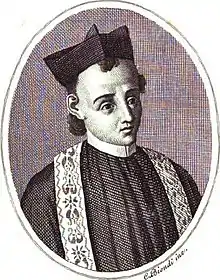 Tommaso Aversa | |
| Born | 1623 Mistretta, Kingdom of Sicily |
| Died | 3 April 1663 (aged 39–40) Palermo, Kingdom of Sicily |
| Pen name | L’Arido L’Esaltado |
| Occupation | poet |
| Nationality | Italian |
| Literary movement | Baroque |
| Notable works | L'Eneide di Virgiliu Siciliani di D. Tomasi Aversa e Castrunovu |
Biography
Tommaso Aversa was born in Mistretta, Sicily, in 1623.[1] Early in life, he moved to Palermo, and applied himself with diligence to the cultivation of literature. It is not known for what particular profession he was intended in his youth. Poetry and the drama, however, soon became his favorite pursuits, almost to the exclusion of every more serious study.
He was still very young when the publication of “Pyramus and Thisbe,” a graceful idyll in the Sicilian language, introduced him to the favorable notice of the public. The literati of Palermo were not slow to recognize the young poet, who was as much distinguished by his amiable manners as by his devotion to the muses. He was enrolled a member of the “Accademia dei Riaccesi;” although with the ill-sounding and inappropriate name of “L’Arido.” Aversa now rapidly rose to distinction; he conciliated the esteem of the learned and noble; and among his friends and patrons at Palermo are reckoned the names of the Cardinal Archbishop, Giannettino Doria, Luigi Moncada, Duke of Montalto, and Diego of Aragon, Duke of Terranova. The last-mentioned nobleman became so attached to his person, that Aversa at his particular request accompanied him to Spain. From Spain he travelled with the Duke to Vienna, and thence to Rome. Don Diego on each occasion acted in the capacity of ambassador from his Catholic Majesty; and Aversa by accompanying him was immediately introduced to the notice of some of the most distinguished men in Europe. At Rome he was made a member of the Academies of “Umoristi” and “Anfistili,” in the latter of which he was known by the name of “L’Esaltato.”
After his wife's death, Aversa was induced to take holy orders.[2] Immediately after his consecration he returned to Palermo, and was appointed by the new Archbishop, Pietro Jerónimo Martínez y Rubio, to the chaplaincy of Santa Maria del Fornice.[1]
From this time to the end of his life he devoted himself with more ardor than ever to his favorite literary occupations; and if we are to judge from the number of his works, his industry must have been astonishing. He died of apoplexy, sincerely regretted by his numerous friends, on the 3rd of April, 1663.
Writings
Of Aversa’s writings, the most notable is a translation into Sicilian rhyme of the Aeneid of Virgil: the rest are — for the most part — either tragedies or comedies.
The following is a list of his works in order of composition date:
- “Piramo e Tisbe,” an idyll in the Sicilian language, Palermo, 1617, 8vo.
- “Gli Avventurosi Intrichi, Commedia,” Palermo, 1637, 8vo.
- “La notti di Palermu” (Night in Palermo, 1638), later published in Italian as Notte, fato, e amore in la corte delle selve (1657), is considered to be the first comedy composed entirely in Sicilian dialect.[3]
- “Il Pellegrino, overo la Sfinge debellata, tragedia sacra,” Palermo, 1641, 8vo.
- “Il Giorno di Messina, Comedia,” Messina 1644, 8vo.
- “Il Sebastiano, tragedia sacra Palermo,” 1645, 8vo.
- “Canzoni Siciliane,” inserted in vol. II part. 2 of the collection entitled “Muse Siciliane,” Palermo, 1647, 12mo, and 1662, 12mo.
- “In portento canzone panegirica all’Illustriss. et Eccel. Signore Conte Guglielmo Stavata, Consigliero di Stato, e Camariero di Sua Maestà Cesarea,” Vienna, 1647, 4to.
- “Il Bartolomeo, overo il Selim Costante, tragedia,” Messina, 1645, 8vo, and Trent, 1648, 8vo.
- “Il primo tomo dell’Eneide di Virgilio tradotta in rima Siciliana,” Palermo, 1654, 12mo. “Il secondo tomo,” Palermo, 1657, 12mo. “II terzo tomo,” Palermo 1660 12mo.
- “Il Padre Pietoso, comedia morale,” Rome, 1656, 12mo.
- “L’Alipio, overo la colomba fra le Palme, poema drammatico sopra il maraviglioso arrivo dell’osse benedette del P.F. Alipio di S. Giuseppe Agostiniano Scalzo Palermitano, alle Spiaggie di Palma in Sicilia, l’anno 1653,” Rome, 1657, 12mo.
- “La Corte nelle Selve, Trattenimenti modesti ed utili, distinti in più veglie per gli dì di Carnivale. Con gli discorsi di Tomino Amistrato (T. Aversa), ed osservationi di lui sopra la comedia titolata Notte, Fato ed Amore,” with the comedy itself at the end, Rome, 1657, 12mo.
- “Idea, overo ordine delle scene per la rappresentatione della tragedia del Sebastiano: con un discorso academico detto: Disinganno,” Rome, 1659.
- “L’Ormindo, tragicomedia reale per la felice nascita del Serenissimo Infante D. Carlo Giuseppe d’Austria, Prencipe della Spagne,” with a reprint of the “Disinganno” attached, Palermo, 1662, 12mo.
References
- Migliori 1962.
- Tommaso Aversa. Oxford Reference. Retrieved 5 Oct. 2021, from https://www.oxfordreference.com/view/10.1093/oi/authority.20110803095437773.
- Gaetana Marrone; Paolo Puppa, eds. (2006). Encyclopedia of Italian Literary Studies. Routledge. p. 1338. ISBN 9781135455309.
Bibliography
- The Biographical Dictionary of the Society for the Diffusion of Useful Knowledge. 4. Longman, Brown, Green, and Longmans. 1844.
 This article incorporates text from this source, which is in the public domain.
 - Migliori, Anna (1962). "AVERSA, Tommaso". Dizionario Biografico degli Italiani, Volume 4: Arconati–Bacaredda (in Italian). Rome: Istituto dell'Enciclopedia Italiana.
- Leo Allatius, Drammaturgia, Rome 1666, pp. 488, 627;
- Antonio Mongitore, Bibliotheca sicula, II, Panormi 1714, p. 254;
- Giuseppe Emanuele Ortolani, Biografia degli uomini illustri della Sicilia, II, Naples 1818, pp. 13-16;
- Rosalia La Porta-Parlato, Note sul teatro popolare siciliano, Palermo 1917, pp. 47-52;
- Concetta Pasculli, Il teatro in Sicilia nel Seicento, Reggio Calabria 1922, pp. 26-30, 57 s.;
- Enrico Di Marzo, La nuova scuola poetica dialettale siciliana, Palermo 1924, pp. 51 s.;
- Giuseppe Cocchiara, Tommaso Aversa e il teatro sacro in Sicilia, Palermo s. d.;
- Giuseppe Cocchiara, Le vastasate. Contributo alla storia del teatro popolare, Palermo 1926, pp. 25 s.;
- Giuseppe Sorge, I teatri di Palermo nei secoli XVI-XVII-XVIII, Palermo 1926, pp. 126 s., 137 s., 151 s., 176 s.;
- Diz. dei siciliani illustri, Palermo 1939, p. 52;
- Francesco De Felice, Storia del teatro siciliano, Catania 1956, p. 19;
- Teatro siciliano, a cura di A. Mango (con introduz. di V. Pandolfi), I, Palermo 1961, pp. XIV s., 23-61.
Authority control  | |
|---|---|
| General | |
| National libraries | |
| Other | |